Here’s a synthesis of answers and comments by მამუკა ჯიბლაძე and Georges Elencwajg fleshed out by your obedient servant.
On June 25, 1980, Henri Cartan was admitted to the honorary degree of Doctor of Science by the University of Oxford. As part of the ceremony, the University Orator, the Egyptologist (and trained classicist) J. G. Griffiths, would have introduced Cartan by delivering a laudatio in Latin: a short speech that describes the honorary doctorand’s life and accomplishments (and thereby justifies the award of the honorary degree). At a rhetorical high point of the laudatio, Griffiths summarizes Cartan’s achievements in algebraic topology and wistfully regrets his own inability to understand the subject (boldface emphasis mine, Latin and English texts presumably by Griffiths):
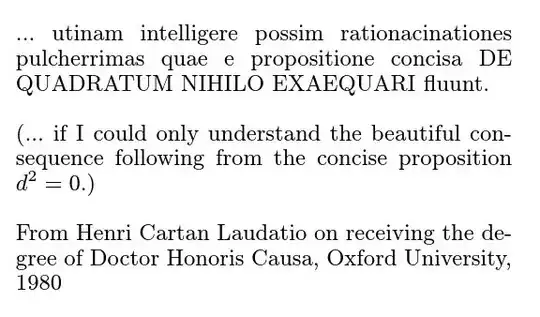
Abhinc annos quinquaginta ‘analysis situs’ quae vocabatur (hodie autem Topologia Algebraica audit) in extremo studiorum margine iacebat paene neglecta; mox per hospitem nostrum magna ex parte stetit ut eam caput fuisse disciplinae diceres. Sed de arte tam arcana ne exspectaveris a me doceri; sciendum est mysteria ibi ἐπόπταις recludi quae profanorum sensus vehementer titillent: utinam intellegere possim ratiocinationes pulcherrimas quae e propositione concisa DE QUADRATUM NIHILO EXAEQUARI fluunt.
Some fifty years ago ‘Analysis of Situation’ as it used to be called (its modern name is Algebraic Topology) lay almost neglected as a fringe area of study; subsequently it became, largely through our honorand’s efforts, what might well be called a fountain-head of the subject. But you must not expect to be told by me about so arcane a subject: you should know that its mysteries are revealed to its initiates, but are such as to tickle the curiosity of the uninitiated. Would that I could understand ‘quelles belles conséquences on peut tirer de l’identité $d^2=0$’.
Non-native speakers of English should note that “would that” is an old-fashioned way of saying “if only.”
The snippet of Latin I bolded became famous as an epigraph to Gel’fand and Manin’s Methods of homological algebra.
However, note the direct quote in French in the corresponding original English text: one can trace it to an address given by J. P. Serre in 1975 that recounts the history of H. Cartan’s seminar (crappy translation mine for those who don’t read French):
Le premier Séminaire (48-49) était une introduction à la Topologie Algébrique. On y apprenait ce qu’est une suite exacte, et quelles belles conséquences on peut tirer de l’identité $d^2=0$ […].
The first seminar (48–49) was an introduction to algebraic topology. There we learned what an exact sequence is and what beautiful consequences one can draw from the identity $d^2=0$ […].


