27

This question is motivated by this xkcd comic strip
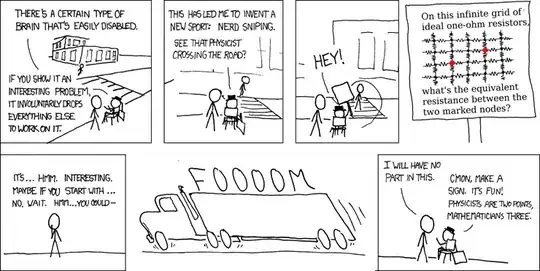
.

The problem is indeed interesting, and my first recollection upon reading this was a similar problem in the book Problems in General Physics by I.E.Irodov(which, in my humble opinion,is a masterpiece).

The question I wanted to ask is, are there any generalizations of the problem known? Can be find the resistance between any two nodes of the grid as a function of the distance between the nodes?

Many thanks in advance!

2 Answers2

19

Yes, it is possible. For example Kevin Brown did here and here including this table.

enter image description here

so for the xkcd problem the answer is $-\frac{1}{2}+\frac{4}{\pi} \approx 0.773$.

Henry
  • 1,988
  • Who is this Kevin Brown? I bought his book and I don't know anything about him. – Kasper May 24 '11 at 12:42
  • @kmm: He is deliberately inconspicuous. In MathPages, his name appears on pictures of the covers of his books and in one other place. – Henry May 24 '11 at 13:14
  • That's strange. I'd just want to e-mail him saying I immensely enjoyed his book. – Kasper May 24 '11 at 20:17
6

As far as I know, the first solution to the general problem is given by Cserti,

József Cserti. Application of the lattice Green’s function for calculating the resistance of an infinite network of resistors. Am. J. Phys. 68 no. 10, pp. 896 (2000). doi:10.1119/1.1285881, arXiv:cond-mat/9909120 [cond-mat.mes-hall])

using lattice Green's functions (and there are references to previous partial solutions). For your first question, the recurrence relation that gives the resistance between nodes in a square lattice is equation 32. The paper also describes how to solve or derive asymptotics for rectangular lattices, triangular lattices, honeycombs, and cubic lattices in higher dimensions.

Emilio Pisanty
  • 132,859
  • 33
  • 351
  • 666