Our chemistry sir and we had an argument today at the lab, he says that white actually is not a colour, it is the abscence of colour, but we say that it is a colour and we gave the following point to substanciate our point that white is a colour: When we see an object in red colour, it actually reflects red colour and absorbs all the other colours, in this point of view, a white object reflects all colours which fall on it, so it is a colour. We do not know who is correct, I am posting this question in hope that I will get the correct answer.
Asked
Active
Viewed 7,215 times
2

-
Related: http://physics.stackexchange.com/q/155512/2451 and links therein. – Qmechanic Mar 02 '15 at 16:03
-
1Frankly, I'd say anything that shows up when I print in grayscale is not a colour (otherwise I'd always be charged for colour printing). White may be a shade, but not a colour. – Jim Mar 03 '15 at 15:23
-
I feel this is a question about the English language, not about physics. "White" means something - and that something is a particular colour. If you ask me what colour my car is, I'm not going to say "oh, my car isn't a colour - it's white". – Dawood ibn Kareem Aug 02 '16 at 12:56
5 Answers
1
The explanation you give is correct. A white body reflects all wavelengths. We call it white when all colors (all wavelengths) are reflected from an object and hit our eye. Black is the opposite.
I would say that white is all colors, as you do. But maybe he sees it from the perspective that since all is reflected and nothing is absorbed, there is "no light" left. I mean, it depends on what he means by "no light". It could be a matter of definition of the words, so maybe you actually agree on what happens but call it differently.
Nevertheless, your explanation is correct.

Steeven
- 50,707
-
Perhaps I'm being too nitpicky, but a blackbody emits all wavelengths even if it looks red or blue. Something appears white if it reflects all incident colours on it (preferably diffusely) or emits the right amounts of red, blue, and green light. Also, when you say "We call it white when all colors emitted from an object hit our eye", all colours emitted from a red object can hit our eye and it would still be red. Surely you meant it's white when all colours reflect from it and hit our eye. – Jim Mar 02 '15 at 15:50
-
@Steeven You say that White is all colours, we have given a name "white" to such a colour that it is a combination of all colours. White is a colour then? – RogUE Mar 02 '15 at 16:10
-
@Steeven I couldn't follow you that it matters on the definition of words. He (our sir) says white is colourless, then what would he call the hue of clear water, glass etc? – RogUE Mar 02 '15 at 16:25
-
-
@RogUE, if white is a color is open to discussion. Look at a light spectrum at the visible wavelength range, and you will see all colors possible EXCEPT for white and black. So if we really want to be nitpicky, then white and black are simply names for either all or no colors (all or none wavelengths) - the two extreme cases. I don't think there is a fixed definition as to if white and black are colors. – Steeven Mar 02 '15 at 20:11
-
@RogUE, reformulated the answer a bit to ease up the confusion. I hope you get my point now. If you would say that white is colorless or not simply depends on if you consider the light coming from the object or the light staying (absorbed) at the object. – Steeven Mar 02 '15 at 20:13
-
1I still don't like the third sentence. If you replace the "(all wavelengths)" with "are" and "hit" with "to", that would change the meaning of the sentence to something more correct. All colours reflected from a red sign may hit our eye, but it's still red. It's only when "all colours are reflected" to our eye, not just when "all colours reflected" hit our eye. Subtle difference but totally different meaning – Jim Mar 02 '15 at 20:13
-
1
-
@Steeven You say both are correct, anyway, he said that our perspective is also right. I think it is important to have more than one perspective when one studies science. – RogUE Mar 02 '15 at 23:45
-
@Steeven - Re Look at a light spectrum at the visible wavelength range, and you will see all colors possible EXCEPT for white and black. No, you won't. For example, you won't find purple on the spectrum, and also not fuchsia, magenta, or rose. These are colors on the line of purples. These are non-spectral colors. White is a different kind of non-spectral color. – David Hammen Mar 03 '15 at 19:02
1
To add to Steeven's answer: Any wavelength of input light will be perceived as lighter or darker in color depending on the intensity of the light. At high intensities, we only 'perceive' whiteness. I'm not sure whether the brain just ignores the overloaded cones (color-sensitive retinal elements) in favor of the rods (non-color elements), or whether a saturated cone-signal is interpreted directly as "white."
Further, it is the case that very low-intensity signals don't even stimulate the cones, so everything is interpreted as white/grey via the rods' signals.

Carl Witthoft
- 10,979
0
One thing is certain: White is not a spectral color.
Beyond that, people argue. People who ascribe to additive light theory (e.g., the manufacturers of your computer screen) are apt to say that white is a color but black is not. People who ascribe to subtractive light theory (e.g., artists) are apt to say that black is a color but white is not.
To complicate matters, there are a number of Jedi mind tricks ("optical illusions") that our eyes and and mind play on us. One such illusion has recently popped up on the internet: Is this dress white and gold or blue and black?
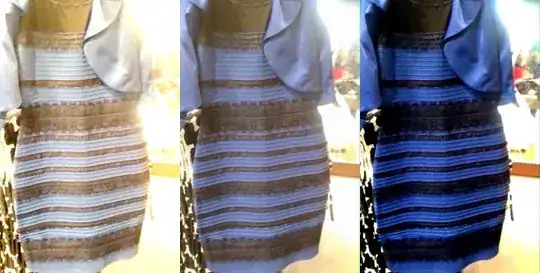
There's a lot, a whole lot, of image processing that goes occurs between photons hitting receptors in our retinas and our mind saying "that's white and gold!" versus "that's blue and black!".
To complicate matters even more, our eyes only have three different kinds of color receptors. People who design lights take advantage of this. White LEDs are a prime example. The spectrum of a white LED is very, very different from the (almost) black body spectrum of the now-banned white incandescent bulbs. Iur eyes don't know the difference because we only have three kinds of receptors.
To complicate matters even more than that, our mind tries to compensate for varying lighting conditions. My living room has cool white lighting. The adjacent hallway, soft white lighting. The hallway walls look yellowish when viewed from the living room. When I go to the hallway, the walls look white.
To complicate matters yet more, our eyes and mind adjust what we think we see based on everything else we see. Suppose you have two objects, one you would definitely say is "gray" and the other you would definitely say is "white". Which of squares A and B below is brighter?

The answer is that they're exactly the same. Our mind plays Jedi mind tricks on itself.
Bottom line, from a physics point of view:
- White is not a spectral color.
- White is an optical illusion.


David Hammen
- 41,359
0
we define color based on which range of wavelength it reflect. as u said a red object is red because it can only reflect red , so it is not any other color. maybe we could call black colorless, and i think our teacher just used a conventional form of speech (dont u think?) ask our teacher what he would call the colour of water?

S C K
- 7
- 3
-
-
i believe rogue is right. there might be a problem how the teacher define "color" – S C K Mar 03 '15 at 15:25
-
It still isn't an answer. It presents a related opinion and agrees with the OP, but it doesn't provide any sort of definite answer that uses physics and isn't opinion. – Jim Mar 03 '15 at 15:27
-1
Colors have been defined by the International Commission on Illumination. They have defined the CIE XYZ color space where white is a color defined by the point x = y = z = 1/3.

Count Iblis
- 10,114