I have a hot object (about 200 centigrade), and would like to cool it down. Is there a way to use its heat to operate a cooling system without exerting external energy; as heat is energy and can theoretically be transformed to other forms? I would like to make it a self sustained cooling system?
Asked
Active
Viewed 88 times
-1

-
What do you mean by 'cooling system'? Technically, leaving the hot object out in the open air does exactly this - the heat is transferred to the nearby air, which then warms up and rises, convecting heat away. No additional energy input is necessary. – catalogue_number Feb 10 '17 at 07:29
-
I mean I would like to cool the hot object down to room temperature within seconds. It should cool down faster the usual rate. – Novice Physicist Feb 10 '17 at 07:32
-
There are too many unknowns here. What is the object under consideration and what is its size, mass, material etc? – Farcher Feb 10 '17 at 08:07
-
Example: material is plastic, size is cup size, and mass is 12 grams. – Novice Physicist Feb 10 '17 at 08:31
2 Answers
2
The trouble with this idea is an irritating thing called the Second Law of thermodynamics. Heat is colloquially classified as low grade energy - Doing something useful like pushing coolant around requires high grate energy, like kinetic or electrical, which would require some kind of a heat engine.
Recovering useful energy from thermal energy is not a direct conversion in the same way that electricity can be converted into motion - useful work can only be done by the movement of heat from a hot reservoir to a cold reservoir, which inevitably loses some of the energy in the process.
With a bit of analysis (omitted for brevity), it can be shown that the maximum efficiency of an engine, $\eta_{Carnot} = 1-\frac{T_C}{T_H}$ is fundamentally limited to some number less than 1. Even in an ideal world, with perfectly frictionless parts and perfectly ideal gasses, you will never be able to recover all of the energy. This also applies in reverse - if you run a heat engine in reverse (i.e. as a refrigerator), you have to put in more energy than it took to compress the gas, which ends up being $\eta_{fridge} = \eta_{Carnot}$. This gives you a total efficiency of $\eta_{autofridge} = \eta_{Carnot}^2 = 13.5\%$ for $T_H = 475K$ and $T_C = 300K$.
The bottom line is that any kind of system designed to 'cool' things, i.e. a heat pump, only ever functions by distributing heat from a small, hot thing to a much larger radiator. This could conceivably be sped up by a high-efficiency engine like a Stirling engine hooked up to a circulatory water pump, but to do anything more complicated than that will take a lot of energy, which the <<13% efficiency will not manage to any practical extent.

catalogue_number
- 2,704
2
Build what candle lamps have been utilising, for centuries. Put a chimney on it. The column of warmed air in a long vertical tube over the hot item creates a directional air current (much faster at cooling than random air movements) and separates the hot upgoing air from the air in contact with the sample (which therefore is continually coming into contact with room-temperature air).
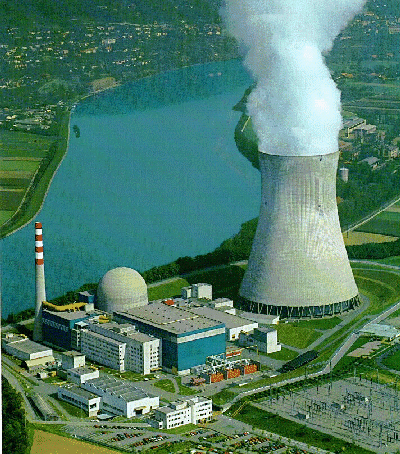
It's not much, but it's heat-powered. Add an evaporative cooling mechanism, and scale it up, and you can park it next to a nuclear plant to remove the excess heat.cooling tower
There's a slight possibility you could use a thermopile to generate current and run a small fan. Alas, efficiencies aren't good, and the thermopile needs a hot-side and a cold-side, so there has to be a bulky/heavy/high-heat-capacity heatsink. If the sample were easy to couple to a thermopile, you could also just directly press it against the heatsink.
Then there's the outside possibility that you could run a small turbine from the chimney flow, and use that to generate electricity and make a thermopile act as a heat pump... but efficiency, as mentioned above, is not very good. A candle lamp can just about tinkle a wind chime in this fashion candle chimes

Whit3rd
- 9,756