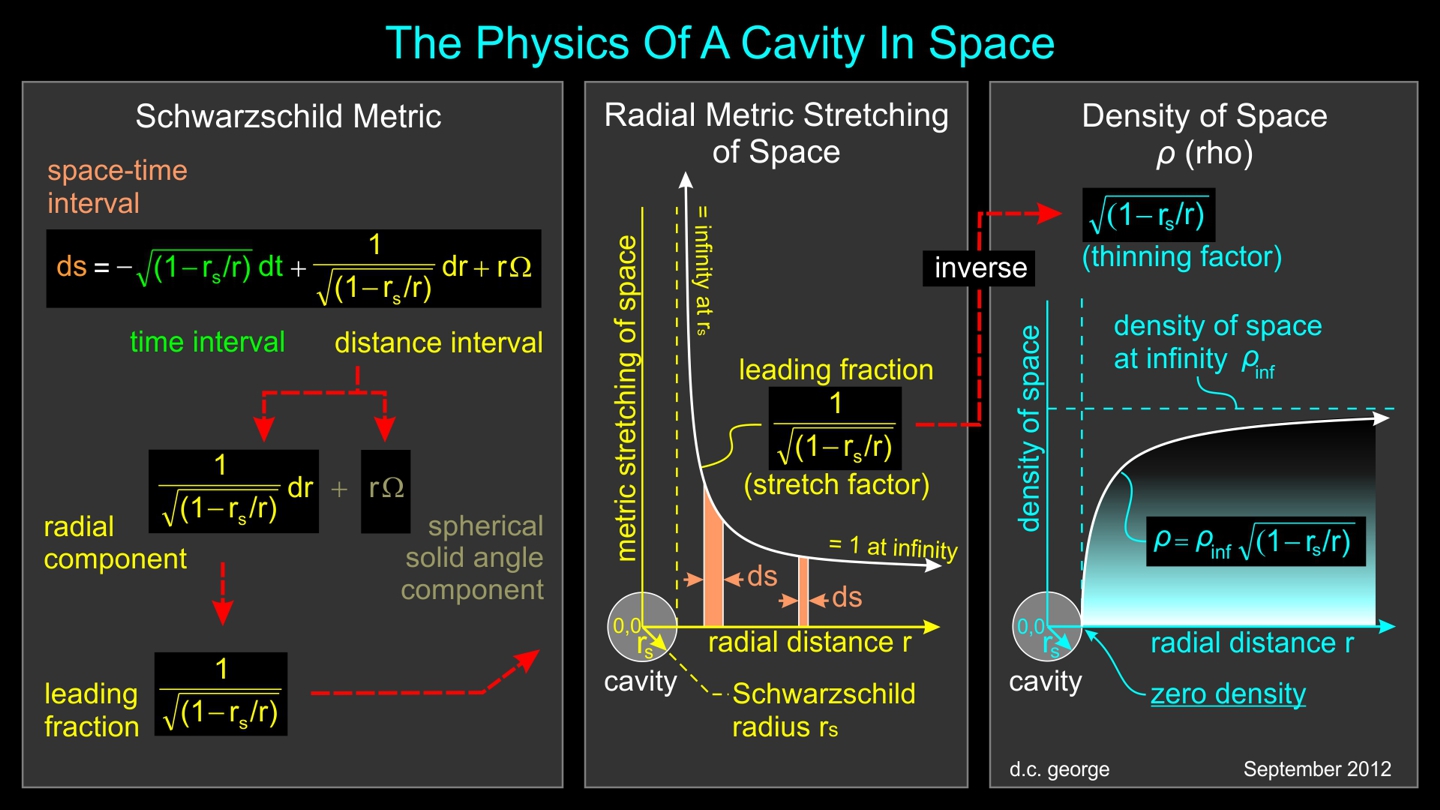
My answer to the question of whether or not metric stretching could create holes or cavities in the spacetime manifold is:
Maybe.
At least, the possibility seems not to have been eliminated. Here's an illustration I made that sums up the basic idea: http://dcgeorge.com/images/ThePhysicsOFACavityInSpace.jpg
Whether or not this cavitation phenomenon is possible depends on a number of fundamental and interrelated issues, each of which is arguable in its own right.
Chris White makes the following points:
you don't need spacetime to sit in anything. ... (I agree)
the math is all about "intrinsic" curvature. ... (I agree)
when the metric changes, test particles may very well find themselves further apart, but spacetime exists between them as much as before. ... (I don't agree, at least in part)
This last point doesn't take into account the thinning-out effect of metric stretching. If you stretch something, it's still there but only up to a point. If you stretch it infinitely, it isn't there any more.
Chris again:
- the infinity at the event horizon can be "removed" by a change of coordinates.
Yes, the free-fall coordinate system that does this makes the infinity “analytically removable” but this is not the same as being completely eliminated. In any case, the purpose of "removing" the infinity is to extend the math on through the event horizon on the assumption that the manifold continues into the interior region. This, in spite of what the math of general relativity appears to be telling us.
Even worse, this coordinate system assumes space itself to be flowing into the black hole like water down a drain, reaching the speed of light at the horizon and infinite speed at the central singularity. I find this unsatisfactory and unconvincing for a number of reasons but mainly because manifolds, as Chris says, are defined intrinsically, i.e., without reference to anything "outside". So, if the manifold were to end at the event horizon, would the coordinate system not, simply end with it?
The main issue, then, seems to come down to whether or not the spacetime manifold can be broken open.
Chris says:
- You can no more tear spacetime than you can tear the abstract notion of the x,y-plane.
Oh? Is there some hard and fast rule that manifolds can't be broken? Just last week I read that Grigori Perelman (in order to prove the Poincaré conjecture) studied the nature of singularities in a 3-manifold and found that certain, simple kinds could exist inside the manifold (all were variations on stretching a sphere along a line). He then cut the manifold apart at the singularities and morphed the pieces (using Ricci flow) back into simple manifolds.
What's especially noteworthy here is that the degenerate form of these singularities, an undistorted, spheroidal singularity, is exactly the picture presented by the radial component of the Schwarzschild metric.
Perleman's singularities and his method of removing them demonstrates that manifolds can be broken up and at least suggests this as a possibility for the spacetime manifold. Given this possibility, metric stretching ending in cavitation would seem to be a clean, natural way to do that.
And, least we forget, mixed in with all of this is the question of:
- whether of not the spacetime manifold has its own intrinsic mass.
The intrinsic mass of the vacuum has been an ongoing debate for decades but the general consensus appears to be moving in favor of it having a mass which is proportional to the cosmological constant Lambda.
The bottom line, it looks to me, is that the possibility of metric expansion creating cavities in the spacetime manifold hasn't yet been eliminated. Considering the implications, would it not be worthwhile for the question to be rigorously explored by experts in the field?