-3

All popular expositions (e.g. these ones) of relativistic electromagnetism claim univocally that electrons in motion become more dense due to the speed. They teach that Lorentz contraction of charges causes charge imbalance and wire with current charged. Thereby, no teacher says that the wire becomes negatively charged (because electrons move) in the lab frame, where we had it originally neutral, when no current was flowing. That is a question: is wire neutrality conserved, once we create a current of electrons in it?

It must be the case because, as Feynman points out, the lighter electrons better react on temperature changes and would charge the wire when heated. But, then answer how neutrality is persisted after you say that electron contraction takes place and it increases their density? Might be "some light" positive charges start moving in opposite direction, to compensate the growth of negative charge?.

I see that all discussions of "magnetism as electricity+relativism" avoid concerning this, most basic and most interesting case. Instead, they jump immediately to the case where you have an electric balance for a test charge in motion. Once finished with this, you are encouraged to answer how it is possible that density of charges is increased whereas volume of the loop is intact?

Val
  • 1
  • 5
    "Positive ions must move to compensate the motion of free electrons!" Er...this is not required. Recall that a typical circuit is one or more loop(s), so everywhere there are electrons moving in to cover for the ones that just left. The net-positively charged substrate can just sit there. And it does when you're talking about current in, say, a copper wire. – dmckee --- ex-moderator kitten May 06 '13 at 19:24
  • What left-in, left-out? The whole loop becomes more negatively charged! You cannot cover electrons by electrons. Ok? – Val May 06 '13 at 19:27
  • 3
    I'm sorry if I wrote that poorly. At any point on the loop there are electrons that have present leaving the scene. Naively this would seem to leave a positive charge, but there are also electrons arriving. In a steady state there are just as many arriving as leaving, so there is no change. – dmckee --- ex-moderator kitten May 06 '13 at 19:30
  • Why arriving and leaving do not cancel each other? Why they add positive charge rather than negative. I bet they add even more negative. How does this affect the fact of relativistic charge density increase? Do you mean that it is always compensated in reality by arrivals? Then it is unobservable. Why do we talk about it? Can you answer in the Ehrenfest paradox. It is very interesting where electron density is coming from. – Val May 06 '13 at 19:43
  • 3
    If you have a closed circuit fountain of water, where does the water come from? That is the analogue of your question. Energy need is supplied by a small motor but the number of water molecules is the same. In a closed circuit the number of electrons and positive charges is equal and charge adds to zero. The electrons just move along continuously as @dmckee explains. The energy needed is supplied by an electric motor or an electric battery – anna v May 07 '13 at 03:29
  • If you say that current cannot exist without a battary, where positive charges move, and therefore compensate the negative charge of the loop, please say that explicitly. I want to hear that originally neutral loop is split into positive and negatively charged segments. Also, consider the infinitely small battery and explain current circulating in superconductor, where no battery exists. – Val May 07 '13 at 08:38
  • 1
    The question is really good and doesn't deserve downvotes. – Hayashi Yoshiaki Mar 18 '19 at 16:57

3 Answers3

3

I don't hope too much to get the answer to the electric current density ernfest paradox.

That question didn't ask about the Ehrenfest paradox and isn't related in any way to the Ehrenfest paradox. The physicsforms link I gave in a comment provides a complete and correct analysis of your question.

Why discussions of relativistic origin of the magnetic field never discuss the simplest case: a neutral wire with current and test charge at rest?

They don't discuss this case because this case isn't interesting. The test charge experiences no electric or magnetic force, so it doesn't accelerate.

This is what should happen if only one polarity charges are moving in the wire. Right?

No, it happens in any frame that is in motion relative to the lab frame (where the lab frame is defined as the one in which the wire is electrically neutral), provided that the positive and negative charges are in different states of motion.

But, it forgets to mention that in the normal lab, the positive charges create a solid structure of the frame and, therefore, cannot move.

It's not a contradiction, because these treatments are not discussing a realistic model of a metal wire, in which the positive charges are atomic nuclei and the negative charges consist of some mixture of bound electrons and conduction electrons. To make the derivations more mathematically transparent, they make a model of a wire that doesn't have all these complicated physical characteristics.

  • Many pointlessly argumentative comments deleted. – dmckee --- ex-moderator kitten May 07 '13 at 16:55
  • @Ben, this answer escapes the question. I have established pretty concrete conditions, asking if it is true that wire becomes charged. When you say "no, this is true for any frame of reference" you evade the question and, confirming my guess from one side, deny it from the other. When you say that it is not interesting you try to get out also. It is of the first importance to know if wire gets charged and test charge will also show electric force then. – Val May 07 '13 at 18:32
3

Let us consider a lattice of static positive ions, through which electrons flow. In the laboratory reference frame, we will have equal charge densities and different velocities, thus their 4-currents would be:
$j_+^\mu=(\rho_+,0)$
$j_-^\mu=(\rho_-,\rho_-\mathbf{v}_-)=(-\rho_+,-\rho_+\mathbf{v}_-)$
and the total current, which creates an electromagnetic field, is their sum:
$j_\Sigma^\mu=j_+^\mu+j_-^\mu=(0,-\rho_+\mathbf{v}_-)$
So far, it is as we expected. Now, let us switch to the moving reference frame, having the velocity $\mathbf{v}_-$, so that electrons would appear static. That is done by the Lorentz transformations for 4-vector of current, and the result is ($\gamma=1/\sqrt{1-v_-^2}$ is the usual abbreviation):
$j_+^{\,\prime\mu}=(\gamma\rho_+,-\gamma\rho_+\mathbf{v}_-)$
$j_-^{\,\prime\mu}=(\gamma\rho_--\gamma\rho_-v_-^2,\gamma\rho_-\mathbf{v}_--\gamma\rho_-\mathbf{v}_-)=(-\rho_+/\gamma,0)$
(zero current of electrons, as we expected)
$j_\Sigma^{\,\prime\mu}=j_+^{\,\prime\mu}+j_-^{\,\prime\mu}=(\rho_+v_-^2\gamma,-\gamma\rho_+\mathbf{v}_-)$
This is exactly the same as we would get if applied Lorentz transformations immediately to $j_\Sigma^\mu$. No balance of the charge in a moving frame is left.

Now we can consider some other conducting system, say, a cell with electrolyte, adjusted in such a way that positive and negative ions in it have the same density and opposite velocity vectors. Now we repeat the same calculations and get:
$j_+^\mu=(\rho_+,\rho_+\mathbf{v}_+)=(\rho_+,-\rho_+\mathbf{v}_-)$
$j_-^\mu=(\rho_-,\rho_-\mathbf{v}_-)=(-\rho_+,-\rho_+\mathbf{v}_-)$
$j_\Sigma^\mu=j_+^\mu+j_-^\mu=(0,-2\rho_+\mathbf{v}_-)$
$j_+^{\,\prime\mu}=(\gamma\rho_++\gamma\rho_+v_-^2,-\gamma\rho_+\mathbf{v}_--\gamma\rho_+\mathbf{v}_-)=(\gamma\rho_+(1+v_-^2),-2\gamma\rho_+\mathbf{v}_-)$
$j_-^{\,\prime\mu}=(\gamma\rho_--\gamma\rho_-v_-^2,\gamma\rho_-\mathbf{v}_--\gamma\rho_-\mathbf{v}_-)=(-\rho_+/\gamma,0)$
$j_\Sigma^{\,\prime\mu}=j_+^{\,\prime\mu}+j_-^{\,\prime\mu}=(2\rho_+v_-^2\gamma,-2\gamma\rho_+\mathbf{v}_-)$

We got the same result! (With the factor of 2 for both frames.) That means, it does not depend on the way we construct the current. The fact holds true that if charges are balanced in some chosen reference frame, then they become unbalanced in other reference frames.

Now, why are charges balanced in the laboratory reference frame, what it the physical cause for this? The moving charges are ultimately supplied to the wire by some current source. That source produces the same amount of current carriers on one pole, as it absorbs on the other pole, and thus keeps the wire uncharged as a whole. Would it be different, that would take much energy to keep the wire in a charged state, because charged conductor has an electrostatic energy $q^2/2C$. That current source "calculates" the energy and balance of chanrge in its own reference frame. That's it: would the wire and the source move, they would keep some other balance, zero in a different reference frame.

Update: Let's consider contraction and stretch of individual charged particles. We follow the Wikipedia article. Figures are taken from it.

In the lab frame:
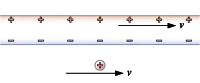
Negative charges are "the lattice" and they make a chain with positions $x_k=ka$, where $a$ is the lattice constant. Then their world-lines are given with equations
$x_{-,k}^\mu(t)=(t,ka\mathbf{e}_x)=(t,ka,0,0)$
Note that the lattice constant is not arbitrary here, and is fixed by the nature of the lattice (for example, if the lattice is made of Fe ions, $a$=0,286645 nm).

Positive charges are "the flowing charges", and they make a chain with the same spacing, though moving. The positions $x_k=ka$ would be only their initial positions, and the world-lines are
$x_{+,k}^\mu(t)=(t,(ka+vt)\mathbf{e}_x)=(t,ka+vt,0,0)$
The requirement $x_{+,k}^x(0)=x_k$ is imposed in order for the wire to have zero charge as a whole.

In the moving frame:
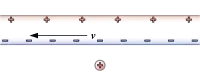
To get this picture, we should take the world-lines of charges in the lab frame, and apply Lorentz transformations to them. For the negative ("lattice") charges, we have
$x_{-,k}'^\mu(t')=(t',\gamma ka-vt'-\gamma kav^2,0,0)=(t',ka/\gamma-vt',0,0)$
for the positive ("flow") charges, respectively,
$x_{+,k}'^\mu(t')=(t',\gamma ka,0,0)$
(please check these calculations yourself).

That shows that the negative ("lattice") charges are moving backwards with the speed $v$, and their distance is contracted ($a/\gamma<a$). At the same time, the positive ("flow") charges are static in the moving frame, and their distance is stretched ($\gamma a>a$). The factor $\gamma$ is a number greater than 1.

Finally, the negative ("lattice") charges are contracted with respect to the positive ("flow") charges ($a/\gamma<\gamma a$) in the frame of the positive ("flow") charges. And the positive ("flow") charges are not contracted with respect to the negative ("lattice") charges in the frame of the negative ("lattice") charges, they do have the same spacing ($a=a$).

firtree
  • 2,043
  • Your notation is very complex. Regarding the charge of electron current in wire, only lab frame with still wire, test charge at rest and moving electrons in the wire are interesting. What is your resolution? Will it be charged? Now, why cannot you just accelerate all electrons once and let them moving themselves, by inertia? Otherwise, resistence forces are missing in your picture, which complicate it even further. So, electrons are moving by inertia, without any current source. Ok? What are implications of that? – Val May 08 '13 at 09:48
  • The notation should be familiar for you if you've read the Feynman lectures chapter 25 "Electrodynamics in Relativistic Notation". The only difference is that I put $\mu$ to the superscript instead of subscript - which is usual for other textbooks. (By rumour, Feynman personally disliked the superscript/subscript differences - and still did perfectly accurate calculations.) – firtree May 08 '13 at 10:05
  • For the accelerated electrons, the answer would depend on the particular mode of acceleration, that is up to you to choose. Electrons are separate particles, and do not make up a single solid body, so they can be set in motion being denser or scarcer, and then move by inertia without any changes. So the wire can be either uncharged, or charged positive or negative, depending on your choice. But, as long as you fixed that choice for the lab frame, the charge would become well-defined in any other frame as well. – firtree May 08 '13 at 10:17
  • Do you understand that my question was "why we see no charge increase despite density is increased?"? What our ability to complicate and compute has to do with this question? – Val May 08 '13 at 10:34
  • Sorry, probably I didn't understand. Could you please make the question more clear? "Why we see..." - in what conditions? How do you define the mentioned values? Then how do you calculate them? Actually, in a closed loop the density of moving electrons is not increased. – firtree May 08 '13 at 10:41
  • How can you say that density does not increase while discussing the relativistic contraction (density increase)? – Val May 08 '13 at 10:49
  • Contraction applies to the two cases: 1) we have some points in known positions in one frame, and look at them in another, 2) we accelerate some solid body, and then by its internal forces it restores relative positions of its parts, and thus its initial length, in its own reference frame. But electrons are not such a body, and their positions are set not in the comoving but in the lab frame. Thus, they are not contracted in the lab frame (since they have to be the same number on the circle of the same raduis), and instead they are stretched in their comoving frames. – firtree May 08 '13 at 12:19
  • Finally, I have got somebody on-topic! But, what I hear completely contradicts to what I read in Feynman and etc. All relativistic electromagnetism teachers agree that moving charges are more densely separated, subject to the same Lorentz contraction as a rigid body. Nobody of them discusses current sources nor any forces that make separation of particles. Is it your invention? Can you link a proof? – Val May 08 '13 at 12:36
  • Take Fig.6 http://en.wikipedia.org/wiki/Relativistic_electromagnetism#The_origin_of_magnetic_forces. Read: "viewed from the reference frame in which the test charge is initially at rest. Here the positive charges in the wire are at rest while the negative charges in the wire are moving to the left. The distance between the negative charges is length-contracted relative to the lab frame, while the distance between the positive charges is not length-contracted, so the wire carries a net negative charge." Doesn't it contradict to your stmt "they are not contracted in the lab frame"? – Val May 08 '13 at 12:46
  • I hope your confusion is just the result of inattentive reading (and maybe obscure textbooks), and not of the wish to contradict teachers. At least some textbooks point out the requirements clearly, and they might become obvious from the proof of the Lorentz contraction - fixed proper length of the body (or distance between points) is one of the requirements. And too deep consideration of internal forces leads to the other field - condensed matter physics - and ultimately relies upon difficult theorems which are not rigidly proven yet. That's why such discussions in textbooks might be rare. – firtree May 08 '13 at 13:39
  • Wiki Fig. 6 - the text in Wiki is the same as what I've been explaining, with the difference that I considered negative electrons moving, and in Wiki there are positive sharges moving. Lab frame: both densities are equal. Moving frame: "lattice" charges are contracted (because they move now), and "flow" charges are stretched (because they were moving, and now they are still - inverse of contraction). Try to draw space-time diagrams and prove length contracion and time dilation yourself - these exercises would help you to get familiar to the technicalities very quickly. – firtree May 08 '13 at 13:48
  • Which technicalities are you talking about? You say that modern science cannot explain them. The diagrams only show how things are contracted (when moving). Why cannot you stop manipulating. You say that no charges are contracted in the lab frame then repeat wiki where moving charges are contracted and then say that wiki says the same. When you start mentioning the contradictions? – Val May 08 '13 at 16:58
  • You say that modern science cannot explain them. No, I said modern science can explain them, just not as strict as the scientists themselves would want to. Charges are not contracted in the lab frame, but they are contracted in the moving frame - what is confusing in that statement? There are no contradictions, the picture that the science gives is consistent in every detail. "Technicalities" I mentioned are the way for you to work with the picture by yourself, without asking others for explanations. – firtree May 08 '13 at 17:38
  • "Charges are not contracted in the lab frame, but they are contracted in the moving frame" contradicts to "The distance between the negative charges is length-contracted relative to the lab frame". Ok? In the moving frame, the distance between negative charges will expand, oppositely to your claims. Might be you need to work with the picture yourself? – Val May 08 '13 at 18:01
  • Now I see thw wording is bad. Actually what hey meant is The distance between the negative charges in the moving frame is length-contracted relative to the lab frame. The word relative does not always mean that we are in that frame. Fig. 5 is the lab frame, and fig. 6 is the moving frame, and you can see minuses in fig. 6 are denser. By the way, do you know what the chat on this site is? – firtree May 09 '13 at 03:09
  • I do not know about the chat but this "bad wording" is everywhere. You is only one in the world who uses "correct wording". The problem with your "correct wording" is that it lacks the logic. Your necessity of rigidness for Lorentz-contraction is your fantasy. BTW, you do not know what relativity means. When you say that some effects are observed in one frame but never in the other, this is opposite to when relativity means. Relativity means that one frame is identical to the others. Relativity applies to electrons identically to rigid bodies. At least, there is no difference in contraction. – Val May 09 '13 at 05:59
  • Positive charges are contracted w.r.t negative, negatives are contracted w.r.t positives. That is the theory of relativity and the what Minkovski diagram shows us. One of the frames is a lab frame. So, something is contracted in the lab frame. Entailing arrogance (go, learn diagrams) and overcomplications with current sources and rigidness you to hide your misunderstanding of relativity and misinform us. – Val May 09 '13 at 06:07
  • First you said I'm on topic, now you say I lack the logic. I cannot help you more than I did already. I just wish you study SR deeper. Feynman is a bit light for you maybe, you can refer to Taylor, Wheeler; Burke; Landau, Lifshitz; Pauli; other textbooks. Lightman, Press, Price, Teukolsky is a good problem book which you can use to check your understanding. – firtree May 09 '13 at 06:14
  • Positive charges are contracted w.r.t negative, negatives are contracted w.r.t positives That is wrong, as can be shown by simple calculations. I can add them to my answer above. – firtree May 09 '13 at 06:17
  • Ok, but in the lab frame, protons are not moving. Therefore you cannot say that lab frame is fig5 rather than 6. – Val May 09 '13 at 06:37
  • Wikipedia has the inverse signs of charges with respect to the real ions and electrons. I pointed that out long ago. Also, read my update in the answer above. – firtree May 09 '13 at 07:24
  • Why do you say that things are not contracted in one case but contracted in the other? Contracted or is a matter of what we had prviously. I may say that originally we were in a moving frame and charges contracted when we jumped into the lab frame. They are contracted in lab. Ok? We call contracted things, which are moving wrt to us. We set something into motion in our frame. How can you, in contrast to Einstein's relativity and all teachers, say that charges, moving wrt to lab frame are not contracted when lab accelerated them? – Val May 09 '13 at 07:41
  • Those wording issues kill me. Let me say that both kinds of charges have the separation $a$ in the lab frame, and "lattice" charges have the separation $a/\gamma<a$, and "flow" charges have the separation $\gamma a>a$, in the moving frame (not in any moving frame, but in the one considered). Is that okay? My calculations follow SR, Einstein, teachers and all, you are free to check them yourself (more like you are strongly encouraged to, actually). – firtree May 09 '13 at 07:56
  • Yes, but I ask to compare not different frames of reference. I ask you to do all comparisons in the lab frame. In the first case you have both +ses and -ses at rest. Then, accelerate -ses to speed v. You look from the same lab frame and compare densities before and after. – Val May 09 '13 at 08:08
  • We do not accelerate -ses as a unite solid body. We do that to them as to separate particles. There is some ambiguity in the process, and it has to be fixed somehow. 1 way: accelerate them so that they would keep their distances in their own frame. Then they would contract in the lab frame. 2 way: accelerate them so that they would keep their distances in the lab frame. Then they would not contract. n-th way: Do as you like. Then you would get some result depending on what exactly you had done. Also see http://en.wikipedia.org/wiki/Bell's_spaceship_paradox . – firtree May 09 '13 at 08:17
  • I want to know exactly what happens. Which route does Nature take? There must be determinism because we always get the same electromagnetic effects for given current. This is the topic of this question. When teachers say (I have created example list http://notepad.cc/share/vF0szTUYns) that moving particles are contracted (whatever frame you look from, call it "lab"), they mean that way 1 is taken always. So, chain of charges accelerated wrt lab must be contracted wrt lab. This must imply that if electrons are moved then wire must get charged negatively. Why wire stays neutral? – Val May 09 '13 at 08:43
  • As far as we know, Nature keeps wire neutral in the lab frame. You can take it as an experimental fact. (Reason for that is electromagnetic and beyond the SR scope.) That means, in real wires the 2nd way takes place. Teachers do not mean the 1st way unless there are physical reasons to select it (solid rod is one example). Read them thoroughly to get sure. So there is no contradiction anywhere except in your own misreading. – firtree May 09 '13 at 11:04
  • I have supplied a collection of 5 treatments, http://notepad.cc/share/vF0szTUYns. Can you point exactly to the point? But, "way 2" can be an answer to my question. If you summarize, I'll accept it. But, I would like to see a proof link. BTW, if you like rigidness, electrons behave exactly like stable rigid bodies than structureless liquids. They support equidistance from each other, exactly like rigid structures. I you shift one, the whole line of electrons will shift, like solid body. Only extreme elasticity of such structure seems to confuse you. But, spring is a solid body, nevertheless. – Val May 09 '13 at 13:17
  • Electrons behave neither like bodies nor like liquids. They behave like point particles, and more strictly, like quantum point particles. They do not have any means to support distances, because they interact only with electomagnetic forces, which do not allow equilibrium (in non-quantum case, see Earnshaw's theorem). Only the system of both electrons and positive ions can behave like a rigid body, only in quantum case, and only at temperatures low enough :-) – firtree May 09 '13 at 13:45
  • Do you say that there is no resistance to attain equilibrium? If not, then what is the point? – Val May 09 '13 at 14:56
  • Sorry about approving that edit, it has been reverted :S – Manishearth May 09 '13 at 17:30
  • I say something opposite: that the equilibrium for the subsystem of electrons, taken alone, is not possible. If these electrons fly in the vacuum, they would just repel from each other at any distance, and would not stop on any particular distance. Only the total system of electrons and ions, taken as a whole, can attain the equilibrium, and that would take the zero average charge in the frame of ions. However would electrons move. Any variation from that equilibrium would meet forces returning the system to it. So even if electrons would want to contract, they would not be able to. – firtree May 09 '13 at 17:35
  • Have you seen my edit proposal? Don't you want to summarize these ideas? You may add a bit about rigidness. Why do you answer instead with in-depth reproduction of the pictures that I linked in complex tensor language but when it comes to the process of acceleration, which is what I say that these pictures "forget" to explain and ask to fill the gap, you send me to read some books and become very inconcrete. I see that it is a typical problem. People respond with what they and everybody knows instead what they asked. – Val May 10 '13 at 09:29
  • Maybe you haven't noticed but these formulas do not just state what is shown in figures, but they explain how it turns out to be such. Formulas are the most concrete thing of all. "Tensors" (actually 4-vectors here) are the very thing that fills the gaps. It is then impossible to make some other workaround way for explanation to you. If you don't like it I cannot help you. Nature is mathematical, and you should do maths to understand what it says. – firtree May 10 '13 at 19:26
  • You contradict to yourself. You have just explained that bodies are normally expanded when accelerated without rigidness. When you now say that this is impossible, you make a very strong ungrounded statement, which contradicts to yourself. http://digitalcommons.calpoly.edu/cgi/viewcontent.cgi?article=1014&context=phil_fac explains the Bell's paradox without the 4-vectors. How is it possible? I see that your cryptic formulas only follow the WP, which considers steady current in different frames, whereas, I've told you, my question is about producing such current in the lab frame. – Val May 11 '13 at 11:25
  • 1
    I strongly advice you learn until formulas would end being cryptic. Or else studying physics would be like travering China while purposely being ignorant of Chinese. About producing such current - take any galvanic element, and it will provide you with such current. – firtree May 11 '13 at 11:57
0

I guess that when electrons start moving, their volume is condensed. So, though charge per volume is increased, the net charge conserves. If this is right, we can answer the next question: how it is possible to condense the electrons, without condensing the loop? Why people keep talking about source of current? Why space contraction is a bad compensation for the density increase?

I think that I have got the right and comprehensible answer is done in the comment, https://physics.stackexchange.com/questions/63534#comment128575_63774. Basically, inter-electron distances expand as they are accelerated. This expansion exactly compensates the Einstein contraction so that inter-electrons distances do not change in the lab frame and wire sustains neutrality. This is not easy realize after you are drilled the fact that objects are contracted when accelerate. This is true only for rigid bodies because they sustain their size in their proper frame and, thus, do not expand as the repelling electrons do.

Val
  • 1