1) The field outside a solenoid is approximated to be zero, because of opposites points "cancelling out". Does this approximation of the field being almost zero become worse as the diameter of the solenoid increases? (since the opposite sides are further apart) I'm looking for an answer for two cases: 1) Only the diameter increases, but all other dimensions remain the same. 2) All dimensions increase proportionally, keeping the aspect ratio the same.
2) Are solenoids approximated as a series of perfect circles (since opposite sides cancel only in a circle)? And consequently shouldn't a stretched out solenoid's field be completely different since its nothing like a series of circles?
EDIT:
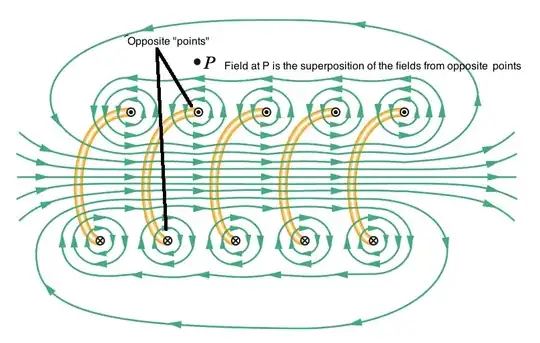
The field at P is the superposition of the fields from the opposite "points". If the diameter of the solenoid increases, the bottom "points" are further away from $P$, so their contribution to the field decreases. Therefore the assumption that the fields from the top points cancel with the bottom points becomes falser/less valid.


