5

Einstein said that it is impossible to distinguish between the effect of gravity and acceleration (so if you stand in an accelerating elevator in space it would not feel any different than if you were in a gravitational field). My question is, can the same logic apply to the perceived expansion of the universe and time slowing down? In other words, can the redshift we see in galaxies be interpreted not as these galaxies accelerating away from us, but as these galaxies standing still but with time slowing down?

BigPic
  • 139

1 Answers1

5

Type Ia supernovas are good "standard candles" because their brightness follows a particular shape over several dozen days. Here's a pretty standard plot, cribbed from these lecture notes:

Supernova brightness vs. time

Notice that these are absolute brightnesses, already corrected for distance (which in this sample is known by other means, such as observations of Cepheid-type variable stars or other galaxies in nearby clusters) and for second-order effects like dust extinction. You can see that the supernovae go from maximum brightness to obscurity in 20–60 days. The correlation between the decay time and the brightness is not related to the apparent brightness of the supernova, as you would expect from a distance effect, but to its total brightness.

These supernovae have been observed with redshifts as large as at least $z\sim2$ (from the same source, credited to 2011 Nobel Laureate Reiss):
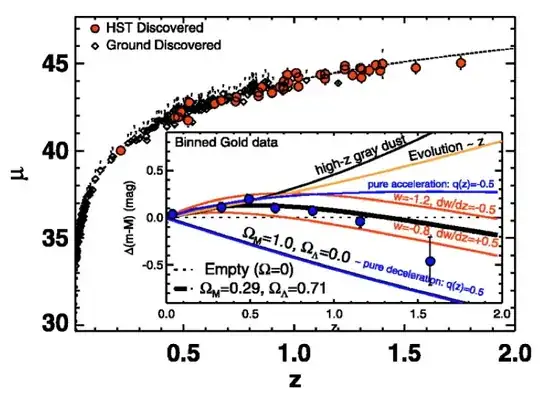
supernova distance modulus vs. redshift

A redshift of $z=2 = \frac{a_\text{now}}{a_\text{then}}-1$ implies that the local scale factor at the time of the supernova was one-third what it is today. If you want to attribute this to time running differently, you'd expect your forty-day brightness curve to extend over either 13 days or 120 days, I can't decide which. Either way, it'd be a huge difference between "local" and "distant" supernovae and there would be some other explanation discussed in the literature.

You suggest to me that you are confused between evidence for an expanding universe (known since Hubble in the 1920s) and evidence for a universe in which the rate of expansion is accelerating (known since 1998. Something for you to look for in your reading.

rob
  • 89,569
  • Well, that doesn't quite answer the question. I'm not suggesting that time is running at a different rate elsewhere in the universe which causes us to see certain galaxies as moving away from us. I'm suggesting that time is uniformly slowing down throughout the universe, which causes us to see all galaxies accelerating away from us, and farther galaxies accelerating faster.

    Maybe a different way to frame it is this: is it possible that instead of space being stretched out (while time remains constant), it is time that is contracting, while space between galaxies remains the same?

    – BigPic Jun 03 '14 at 02:02
  • 1
    I don't understand how a change in the rate at which time flows can affect the way that light (from events in the distant past) reaches us from distant galaxies, but not affect the apparent duration of events that we perceive in those galaxies. Can you explain? Do you have some kind of model in mind? – rob Jun 03 '14 at 02:08
  • Well, the redshift we see from farther galaxies is greater than the one we see from closer ones. That's why scientists believe that the universe is expanding. Now, if we see a supernova exploding in such galaxy this tells us that it is farther away (because the light is deemer). However, the supernova will have a redshift that is no different from the galaxy it is in. So that doesn't really tell us if it is time that's slowing down or if the supernova (together with the galaxy) is accelerating away from us. The effect on duration would simply be perceived as the supernova moving away from us. – BigPic Jun 03 '14 at 02:16
  • So, for example, let's say an object is 1 million light years away from us, and we decide to measure whether it is stationary in relation to us or whether it is moving away from or toward us. So we measure it's distance at what we perceive as two fixed points in time - let's say one year or one minute, and the object appears to accelerate away from us. If we assume that the one minute (or one year) remains constant then the object indeed is at a farther distance. But what if the one year (or minute) is in fact shorter than what we perceive? Then the object could remain in the same location... – BigPic Jun 03 '14 at 02:28
  • 1 Mly is nearer than Andromeda, where local effects are more important than cosmic expansion — Andromeda is moving towards us. – rob Jun 03 '14 at 02:32
  • Well, whatever scale the expansion takes place at. This is just an example, so it makes no difference if its 1 Mly or 1 Bly. In any case, if what we perceived to be 1 year was actually slightly shorter (ie. if time is slowing down), then we would perceive the object that is 1 Bly away from us to be farther away (we would see redshift). And we would see greater redshift for galaxies that are 2 Bly away. – BigPic Jun 03 '14 at 02:38
  • In other words, does the logic of Einstein's elevator thought experiment apply here? That it is impossible to distinguish between galaxies moving away from us if time is uniformly changing, vs. galaxies that are not moving away from us while time is slowing down (though we perceive it to change uniformly) - thus, in either case we would perceive the same effect: as galaxies accelerating away from us (though they may in fact be in a fixed location relative to us) – BigPic Jun 03 '14 at 02:41
  • 1
    OK, now I understand what you meant by type Ia supernovae as good "standard candles." I'm still trying to work out in my mind the possibility of there being a "canceling effect" when we see a supernova that is farther away (and therefore further back in time). If we are to assume that time was moving faster than it appears, surely we should then see the supernova's maximal brightness over less than 20 day (or, at least we'd see a difference between older and newer explosions). – BigPic Jun 04 '14 at 03:38
  • 1
    According to Ned Wright's Cosmology FAQ there is evidence of Supernova light curves being stretched by cosmological time dilation. His pages are down at the moment so I can't give a link but look in his FAQ. – John Eastmond Jun 04 '14 at 21:55
  • Here's the Ned Wright link (I think): http://www.astro.ucla.edu/~wright/cosmology_faq.html#TD – John Eastmond Jun 04 '14 at 22:03