6

I have just watched a trailer for the upcoming movie Interstellar and started to wonder about some physics involved. In the end of the trailer, they are obviously plunging into a Black hole hoping to travel into a different universe. Let us for a moment forget about the fact that most Black holes just probably are not worm-holes.

But a large problem is, how do they get there since the closest Black holes such as Sagittarius A* are several thousand light-years away? The Black hole at Sgr A* is surely massive enough for tidal forces not to pose a larger problem for the starship.

My first guess of transport would be a warp drive, since in the trailer there is a ring around the starship resembling the one usually included in warp drive designs (see the NASA concept below). But for a warp drive we need exotic matter and how much exotic matter would we need to get through 26 000 light-years in few tens of Earth years (using also hibernation of the pilots)? Is there possibly enough exotic matter in the Solar system for such a transport? Or is there something I am missing such as a very large Black hole nearby (i.e. large enough for tidal forces not to rip the spaceship apart)?


EDIT: Luboš Motl pointed rightly out that Sgr A* isn't the closest black hole, this doesn't change the argument that the closest known black holes are still too far away. I also edited some of the wording - even primordial black holes would not be good wormholes, only exotic matter allows them to be traversable. (Thanks again to Luboš for the point.)

Everybody seems to be very perplexed by the concept of exotic matter. Yes, it is a highly speculative idea which might not have any physical significance, thus eliminating the possibility of both wormholes and warp drive. But, it is not completely ruled out. We could e.g. speculate that the negative energy density is actually an underdensity of dark energy. Etc. etc. Either way, both traversable wormholes and warp drives are serious lines of (speculative) research not so different in empirical substantiality from e.g. all quantum gravity theories including the very much stressed string theory, so let us consider them at least for a while.
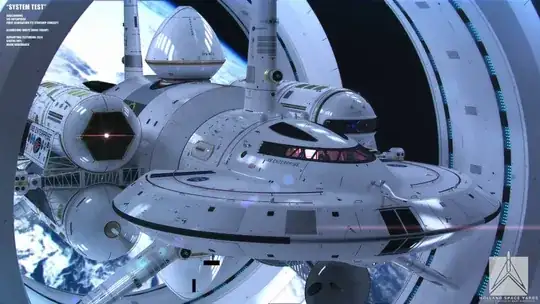
warp drive starship

Void
  • 19,926
  • 1
  • 34
  • 81
  • "Is there enough exotic matter in the Solar system for such a transport?" Notwithstanding the other problems with the assumptions you make in this question, the answer to that is fairly simple: if we postulate that whatever exotic matter would be needed is evenly distributed in the universe, however thinly, then it would stand to reason that you can either gather enough to go where there's more to gather that, or you can't gather enough to go anywhere useful at all. I'm sure one could make that point with math, but I'm not going to try because Luboš Motl's answer shows why it's not that easy. – user Jul 31 '14 at 11:18
  • Related: http://physics.stackexchange.com/q/119522/ – user11153 Jul 31 '14 at 14:33
  • I've said it many times, and I'll say it again: Harold White is a fraud, and the fact that NASA funds his nonsense is a shame upon all of science. Entertaining the notion of "warp drives" will only damage your intelligence and prevent you from actually learning physics. –  Jul 31 '14 at 15:46
  • @ChrisWhite You're probably right but theres a certain irony in telling people in the name of science to dismissing a theory without presenting any evidence that it is wrong – Richard Tingle Jul 31 '14 at 16:02
  • @RichardTingle The evidence is all of relativity and anyone who has taken a high school course in SR should understand that the causal structure of the universe as we know it falls apart if anything goes faster than light. –  Jul 31 '14 at 16:04
  • 1
    @Chris frankly I don't consider myself anywhere near qualified to determine if this is plausible (and I have a physics degree, a high schooler certainly isn't), clearly it looks like its in violation of special relativity but if the maths checks out then the maths check out. Regardless, every true revolutionary theory has been derided before eventual acceptance (as of course has every incorrect theory). I'm also not convinced it breaks true causality (as in the ability to affect effect events out of order, as opposed to observing them out of order) – Richard Tingle Jul 31 '14 at 16:11
  • Not to spoil the movie if you haven't seen it, but the plot involves the discovery of an "artificial" black hole in the solar system. – Drunken Code Monkey Jul 12 '16 at 01:37

1 Answers1

11

Warp drives are not allowed by the basic laws of physics, in particular the theory of relativity prohibits any superluminal motion or superluminal propagation of usable information. So whatever "exotic matter" or other wordings are proposed to justify the superluminal warp drives is banned, too. The typical "exotic matter" needed for warp drives would need to admit a negative energy-mass density. If Nature allowed the energy density to go negative, the vacuum itself would be unstable.

The laws of physics also ban the transfer of an object from a universe to a different universe through a black hole, whether it is primordial or not. Wormholes allowed by the laws of physics, if there are any, have to be non-traversable. It means that by jumping into such a black hole, he is guaranteed to end up in the singularity. At most, the singularity where he ends may be shared between a pair (or perhaps a higher number) of black holes. Such a pair of black holes is known as the non-traversable wormhole or the Einstein-Rosen bridge (at least the simplest one). But whoever falls into a black hole can never escape to the "liberated space" outside it, in any Universe, by the very definition of a black hole. Incidentally, the technical reason why a traversable wormhole can't be built is the very same why the warp drives are impossible: negative energy density would be needed for them, too.

Sagittarius A* is in no way the nearest black hole to the Earth. For example, V404 Cygni has a black hole in it that

https://en.wikipedia.org/wiki/V404_Cygni

is 7,800 light years away, and there are probably many closer ones, too.

It wasn't my plan to correct statements in the question but I have to. While an idealized empty large black hole is indeed mildly curved and one may survive the fall behind the horizon, that's not true for realistic black holes, especially Sagittarius A*. The latter is surrounded by plasma, matter that the black hole devours. A good description of the plasma around Sgr A* is the two-temperature plasma. The temperature of the electron component of the plasma is about 100 billion kelvins. No material that could be used to build a spaceship could survive these conditions. We would need a much more isolated black hole to avoid this thermal hell but it isn't clear whether such astrophysical black holes exist.

Luboš Motl
  • 179,018
  • If Nature allowed the energy density to go negative, the vacuum itself would be unstable. Please elaborate? – Ali Caglayan May 01 '16 at 21:04
  • The vacuum has to stay the vacuum, so it must be the state of the Universe with the lowest energy - often labeled by the number zero. If there existed states of negative energy (energy lower than the vacuum's), the set of configurations in which the Universe may be would resemble a pencil standing on its tip. Even if the forces were balanced, any tiny deviation would lead to the pencil's exponentially growing deviation from the unstable position, and the pencil would fall. Similarly, the Universe would get filled with lots of tachyon waves moving everywhere. – Luboš Motl May 02 '16 at 05:17
  • The total energy of the later states of the Universe would still be zero because the energy is conserved - but there would be both positive and negative contributions. It would be analogous to the pencil.When it's already falling, the potential energy is lower (negative relatively to the initial state) than zero, while the kinetic energy of the pencil is positive. In the Universe, the analogy of the falling pencil would be a cosmic cataclysm (cosmos filled with huge amounts of hot radiation etc.) that would begin immediately. – Luboš Motl May 02 '16 at 05:19
  • If exotic matter causes such problems why is it still a hypothesis? – Ali Caglayan May 02 '16 at 08:44
  • "Exotic matter" (in this sense, e.g. of having some negative energy density) is a hypothesis that is considered ruled out by physical arguments - and almost all practising physicists would agree that some matter that "clearly violates the null energy condition" is impossible. Its being ruled out or implausible doesn't mean that we must stop calling it a "hypothesis". – Luboš Motl May 03 '16 at 09:09
  • Warp drive is NOT superluminal. It functions (theoretically) by warping the fabric of space around the ship. It contracts space in front and expands space behind, so that the net displacement is nothing. It does not contradict GR, and has been calculated as theoretically possible, although the amounts of energy needed to bend space probably prohibit it, barring a good supply of unobtainium reactors. In a sci-fi context, if you can generate gravity through floor plating you can probably achieve warp travel by creating an artificial gravity well in front of your ship. – Drunken Code Monkey Jul 12 '16 at 01:41
  • Warp drive is by "wishful thinking" superluminal relatively to the asymptotic metric at infinity, and that's also a violation prohibited by relativity. The causal restrictions you're imagining as "restrictions of GR" are not the whole story. You are basically forgetting special relativity for the whole spacetime. You think that special relativity for an asymptotic Minkowski spacetime gets "revoked" by GR. But it doesn't get revoked. Equivalently in GR, these restrictions arise from the energy conditions (non-negativity of energy density, roughly speaking). – Luboš Motl Jul 12 '16 at 04:17