10

This question about whether or not it is possible to focus black-body radiation to make something hotter than the radiation's source was answered mostly negative: the second law of thermodynamics and/or the fact that etendue cannot be reduced are the reasons named.

Now, consider the following scenario:

Take an infinitely (or sufficiently) large plate as black-body radiator at temperature $T_r$. You have a power source available which is able to hold the plate's temperature constantly at this arbitrary chosen temperature.

Place a perfect parabolic mirror with its symmetry axis parallel to the plate's normal, opening toward the radiator, so that much light is focused in the focal point. If you now place a perfect black-body sphere with temperature $T_s<T_r$ at the focal point, it will absorb the energy and heat up.
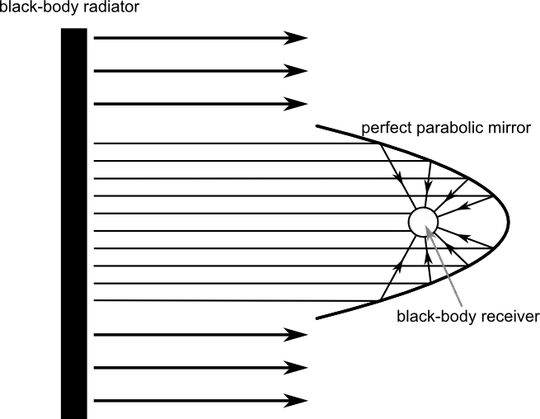
enter image description here

Let's do an net-energy analysis. The photonic energy hitting the sphere is proportional to the geometrical cross section $A_m$ of the mirror: if the mirror is twice as large, it collects twice as much light and the sphere absorbs twice as many photons per unit time.

Since the sphere is a black-body, it emits photons in a radiation according to the Planck spectrum of $T_s$. As far as I understand, the total energy output of that radiation depends on temperature and surface area only. Since the surface is constant, $T_s$ is the only parameter.

In thermal equilibrium, the sphere will emit as much energy as it receives, and we have

$$ E_{in}(A_m) = E_{out}(T_s) $$

We can make the left hand side arbitrarily large since we have an infinitely large plate and we can use a broader or further extended mirror.

The right hand side apparently has a limit: the energy output of the maximally reachable temperature $E_{out}(T_r)$. So, if it is really true, that the sphere cannot get hotter than $T_r$, where does the excess energy go if $E_{in}(A_m) > E_{out}(T_r)$?

Or is that a thing that can never happen? Did I make some other mistake?

M.Herzkamp
  • 1,488
  • 8
    The radiation from a black body radiator is not parallel rays. If you were to make the radiation parallel with a collimator, you would end up with a much lower total intensity than given by the black body formula. Rays that are not parallel, however, do not get focused on the sphere by the parabolic mirror. – CuriousOne Oct 14 '14 at 14:56
  • 1
    @CuriousOne: If the radiation is isotropic, most of the light will be radiated orthogonally of the plate, since $p(\theta)\propto cos(\theta)$. In my argumentation I don't care about the photons that are emitted in another direction, because one can increase the size of the mirror to compensate. Important is, that photons hitting the sphere are distributed according to the Planck spectrum. – M.Herzkamp Oct 14 '14 at 17:05
  • Your argument is based on a misunderstanding of the amount of light that can be focused with a parabolic mirror. Every optical path is completely reversible. Imagine a 1W source of 0.01m diameter at the center of a 1m mirror. How much power is absorbed by a black plate in front of the mirror? Now make that mirror 10m in diameter. Does the power increase by a factor of 100? Why not? What does that mean for the reverted light path? – CuriousOne Oct 15 '14 at 00:34
  • @CuriousOne: In your case, the power does not increase by a factor of 100, because the sphere radiates equally strong in all directions. So the power density absorbed by the plate is lower on the outside than on the inside. In my case, the output of the plate is uniform. That means, the sphere is not irradiated equally from all sides. So it still might be possible to arbitrarily increase the power input by scaling the mirror. – M.Herzkamp Oct 15 '14 at 05:15
  • The light path is reversible and you can calculate it if you like either way. You will see that the effect you are looking for can not be achieved with mirror. The general phenomenon is called etendue and is basically the Liouville theorem for photons. – CuriousOne Oct 15 '14 at 05:41
  • You can try a different hand-wave: surround your parabolic mirror with a perfect cylindrical mirror all the way to the black body emitter surface. Now you are forming a perfect hohlraum from which no energy can escape. Does the temperature in this hohlraum rise above the temperature of the black body surface? Why would it rise in the focal point of the parabolic mirror? – CuriousOne Oct 15 '14 at 06:18
  • @CuriousOne: Okay, I see your point. The problem seems to be the isotropy. Because of that, the amount of light hitting the sphere per unit area of the plate decreases towards zero with increasing excentricity and therefore there can exists a limit to $E_{in}(A_m)$. Care to post an answer? – M.Herzkamp Oct 15 '14 at 06:38
  • Yep. If one had a "black body laser" with almost perfectly collimated radiation, then the mirror focus would indeed get hotter than the black body. If you like you can put the pieces together for yourself now. I am glad if I could help just a little bit with an intuitive approach in the comments. – CuriousOne Oct 15 '14 at 06:47
  • I believe your basic misunderstanding is in the limit you put T_r to the sphere. The limit is not a law. It just means that it will melt at that temperature and the geometry will be destroyed as far as absorption and radiation goes so the relevance of conservation of energy is lost. – anna v Jul 11 '15 at 02:47
  • 1
    @annav: No, T_r is the temperature of the black body radiator. If we use its radiation, we cannot heat something up to a higher temperature that T_r. that is why it is the maximum temperature. It may be well below any critical temperature of the material. – M.Herzkamp Nov 30 '15 at 11:37
  • looking at it again, when the sphere reaches its maximum black body temperature as you say limited by the wall temperature, it is at a radiative equilibrium with the wall, it is a part of the wall (ignoring the mirror). The excess energy goes where the rest of the wall's energy goes. Just the geometry is different. – anna v Nov 30 '15 at 11:55
  • The paths that the radiated photons take are reversible, the incoming rays to the sphere are also outgoing, those are the photon two way radiation paths. ( absorption incoming, emission outgoing). – anna v Nov 30 '15 at 12:14
  • A similar question, from the point of view of etendue: http://physics.stackexchange.com/questions/234996/why-does-conservation-of-%C3%A9tendue-matter-when-showing-one-cannot-focus-light-to-a – Rococo Jun 21 '16 at 02:33
  • my answer here , particularly the edit, is yes we can :http://physics.stackexchange.com/questions/140949/is-it-possible-to-focus-the-radiation-from-a-black-body-to-make-something-hotter , by picking up different areas of the radiating body with many mirrors and focusing on the same spot – anna v Jun 21 '16 at 03:33

2 Answers2

1

UPDATED: I now think my previous answer was wrong, because the set up would be equivalent to the following question: Is a black body sphere inside a black body shell hotter than the shell?

Just change the question to add a carefully crafted lens that focuses all the radiation into the sphere (you could make the shell as large as you want), which of course is impossible to make or it would violate the second law.

  • Thanks. That was what I suspected. Now someone should post an answer to the linked question. – M.Herzkamp Oct 15 '14 at 05:18
  • This is not a second law violation. Of course one cam heat things above the temperature of the hottest radiation source, but not with a mirror. This is a case of ettendue: http://en.wikipedia.org/wiki/Etendue. The phase space volume element occupied by photons can not be compressed with optical means alone. – CuriousOne Oct 15 '14 at 05:39
  • @CuriousOne can you send me a link or give me a reference with the demostration? it is not clear to me from the wikipedia article that the conservation of etendue prevents the sphere to become hotter, as it only applies to refractions and reflections, and the light path is not reversible, it is absorbed at the sphere surface. The light path is not reversible. Also, could you point out what is wrong in the argument of the original OP? you might be right, but prove it or send a link to a proof, please. –  Oct 15 '14 at 08:28
  • 1
    It's the conservation of etendue together with the characteristics of black body radiation. One can, of course, imagine a light source that has a black body spectrum but a much higher intensity (or a much narrower angular distribution) than a black body with the same temperature would have, but that can't be a black body for thermodynamic reasons. – CuriousOne Oct 15 '14 at 17:52
1

I will answer this from the OP, presupposing that there is excess energy according to the arguments offered in the comments:

So, if it is really true, that the sphere cannot get hotter than $T_r$, where does the excess energy go if $E_{in}(A_m) > E_{out}(T_r)$?

Conservation of energy holds for an isolated system. Your system is an infinite hot plate at an initial temperature $T_r$, a small sphere at the focus of the parabolic mirror, and an electromagnetic field covering the vacuum ( where the masses are placed). The system is not isolated when you keep the temperature by outside energy input at $T_r$ .

Let us see what happens when there is only an initial temperature $T_r$ , an isolated system.

You have ignored the ambient electromagnetic field , it carries energy (and there is where any excess energy can be stored) going back to the infinite plane and it will be reabsorbed, in the thermodynamic process of equilibrating the temperatures.The plane and the ball will reach a temperature lower than $T_r$.

If you enter a source keeping the temperature of the infinite plane fixed, once the temperature of the ball and mirror are at $T_r$ , any excess will be stored initially in the electromagnetic field, with continuous reflections raising the poynting vector of the electromagnetic field. Please note that the system trying to keep the temperature of the plane at $T_r$ will need to cool it so that it stays at that value.

The moral of the example is that energy conservation holds for isolated systems, in this case the source/sink keeping the temperature fixed has to be considered in the isolation, so excess energy can be extracted to the sink.

anna v
  • 233,453