1

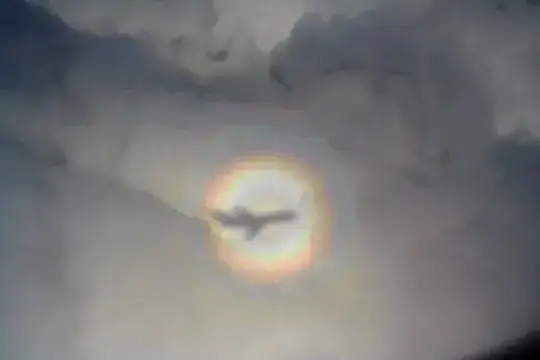
Just a while ago while I was reading news paper, I saw an amazing article. Someone had caught a photo of a 360 Degree Rainbow.

But how is it possible. I mean after refraction the only rainbows that should form are either VIBGYOR Rainbow or the ROYGBIV Rainbow due to the change in angles.

So how can a 360 degree rainbow be formed?

bobie
  • 5,854
Amey Shukla
  • 841
  • 1
  • 9
  • 16

4 Answers4

2

Its all upto the relative position of the observer and the sun. The imaginary line connecting the centre of the rainbow and eye of the observer called the line of vision makes the apparent struture of a rainbow. If the line of vision is a straight horizontal line with respect to the surface of the earth. You will definitely see a 360 degree rainbow.

I daily life events, you can see this from an aircraft.

Vinayak
  • 898
  • 2
  • 13
  • 28
1

For the conditions to see a part of a rainbow, I would say you need the following:

  1. sufficient moisture to form numerous micro spheres of water, which creates the refraction pattern
  2. the right angle between the observer and the sun
  3. sufficient mass-thickness with this angle and with this composition to build up a visible amount of color

Since the sun is practically infinitely far away, the distance between you and a drop of water doesn't really affect the angle. Because of that, you can have a coherent rainbow shape form, because one line of sight will consistently reflect red, blue, or whatever wavelength.

However, looking up or horizontally builds up potentially miles of a line of sight. If I wanted to be pedantic, I would claim that literally all rainbows you see are 360 rainbows. The parts below the horizon are just too dim for you to make our with your eyes because they are not high enough sensitivity, nor do they have the ability to make out those colors against the brighter background. To drive home my point, consider such an image from an aircraft:

https://i.stack.imgur.com/TaYXC.jpg

I hope you find it somewhat believable that the rainbow is less bright as we look at the lowest part of it. This part is formed by the atmosphere between the aircraft and the ground. Because of that, the distance of this line of sight is limited. Perhaps a few 100 feet, it depends on how high you're flying. Compare to a human standing normally. The line of sight to the ground may only be a few feet. This is not enough to intersect with enough water droplets to see the pattern.

Alan Rominger
  • 21,047
0

Take a hose that sprays water in fine droplets and direct it towards a bright object like the sun or a lamp... instant 360 degree rainbow!

CuriousOne
  • 16,318
  • Does this optical effect meet the definition of a rainbow? (As opposed to, say, a sun dog) – DJohnM Dec 19 '14 at 16:39
  • Why not? It's an artificial rainbow. – CuriousOne Dec 19 '14 at 23:04
  • From Wikipedia: Rainbows caused by sunlight always appear in the section of sky directly opposite the sun. (Emphasis added) – DJohnM Dec 20 '14 at 01:15
  • @User58220: Oh, I see... didn't think about that one! You are right, to make it a real rainbow one has to look at it from the direction of the sun, which probably requires getting a ladder... :-) – CuriousOne Dec 20 '14 at 01:19
0

You'll find a number of images on the internet such as the one below that claim to be a 360° rainbow. Most of these supposed rainbows are not rainbows. They are instead "glories" (wikipedia article). The image below is from that wikipedia article.

Rainbows are much bigger than glories. A rainbow, like a glory, naturally is a 360° optical effect. You don't see the full 360° from the ground because the ground gets in the way. You need to be in the air to see a 360° rainbow. The Astronomy Picture of the Day from 2014 September 30 shows a very nice circular rainbow taken from a helicopter. Unfortunately, the photograph is copyrighted material, so I'm not incorporating that image into my answer. Click on the link. It is a beautiful image.

David Hammen
  • 41,359