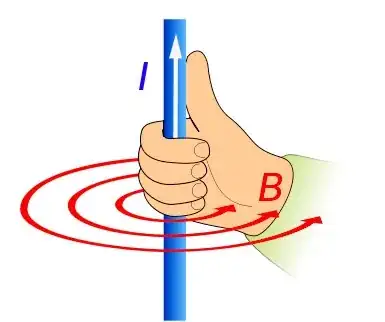
Consider the magnetic field generated by a straight current carrying conductor.
Where are the poles?
Consider the magnetic field generated by a straight current carrying conductor.
Where are the poles?
There are no poles in a magnetic field generated by a current carrying conductor.
With permanent magnets, magnetic poles arise from the illusion that the magnetic field starts at the north pole and ens at the south pole. It's an illusion, because magnetic fieldlines are always closed (contrary to electric fieldlines that do originate at a positive charge or end in a negative charge). The magnetic field of a magnet seems to end in the south pole, as you can't go inside the magnet and see how the field is overthere, but actually, it continues and it appears again at the other side of the magnet at the north pole:

The magnetic field of a straight conductor is concentric around the conductor, so the fieldlines don't seem to start or end anywhere, so there are no poles.
In a more mathematical way, two of Maxwell's equations say just the same:
Gauss's law, $\vec{\nabla} \cdot \vec{E}= \frac{\rho}{\epsilon_0}$, says that electric field lines originate at electric charges.
Gauss's law for magnetism, $\vec{\nabla} \cdot \vec{B} = 0$, says there's no such thing as magnetic charge, so magnetic field lines have no beginning or end, they close in on themselves.
Facts:
Pole is defined as the region at the ends of a magnet where the external magnetic field is strongest.
Poles are of 2 types: The North seeking pole of a magnet will be it's North Pole and the south seeking pole will be it's south Pole.
How we found the poles of a magnet in school: A compass needle was extensively used by us at school to find out the pole of a magnet and the direction of the magnetic field lines. When sufficient number of field lines had been traced. It would be found that they seem to emerge from a certain point; conventionally taken to be North Pole of the magnet and terminate at another point called the South Pole.
Here your answer:
In case of a solenoid/circular current carrying loop, the field lines seem to merge somewhere as illustrated in this gives rise to poles in it.i.e. i*(L x B)(this might give rise to levitation in some cases when appropriate conditions are used). Hence there seems to be no evidence of any North seeking or south seeking pole.Thus on the basis of the above observations/facts/knowledge. One might intuitively conclude that the no poles are present in a magnetic field produced by a straight current carrying wire.


Electrons and protons have electric charge, magnetic dipole moment and intrinsic spin. In permanent magnets the magnetic dipole magnets of this particles not equally distributed, their magnetic dipole moments are aligned under external magnetic field and this state is frozen then.
But there is an other way to induce magnetic fields. Whenever electrons get accelerated in curved trajectory their intrinsic spin get aligned (gyroscopic effect) and the magnetic dipole moments - which are related to spin - get aligned too. The sum of this magnetic dipole moments is the magnetic field, for example, in a coil. On the other side there is the effect of self induction in a wire when the current increases or decreases.
But there is one more effect. A magnet near a current carrying wire influence the magnetic dipole moments of the electrons in the wire. It is a self-reinforcing process too. The question is, could one differ between this self-reinforcement from an external magnet and the declared magnetic field that has to be by itself around a current carrying wire.

Where many magnetic field lines seem to meet, a pole is formed. In the case of straight wire, concentric magnetic field lines are produced so, no magnetic lines meet or come near to each other. Hence, current carrying straight wire have no poles.


