3

For an EM wave, my textbook says that the amplitude of E or B at a certain point on the wave is $$E=E_0sin(2\pi(\frac{x}{\lambda}-ft))$$ $$B=B_0sin(2\pi(\frac{x}{\lambda}-ft))$$ I don't understand how this works.

The formula I am most familiar with is of the form $sin(\omega t) --> sin(2\pi ft)$. So I understand that the $2\pi$ is the full revolution, while the $(\frac{x}{\lambda}-ft)$ acts like a multiplier describing how many of $2\pi$ revolutions occur.

But $\frac{x}{\lambda}$ is essentially $\frac{[\text{total distance}]}{[\text{distance of one cycle}]} --> [\text{total cycles completed}]$, yet $ft$ gives the same number another way: $\frac{cycles}{second}(\text{seconds}) --> \text{cycles}$.

This seems to me like it would give zero every time (because, as $t$ increases, so does $x$, the distance covered by the EM wave). After all, they're both giving the number of cycles, and $\text{cycles-cycles}=0$.

I'm definitely missing something, but I don't know what.

Alex G
  • 221
  • 1
    Pick a fixed $x$ and look at what happens as you change $t$. Now do the same thing fixing $t$ and changing $x$. – By Symmetry Nov 22 '16 at 12:19
  • 1
    Oh. Never has a simple comment like that explained so much. I was under the impression that x changes with t, because as time passes the wave travels further. But this expression, I guess, looks at a fixed spot x and examines how that spot's magnitudes change as the wave passes? – Alex G Nov 22 '16 at 12:29
  • 2
    Probably this link would be useful also : http://physics.stackexchange.com/q/265008 – Frobenius Nov 22 '16 at 13:41

2 Answers2

6

The form of a travelling wave is of the form: $$ A \sin{(kx-\omega t)}$$ where $k = \frac{2\pi}{\lambda}$ (wavevector) and $\omega = 2\pi f$ (angular frequency).

The two terms in the sine term do not cancel out as $x$ does not increase as $t$ increases. The whole sinusoidal curve either shifts left or right.

When you plot it on a graph, you generally don't vary both $x$ and $t$ at the same time. You vary only one. If you fix $t$ and plot it against $x$, you get a sinusoidal curve. Now vary $t$ and the curve shifts left or right, depending on how $t$ is varied, as how traveling waves behave.

So as time passes, the wave shifts? I'm confused. If I was at a point P on the x-axis (on which the wave of light is travelling) and I stayed at that point, would I see the magnitudes of B and E change at my point? I thought that at point x0x0 it is one value of B and E, then x1x1 has another value of B and E (either increasing or decreasing), etc. Does the wave move past me, varying at point P over a time period, or is it only one magnitude at P, then it's passed and I'm back in empty space?

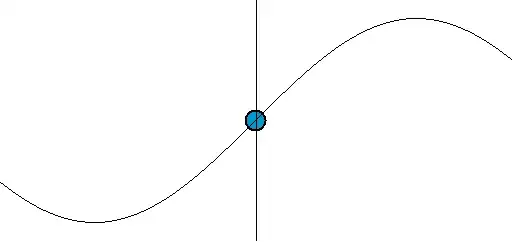
If you were on a point $P\,(x_{0}, A\sin{(kx_{0}-\omega t)})$ on the wave, then as $t$ increases, you will see the point move up or down as shown in the figure below:

However, the whole wave can be described as either moving left or right. So the wave moves past you, and point $P$ moves as time $t$ changes.

NaOH
  • 628
  • So as time passes, the wave shifts? I'm confused. If I was at a point P on the x-axis (on which the wave of light is travelling) and I stayed at that point, would I see the magnitudes of B and E change at my point? I thought that at point $x_0$ it is one value of B and E, then $x_1$ has another value of B and E (either increasing or decreasing), etc. Does the wave move past me, varying at point P over a time period, or is it only one magnitude at P, then it's passed and I'm back in empty space? – Alex G Nov 22 '16 at 12:33
  • 1
    I edited the answer, hopefully it addresses your concern. – NaOH Nov 22 '16 at 13:11
  • 2
    https://www.geogebra.org/m/fAqWVCUP enjoy. @AlexG – ProfRob Nov 22 '16 at 13:58
  • Oh my god. That is AMAZING. I'm guessing you made that? I was doing that in my head and getting the intuition, that just solidified it even more. On a related note, I just downloaded the app -- how awesome. Thanks for this awesome find! – Alex G Nov 22 '16 at 14:18
2

You should for a moment forget that you know something about the speed of light. We will see that the speed of light will follow from the equations.

The easiest way to get some intuition for these kind of equations is to see what happens in the following two situations (I'll focus on the electric field):

  • How does the electric field behave as a function of time at a fixed position x?
  • At a fixed moment in time, what does the electric field as a function of position look like?

Now for t=0 pick one of the maxima in the electric field. This maximum will start to move as time increases. If you calculate the velocity of this movement, you will find the velocity of light.

(Warning: When talking about velocities for waves there is a difference between the phase velocity and the group velocity. The velocity we have calculated here is actually the phase velocity. For sine waves, the phase velocity and group velocity are equal, so in this case the difference does not matter, but this is not generally true.)

Crimson
  • 2,871
  • It looks to me like the wave is in fact moving. I'm still not sure why this is (because if the "wave" is really just a combination of all of the transverse vectors in each frame of time, it should just pass by -- it seems like only the plane in which the photon exists at time t should be the one with the vectors). As I vary t and hold x constant, the wave passes and my point goes up and down (like a ball in an ocean). The best way to describe how I picture it is the wave, with all its peaks and troughs, isn't oscillating in "its perspective" -- it's just moving past. Yes? – Alex G Nov 22 '16 at 12:48
  • 1
    @AlexG A real signal will behave differently from this ideal picture. Waves that exist everywhere at all times are not physical. If you have a pulse, this form of oscillation will occur (referred to as the carrier), but it is multiplied by an envelope factor that localizes it in time and space. – Orhym Nov 22 '16 at 18:40