I thought this would be a simple question, but I'm having trouble figuring it out. Not a homework assignment btw. I am a physics student and am just genuinely interested in physics problems involving math, which would be all of them.
So lets say we drop an object from a height, $R+r$, it falls toward earth. This height, $R+r$, is far enough away that the $g$ it experiences is a fraction of $g$ at sea-level. Let's just say that air resistance is negligible, and it wouldn't be that complicated to just integrate from $0$ velocity to the terminal velocity piece wise and deal with the rest of it later.
So the key here is that acceleration is changing with time. I thought I could simplify this by saying it changes with distance, and it has nothing to do with time, but this didn't really help, my guess is that maybe time is important (doh).
I tried integrating acceleration with time, and ended up nowhere. I tried integrating $a=GM/R^2$ with respect to $R$ from $R+r$ to $R$ and ended up with a negative function.
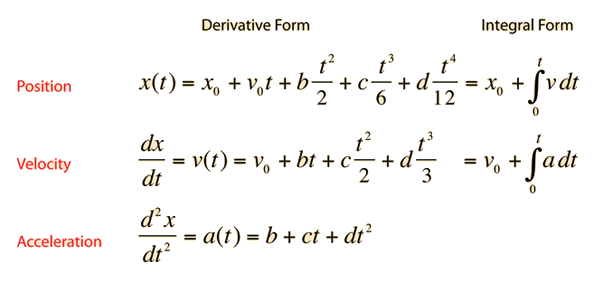
I saw somewhere someone tried to expand with taylor series, they even have something similar on hyperphysics, but I can't figure out how to obtain the polynomials that precede the variables.
http://hyperphysics.phy-astr.gsu.edu/hbase/images/avari.gif
This is the hyperphysics site where they use polynomials to find the distance. http://hyperphysics.phy-astr.gsu.edu/hbase/avari.html#c1
Maybe I can't solve this because I haven't taken a course in differential equations yet. What I want to know is how to calculate the distance at any time.


$a=a_0+2/x^3=1/x^2+2/x^3$
So basically, I discarded the gravitional constant and the mass of earth to simplify things.
and in fact, even this equation looks wrong to me, because integrating $1/x^2$ should give $-2/x^3$. But I thought that would be silly, I want to add acceleration not subtract it.
– Kam May 07 '13 at 06:01That's why I thought I would need to know differential equations, because I was watching a few videos from mit and I am not sure how to do boundary solutions and things like that.
For example, wouldnt I have to use a ODE where we take into account the frequency, or something along those lines.
I guess my original question was silly.
– Kam May 07 '13 at 06:06Im confused at how you got to $G(m_1+m_2)$ from the previous equations. Thanks for the information. Ill keep reading till I figure this out.
– Kam May 07 '13 at 06:30