3

Would like a product that enables me to use my computer to throw an small DC ON / OFF switch. Seems like a stupidly simple thing to do, but for the life of me I can't seem to find such a device when I search online.

Is there a device floating around out there that I can order? Or is there some kind of term I should be searching for?

Thanks so much!

Chris Dutrow
  • 131
  • 3
  • Do you want to be able manually control the switch as well? – DaemonMaker Sep 29 '13 at 22:18
  • By “throw a small DC ON / OFF switch” do you mean physically actuate an existing switch? – James Waldby - jwpat7 Sep 29 '13 at 22:22
  • @DaemonMaker - No I don't need to manually control it. – Chris Dutrow Sep 29 '13 at 22:26
  • @jwpat7 - No, not an existing switch. I just need to connect two wires carrying a low DC load for a second and then disconnect them. – Chris Dutrow Sep 29 '13 at 22:26
  • How much current are we talking about? You can use a relay or a solid state switch... When you say switch do you mean physically disconnect? Sometimes a transistor will do the job. – Guy Sirton Sep 29 '13 at 23:45
  • Just FYI, shopping questions are not really fit for this Q&A site. Try rephrasing the question to instead of being "what product to buy to do X?", it would be more like "how can I achieve X with properties Y, Z and W?" The answers would certainly have enough pointers for you to be able to find the product you are looking for. – Shahbaz Sep 30 '13 at 08:15
  • There are some AC extension leads that you can control via USB. It should be easy to reuse these. – ott-- Sep 30 '13 at 11:34
  • Does your computer have a parallel port? (nowadays an "old" port used for connecting printers) – Claudio Oct 03 '13 at 19:34
  • It may on the motherboard. If not I could connect it to an Arduino via USB. – Chris Dutrow Oct 04 '13 at 00:55
  • 1
    Put the switch in front of the computer's CD drive. Eject the CD drive, and it will hot the switch! – Rocketmagnet Oct 08 '13 at 14:08

1 Answers1

2

There are two easy ways:

  • Use a relay
  • Use a transistor

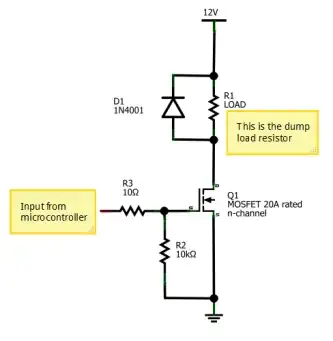
In both cases, you can use the processor as the switch input...

Example MOSFET switch

Andrew
  • 560
  • 2
  • 10
  • 26
  • I think I actually have all the parts to do this. Would you use the serial or USB port to send the signal? A concern I have is the time factor. I feel like if I can buy a USB Nerf Missile Launcher off Amazon.com, shouldn't there be a device to simply turn something on or off that is commercially available? – Chris Dutrow Sep 30 '13 at 15:55
  • On a PC, you could use a parallel port directly... if you use serial or USB you will need to unpack the data first – Andrew Sep 30 '13 at 18:33
  • Ah, interesting. I think I understand now, thanks so much! – Chris Dutrow Oct 04 '13 at 00:54
  • I might be reading this wrong, but why are you bypassing the dump load resistor with a diode? – Chris Dutrow Oct 10 '13 at 02:58
  • The diode is there to stop back EMF and offers reverse protection. The diode is (if you notice) reverse biased, so it is NOT bypassing the load! – Andrew Oct 10 '13 at 10:25
  • Ok, so it allows current to flow freely from 12V to ground? When would this happen? The reason I am asking is because I built a similar, but more complex circuit to control 8 machines using the Arduino. It works fine when plugged in, but restarts the machines sometimes when I unplug the USB. – Chris Dutrow Oct 10 '13 at 17:30
  • Just posted the question here: http://electronics.stackexchange.com/questions/85013/multiplexers-used-as-a-switch-seem-to-leak-when-power-is-cut – Chris Dutrow Oct 10 '13 at 19:09