2pietjuh2's Mom:
Are you familiar with dog whistles?

Dog whistles make a sound at a frequency that dogs can hear but humans can not. The sound it makes has a higher frequency than the maximum frequency humans can hear.
If we try to draw a picture of what human hearing is like it looks something like this:
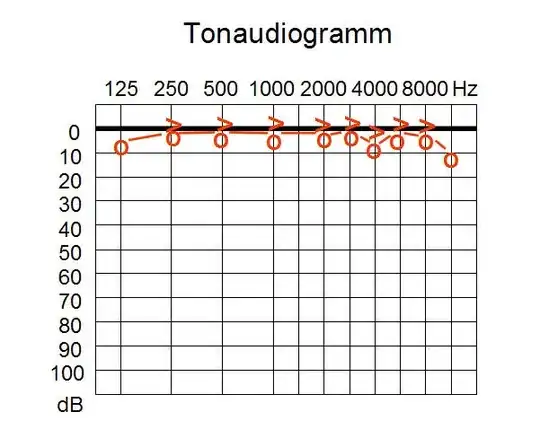
You may have seen this already if you've ever taken a hearing test. Where the red circles are low signal where our hearing gets worse. In this example we have a person who can hear pretty well between 250Hz and 8000Hz (Hz is a measuring unit called after Heinrich Hertz and means cycles per second) but less well outside this range, or band. We can think of the area from the first frequency to the last frequency as a "band". Humans with good hearing can still hear something up to 20000Hz but we are not as sensitive to those higher frequency sounds. At some point we simply will hear nothing at all no matter how loud/strong the sound is.
Not this kind of a band:

But more like a band you'd wear on your wrist. We measure the width of this band and that's our band width, bandwidth. For our human example it's 8,000 minus 250 Hertz or about 7,750 Hertz (ignoring the little dip around 4,000). If someone asked me to design the hearing system for this human they would specify a bandwidth of 7,750Hz. We usually need to decide what's large enough to count as being inside the band in order to determine this. The "standard" human hearing range is often considered to be 20Hz to 20,000Hz or a bandwidth of about 19,980Hz.
Meanwhile, our best friend:

Has a hearing range of about 40 Hz to 60 kHz (kHz is kilo-Hertz or one thousand Hertz). So we can say his hearing bandwidth is about 59,960Hz (60,000-40).
We can explain this mathematically and more rigorously but that will take more time where most people would lose interest (a few hours should yield an expert level of understanding for this particular concept). I think it's important to stress out the origin of the term as the width of the band in a graph of frequency vs. response (e.g. in radio, light etc.)
(p.s. All images from Wikipedia)


