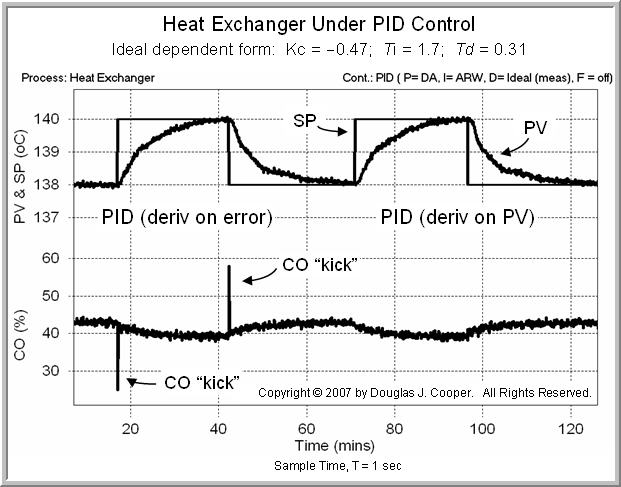
A PID loop and a so-called PIV loop with equal gains should have the same response to a disturbance, so I'm not sure why the claim that the disturbance response is better or worse.
As mentioned, the derivative "kick" will be less, which can be a good thing if you give the thing sharp inputs.
In addition, there can be some benefits as the thing comes out of integrator saturation, depending on how you implement your anti-windup.
Mostly, the so-called PIV loop is just a way of affecting the zeros of the closed-loop transfer function. It's a special case of a more general scheme where your controller output is (in Laplace notation)
$$Y(s)=\frac{k_{fi}U(s) - k_{bi}X(s)}{s} + \left(k_{fp}U(s) - k_{bp}X(s)\right) + \left(k_{fd}U(s) - k_{bd}X(s)\right)s$$
where $Y$ is the controller output, $U$ is the system command and $X$ is the controlled variable, while the various $k_{xx}$ are forward and backward integral, derivative, and proportional gains. In this scheme you tune the various feedback gains ($k_{bx}$) to get the loop (and hence disturbance) response that you want, and you tune the forward gains ($k_{fx}$) to improve the response to a command change, by whatever criteria you have for "better".
Setting all the forward and reverse gains equal gets you a plain ol' PID, while setting $k_{bp}=0$ and $k_{bd}=0$ gets you the so-called "PIV" controller.