3

I want to give my robot a differential mechanism for the system of turning and steering. Considering the case of turning a right-angled corner, the robot will achieve this by following a gradual circular arc through the intersection while maintaining a steady speed. To accomplish this end, we increase the speed of the outer wheel while slowing that of the inner. But supposing i want the turn to be within a definite radius, how do i calculate what ratio the 2 speeds have to be in? Can someone give me an insight into this?

What Ive done is this, although I have my doubts.

If the speed of the right wheel is $V_r$ and the speed of the left wheel is $V_l$, then the ratio of their speeds while turning will be equal to the ratio of the circumferences of their corresponding quadrants.

Therefore $$V_r :V_l =\frac{r+A}{r}$$

Is this right? I have a sinister feeling Im missing something out..
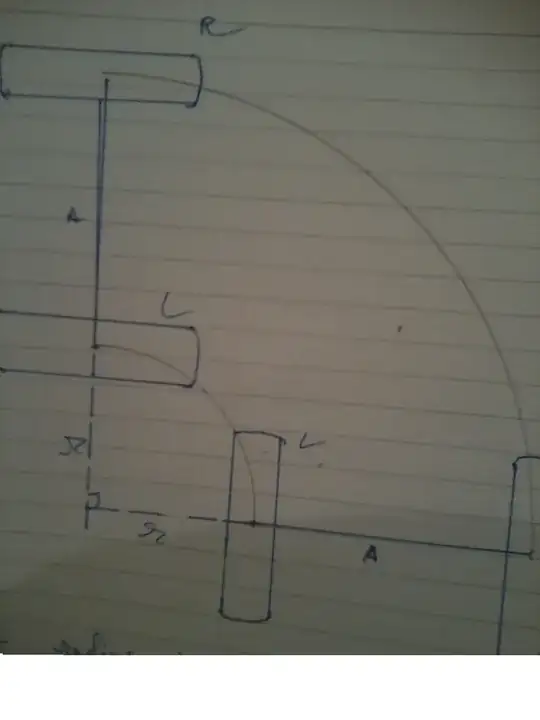
enter image description here

Ian
  • 11,013
  • 2
  • 23
  • 65
Ghost
  • 143
  • 1
  • 3
  • Hi Ghost, welcome to robotics, I closed your other copy of this question as this has more detail. You may also want to have a read through my answer to Line Follower optimization. The standard equations there may answer your question directly and if not then the diagram there might help you explain your problem a little better. – Mark Booth Jul 16 '13 at 13:31

1 Answers1

1

Your intuition is correct. We can look at the difference in arc length that each wheel will roll for a given sector (specified by $\theta$ in degrees).

$$d_l = \frac{\theta*2\pi{r}}{360}$$ $$d_r = \frac{\theta*2\pi(r+A)}{360}$$

This simplifies to:

$$ \frac{d_r}{d_l} = \frac{\frac{\theta*2\pi(r+A)}{360}}{\frac{\theta*2\pi{r}}{360}} = \frac{r+A}{r}$$

Speed is just distance over time:

$$ \frac{V_r}{V_l} = \frac{d_r/t}{d_l/t} = \frac{r+A}{r}$$

Ian
  • 11,013
  • 2
  • 23
  • 65