Here are three more array-based solutions. One each depending on whether the cell contents should be left-aligned, centered, or right-aligned. Observe that contents of the three array environments are identical; they only differ in the use of the L, C, and R column types.
A separate topic: The code uses \cdots rather than \dots, as LaTeX doesn't "know" that the dots will be flanked by + (a binary operator) on either side -- but in the adjacent cells.( If +\dots+ is found, LaTeX is smart enough to change \dots to \cdots.)
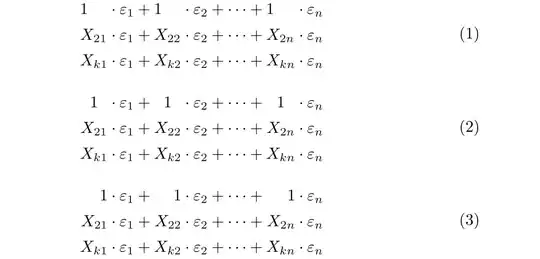
\documentclass{article} % or some other suitable document class
\usepackage{array} % for '\newcolumntype' macro
\newcolumntype{O}{>{{}}c<{{}}} % for operators ( + , \cdot )
\newcolumntype{C}{>{\displaystyle}c}
\newcolumntype{L}{>{\displaystyle}l}
\newcolumntype{R}{>{\displaystyle}r}
\usepackage{amsmath} % for 'gather' environment
\begin{document}
\setlength\arraycolsep{0pt}
\renewcommand\arraystretch{1.33}
\begin{gather}
\begin{array}{ {6}{LO} L }  % left-aligned
1      &\cdot& \varepsilon_1 &+& 1       &\cdot& \varepsilon_2 &+& \cdots &+& 1      &\cdot& \varepsilon_n\
X_{21} &\cdot& \varepsilon_1 &+& X_{22}  &\cdot& \varepsilon_2 &+& \cdots &+& X_{2n} &\cdot& \varepsilon_n\
X_{k1} &\cdot& \varepsilon_1 &+& X_{k 2} &\cdot& \varepsilon_2 &+& \cdots &+& X_{kn} &\cdot& \varepsilon_n
\end{array}
\[2\jot]
\begin{array}{ {6}{CO} C }  % centered
1      &\cdot& \varepsilon_1 &+& 1       &\cdot& \varepsilon_2 &+& \cdots &+& 1      &\cdot& \varepsilon_n\
X_{21} &\cdot& \varepsilon_1 &+& X_{22}  &\cdot& \varepsilon_2 &+& \cdots &+& X_{2n} &\cdot& \varepsilon_n\
X_{k1} &\cdot& \varepsilon_1 &+& X_{k 2} &\cdot& \varepsilon_2 &+& \cdots &+& X_{kn} &\cdot& \varepsilon_n
\end{array}
\[2\jot]
\begin{array}{ *{6}{RO} R }  % right-aligned
1      &\cdot& \varepsilon_1 &+& 1       &\cdot& \varepsilon_2 &+& \cdots &+& 1      &\cdot& \varepsilon_n\
X_{21} &\cdot& \varepsilon_1 &+& X_{22}  &\cdot& \varepsilon_2 &+& \cdots &+& X_{2n} &\cdot& \varepsilon_n\
X_{k1} &\cdot& \varepsilon_1 &+& X_{k 2} &\cdot& \varepsilon_2 &+& \cdots &+& X_{kn} &\cdot& \varepsilon_n
\end{array}
\end{gather}
\end{document}


&on each line. n for alignment columns, and n-1 to separate the alignment columns. In this case I'se use\begin{alignedat}{3}for better spacing – daleif Nov 11 '21 at 08:381terms be aligned: to the left, centered, or to the right? Please advise. – Mico Nov 11 '21 at 08:58