For a general intro to LaTeX's basic method for creating cross-references and an overview of various cross-referencing packages, please see the posting Cross-reference packages: which to use, which conflict [shameless self-citation alert!].
If you will cross-reference single instances of theorems, lemmas, propositions, etc, all you need to do is load the cleveref package and write \cref{EulersTheorem} instead of \ref{EulersTheorem} in order to get both a name label and the number for the proposition. If there's a chance that you'll create to two or more instances of a theorem, lemma, proposition, etc in one \cref directive, it's necessary to inform cleveref about the plural forms of the labels via \crefname directives. How to do this is shown in the following example document.
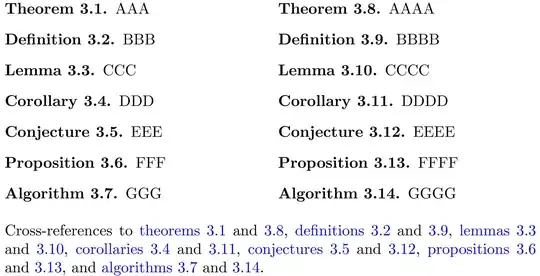
Observe that all cross-references were generated with a single \cref statement.
\documentclass{article} % or some other suitable document class
\usepackage{multicol}
\usepackage{amsthm} % for '\theoremstyle' and '\newtheorem' macros
\usepackage[colorlinks,allcolors=blue]{hyperref}
\usepackage[nameinlink,noabbrev]{cleveref}
% The following \crefname declarations are needed only
% if your cross-references contain plural items
\crefname{thm}{theorem}{theorems}
\crefname{defn}{definition}{definitions}
\crefname{lem}{lemma}{lemmas} % or 'lemmata'?
\crefname{cor}{corollary}{corollaries}
\crefname{conj}{conjecture}{conjectures}
\crefname{prop}{proposition}{propositions}
\crefname{alg}{algoirithm}{algorithms}
\theoremstyle{definition}
\newtheorem{thm}{Theorem}[section]
\newtheorem{defn}[thm]{Definition}
\newtheorem{lem}[thm]{Lemma}
\newtheorem{cor}[thm]{Corollary}
\newtheorem{conj}[thm]{Conjecture}
\newtheorem{prop}[thm]{Proposition}
\newtheorem{alg}[thm]{Algorithm}
\begin{document}
\setcounter{section}{3}
\begin{multicols}{2}
\begin{thm} AAA \label{thm:aaa} \end{thm}
\begin{defn} BBB \label{defn:bbb} \end{defn}
\begin{lem} CCC \label{lem:ccc} \end{lem}
\begin{cor} DDD \label{cor:ddd} \end{cor}
\begin{conj} EEE \label{conj:eee} \end{conj}
\begin{prop} FFF \label{prop:fff} \end{prop}
\begin{alg} GGG \label{alg:ggg} \end{alg}
\begin{thm} AAAA \label{thm:aaaa} \end{thm}
\begin{defn} BBBB \label{defn:bbbb} \end{defn}
\begin{lem} CCCC \label{lem:cccc} \end{lem}
\begin{cor} DDDD \label{cor:dddd} \end{cor}
\begin{conj} EEEE \label{conj:eeee} \end{conj}
\begin{prop} FFFF \label{EulersTheorem} \end{prop}
\begin{alg} GGGG \label{alg:gggg} \end{alg}
\end{multicols}
\noindent
Cross-references to
\cref{thm:aaa,defn:bbb,lem:ccc,cor:ddd,conj:eee,prop:fff,alg:ggg,%
thm:aaaa,defn:bbbb,lem:cccc,cor:dddd,conj:eeee,EulersTheorem,alg:gggg}.
\end{document}


\label{}within thepropenvironment and refer to it using\ref{}. Search for cross reference. It is powerful. – Sigur Dec 31 '21 at 00:52\label{<name>}within the environment (if you put it at the beginning, it will be easy to find later) will allow you to use\ref{<name>}from anywhere else in your document; you will have to process the document twice to resolve the reference. You might also find it helpful to read the document foramsthm--texdoc amsthdoc. – barbara beeton Dec 31 '21 at 00:57\begin{document}. They should be before it, in the preamble. – barbara beeton Dec 31 '21 at 00:59cleverefpackage to do what you wish about the Prop. names. – Sigur Dec 31 '21 at 01:00amsthm, notamsmath. I've edited the tags accordingly. – barbara beeton Dec 31 '21 at 01:57