It seems that your question is duplicate to how-to-influence-the-position-of-float-environments. Anyway, due to specific of your question (which is not very clear), some possibilities are summarized below.
In the first, advantage of float environments are that they can float! It is not a sin, if for better looking of document, image is moved after some section title :-).
From use of the figure* environment can be concluded that you use two column article and that you like to span figures over both columns. In this case figure* only supports [tp] (see @John Kormylo comment) and will always appear on the top of the next page (consequently you can float's omit placeholder):
\documentclass[twocolumn]{article}
\usepackage{graphicx}
\usepackage{multicol}
\usepackage{lipsum}
\begin{document}
\lipsum[1-3]
\begin{figure}
\centering
\includegraphics[height=33mm,width=\linewidth]{example-image-A}
  \caption{fig: title of figure}
\end{figure}
\begin{figure}
\centering
\includegraphics[height=33mm,width=\linewidth]{example-image-B}
  \caption{Figure: title of figure}
\end{figure}
\section{Discussion}
\lipsum[4-5]
\section{Conclusion and future work}
\lipsum[6-7]
\end{document}

In the case that you estimate, that at bottom of page is sufficient space, it will be placed here by help of package stfloats:
\documentclass[twocolumn]{article}
\usepackage{graphicx}
\usepackage{multicol}
\usepackage{stfloats}   % <---
\usepackage{lipsum}
\begin{document}
\lipsum[1]
\begin{figure}[b]
\centering
\includegraphics[height=33mm,width=\linewidth]{example-image-A}
  \caption{fig: title of figure}
\end{figure}
\begin{figure}[b]
\centering
\includegraphics[height=33mm,width=\linewidth]{example-image-B}
  \caption{Figure: title of figure}
\end{figure}
\lipsum[1-3]
\section{Discussion}
\lipsum[4-5]
\section{Conclusion and future work}
\lipsum[6-7]
\end{document}
As you see, here images are inserted earlier in text that in page is sufficient space for them. This "trick" is handy in the many cases.

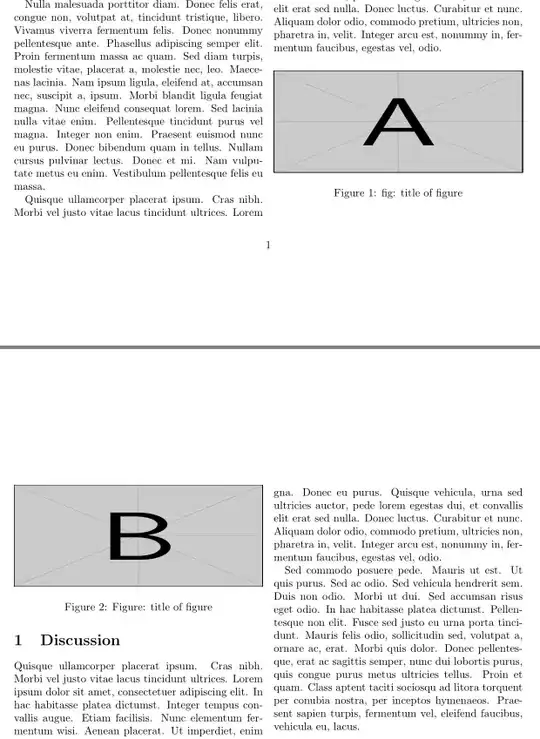
However, in the case of use figure, i.e. that images widths are equal to column width, than you can use figure placement specifier for example htb and newer just [h]. In later case can happen that TeX will push figure on the end of document if in text is not enough space at point of insertion.
\documentclass[twocolumn]{article}
\usepackage{graphicx}
\usepackage{multicol}
\usepackage{lipsum}
\begin{document}
\lipsum[1-6]
\begin{figure}[ht] % <---
\centering
\includegraphics[height=33mm,width=\linewidth]{example-image-A}
  \caption{fig: title of figure}
\end{figure}
\begin{figure}[ht]
\centering
\includegraphics[height=33mm,width=\linewidth]{example-image-B}
  \caption{Figure: title of figure}
\end{figure}
\section{Discussion}
\lipsum[4-5]
\section{Conclusion and future work}
\lipsum[6-7]
\end{document}


Hnoth, but it's worth taking the time to read the reasons for not doing this. – Ian Thompson Jan 19 '22 at 22:40\rule{4cm}{4cm}in place of the\includegraphicscommands, and change the sizes as necessary. – Ian Thompson Jan 19 '22 at 22:54