0

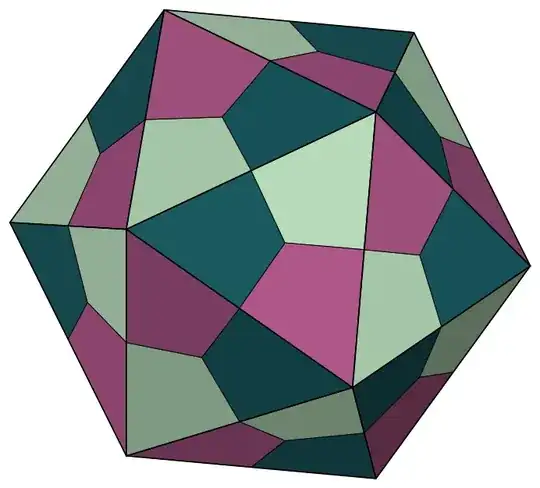
I would like to draw something like this by using TikZ. Here I have found several answers on how to draw such a Platonic solid but no one has the faces divided like this. I do not really care about colours. What really matters to me is to draw such icosahedron as an origami like the picture below. Here I've found a way fro drawing an icosahedron but without subdivision of the faces.

How can I do?

Thanks!

enter image description here

InsideOut
  • 169
  • 1
    The shapes that each face is divided into are definitely not triangles. – Henri Menke Jan 21 '22 at 16:18
  • If you're drawing in 3D with coordinates, it should not be very difficult to find the faces centres and the edges middles. – SebGlav Jan 21 '22 at 17:01
  • @HenriMenke you’re right, the title is kinda misleading. For any face, a “kite” shape is the union of two triangles. So if I find a way to draw 6 right-angle triangles in each face then I can color them to obtain somewhat like in the picture. – InsideOut Jan 21 '22 at 17:13
  • @SebGlav where I can learn how to use 3D coordinates? – InsideOut Jan 21 '22 at 17:14
  • Actually no because the faces are not triangulated or divided in 3 “kites” as in the picture. – InsideOut Jan 21 '22 at 17:30
  • 2
    I see the question was closed. However, the cited duplicate, in my mind, does not address the issue of subdivided facets. If you also believe the cited duplicate does not answer your question, reply to me, and I will vote to reopen the question. If the cited duplicate provided you enough information to proceed, we will let things sit. – Steven B. Segletes Jan 21 '22 at 20:42
  • 1
    @StevenB.Segletes thanks for the comment. Indeed the cited duplicated doesn’t help me. I mean, I saw that post and but as you said it doesn’t address of subdivided faces. – InsideOut Jan 21 '22 at 21:01
  • I suggest you upvote {click the up arrow) next to my prior comment, so that readers will see it as the question loads. – Steven B. Segletes Jan 21 '22 at 21:05
  • I can't help with tikz, but the title might be improved, e.g., "... icosahedron with each face divided into three equal parts". – barbara beeton Jan 21 '22 at 21:47
  • @ínideOut What is the name of polyhedron? – minhthien_2016 Jan 21 '22 at 23:52

1 Answers1

2

You can find the needed points in each triangle with the calc library: they are the midpoint of each edge and the centroid of the triangles. Then you can make a macro to draw a triangle with those divisions.

Something like this:

\documentclass[tikz,border=2mm]{standalone}
\usetikzlibrary{calc,perspective}

\definecolor{color1}{HTML}{1A5960} \definecolor{color2}{HTML}{B7DAB9} \definecolor{color3}{HTML}{AE5689}

\newcommand{\mytriangle}[4] % 3 poiints, 'shadow' opacity { \coordinate (center) at ($1/3(#1)+1/3(#2)+1/3*(#3)$); \coordinate (m12) at ($(#1)!0.5!(#2)$); \coordinate (m13) at ($(#1)!0.5!(#3)$); \coordinate (m23) at ($(#2)!0.5!(#3)$); \draw[fill=color1] (center) -- (m12) -- (#1) -- (m13) -- cycle; \draw[fill=color2] (center) -- (m12) -- (#2) -- (m23) -- cycle; \draw[fill=color3] (center) -- (m13) -- (#3) -- (m23) -- cycle; \draw[thick,fill=black,fill opacity=#4] (#1) -- (#2) -- (#3) -- cycle; }

\begin{document} \begin{tikzpicture}[line cap=round,line join=round,3d view={40}{35}] % Dimensiones \pgfmathsetmacro\ph{(1+sqrt(5))/2} % golden ratio \pgfmathsetmacro\ed{3} % edge (half) \pgfmathsetmacro\hh{\ed*\ph} % height (half) % Vértices \coordinate (A1) at ( \hh,-\ed, 0); \coordinate (B1) at ( \hh, \ed, 0); \coordinate (C1) at (-\hh, \ed, 0); \coordinate (D1) at (-\hh,-\ed, 0); \coordinate (A2) at ( \ed, 0,-\hh); \coordinate (B2) at (-\ed, 0,-\hh); \coordinate (C2) at (-\ed, 0, \hh); \coordinate (D2) at ( \ed, 0, \hh); \coordinate (A3) at ( 0, \hh,-\ed); \coordinate (B3) at ( 0, \hh, \ed); \coordinate (C3) at ( 0,-\hh, \ed); \coordinate (D3) at ( 0,-\hh,-\ed); % Faces \mytriangle{A2}{A1}{D3}{0.4}; \mytriangle{A1}{B1}{A2}{0.5}; \mytriangle{D1}{C3}{D3}{0.2}; \mytriangle{A1}{D3}{C3}{0.3}; \mytriangle{C3}{D2}{A1}{0.0}; \mytriangle{B1}{A1}{D2}{0.1}; \mytriangle{D2}{B3}{B1}{0.3}; \mytriangle{C2}{D1}{C3}{0.2}; \mytriangle{D2}{C3}{C2}{0.1}; \mytriangle{B3}{C2}{D2}{0.2}; \end{tikzpicture} \end{document}
enter image description here

Juan Castaño
  • 28,426