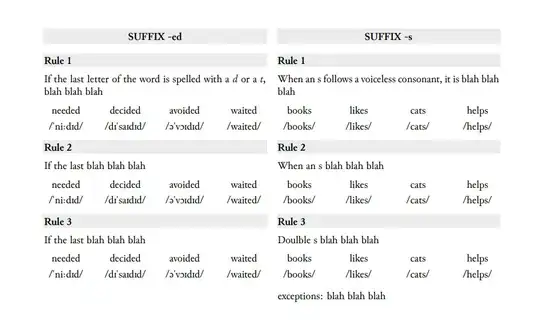
A solution with tabularray.
Since you didn't provide an MWE, for convenience I used "blah" and didn't write the correct phonetic symbols and words.
\documentclass{article}
\usepackage{tabularray}
\usepackage{xcolor}
% code from https://tex.stackexchange.com/a/400676/101651
\usepackage{fontspec}
\setmainfont{Junicode} % or any other font that provides the glyphs
\begin{document}
\begin{table}\footnotesize
\begin{tblr}{
    colspec={*8{X[c]}},
    cell{1}{1,5}={c=4}{c, font=\normalfont\bfseries, bg=lightgray!30},
    cell{2,6,10}{1,5}={c=4}{l, font=\bfseries, bg=lightgray!30},
    cell{3,7,11,14}{1,5}={c=4}{j},
    hspan=minimal,
    vline{5}={wd=7pt, white},
    hline{2}={wd=7pt, white},
    row{1}={rowsep=3pt},
    row{2,6,10}={rowsep=2pt},
    row{3,7,11}={rowsep=6pt},
    row{5,9,13}={belowsep=6pt},
    stretch=0,
    column{1,5}={leftsep=1pt},
    column{4,Z}={rightsep=1pt},
    }
    SUFFIX -ed &&&& SUFFIX -s &&&\
    Rule 1 &&&& Rule 1 &&&\
    If the last letter of the word is spelled with a \emph{d} or a \emph{t}, blah blah blah &&&& When an s follows a voiceless consonant, it is blah blah blah &&&\
    needed &  decided & avoided & waited & books & likes & cats & helps\
    /ˈniːdɪd/ & /dɪˈsaɪdɪd/ & /əˈvɔɪdɪd/ & /waited/ & /books/ & /likes/ & /cats/ & /helps/\
    Rule 2 &&&& Rule 2 &&&\
    If the last blah blah blah &&&& When an s blah blah blah &&&\
    needed &  decided & avoided & waited & books & likes & cats & helps\
    /ˈniːdɪd/ & /dɪˈsaɪdɪd/ & /əˈvɔɪdɪd/ & /waited/ & /books/ & /likes/ & /cats/ & /helps/\
    Rule 3 &&&& Rule 3 &&&\
    If the last blah blah blah &&&& Doulble s blah blah blah &&&\
    needed &  decided & avoided & waited & books & likes & cats & helps\
    /ˈniːdɪd/ & /dɪˈsaɪdɪd/ & /əˈvɔɪdɪd/ & /waited/ & /books/ & /likes/ & /cats/ & /helps/\
    &&&& exceptions: blah blah blah &&&\
\end{tblr}
\end{table}
\end{document}


tabularx? – Zoltan King Mar 10 '22 at 17:10{}icon. Unrelated: your rule 3 for –s has nothing to do with –s, Don't you want something about the pronunciation of –s after /s/, /z/, /ʃ/, /ʒ/, /tʃ/ and /dʒ/ instead? – Alan Munn Mar 10 '22 at 19:50