11

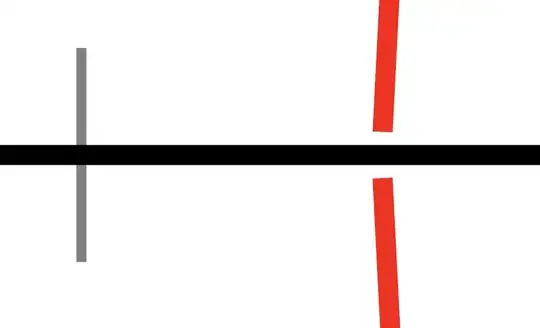
I'm trying to plot an elliptic curve but it leaves a weird "gap". I have tried different values for the domain but the gap remains.

    \begin{tikzpicture}
        \begin{axis}[
            xmin=-2.5,
            xmax=3,
            ymin=-5,
            ymax=5,
            xlabel={$x$},
            ylabel={$y$},
            scale only axis,
            axis lines=middle,
            domain=-1.71:3,
            samples=200,
            smooth,
            % to avoid that the "plot node" is clipped (partially)
            clip=false,
            % use same unit vectors on the axis
            axis equal image=true,
        ]
            \addplot [red] {sqrt(x^3+5)};
            \addplot [red] {-sqrt(x^3+5)};
    \end{axis}

\end{tikzpicture}

pic

Ingmar
  • 6,690
  • 5
  • 26
  • 47

4 Answers4

13

You get

NOTE: coordinate (2Y1.71e0],3Y0.0e0]) has been dropped because it is unbounded
(in y). (see also unbounded coords=jump).
NOTE: coordinate (2Y1.71e0],3Y0.0e0]) has been dropped because it is unbounded
(in y). (see also unbounded coords=jump).

Compute the cube root of 5 like TikZ would.

\documentclass{article}
\usepackage{pgfplots}

\pgfplotsset{compat=1.18}

\begin{document}

\begin{tikzpicture} \pgfmathsetmacro{\cuberootoffive}{exp(ln(5)/3)} \begin{axis}[ xmin=-2.5, xmax=3, ymin=-5, ymax=5, xlabel={$x$}, ylabel={$y$}, scale only axis, axis lines=middle, domain=-\cuberootoffive:3, samples=200, smooth, % to avoid that the "plot node" is clipped (partially) clip=false, % use same unit vectors on the axis axis equal image=true, ] \addplot [red] {sqrt(x^3+5)}; \addplot [red] {-sqrt(x^3+5)}; \end{axis} \end{tikzpicture}

\end{document}
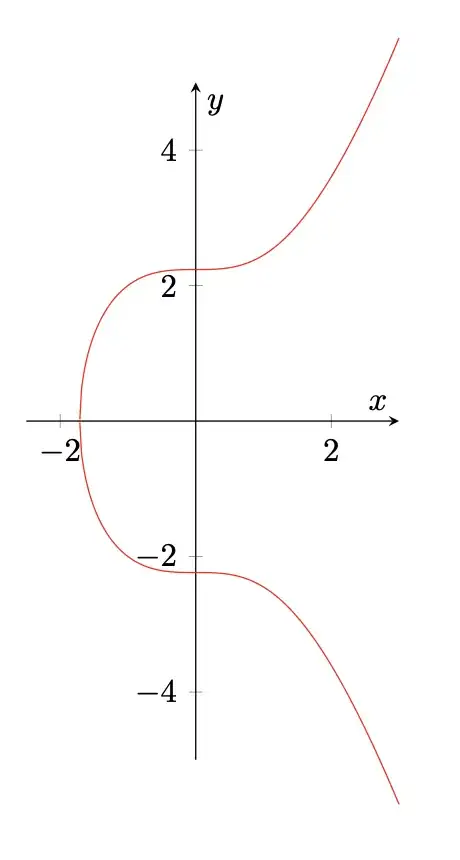
enter image description here

There is still a tiny gap, though:

enter image description here

No gap with xfp and the graph is actually correct.

\documentclass{article}
\usepackage{pgfplots}
\usepackage{pgfmath-xfp,xfp}

\pgfplotsset{compat=1.18}

\begin{document}

\begin{tikzpicture} \edef\cuberootoffive{\fpeval{exp(ln(5)/3)}} \pgfmxfpdeclarefunction{cubic}{1}{sqrt((#1)^3+5)} \begin{axis}[ xmin=-2.5, xmax=3, ymin=-5, ymax=5, xlabel={$x$}, ylabel={$y$}, scale only axis, axis lines=middle, domain=-\cuberootoffive:3, samples=200, smooth, % to avoid that the "plot node" is clipped (partially) clip=false, % use same unit vectors on the axis axis equal image=true, ] \addplot [red] {cubic(x)}; \addplot [red] {-cubic(x)}; \end{axis} \end{tikzpicture}

\end{document}
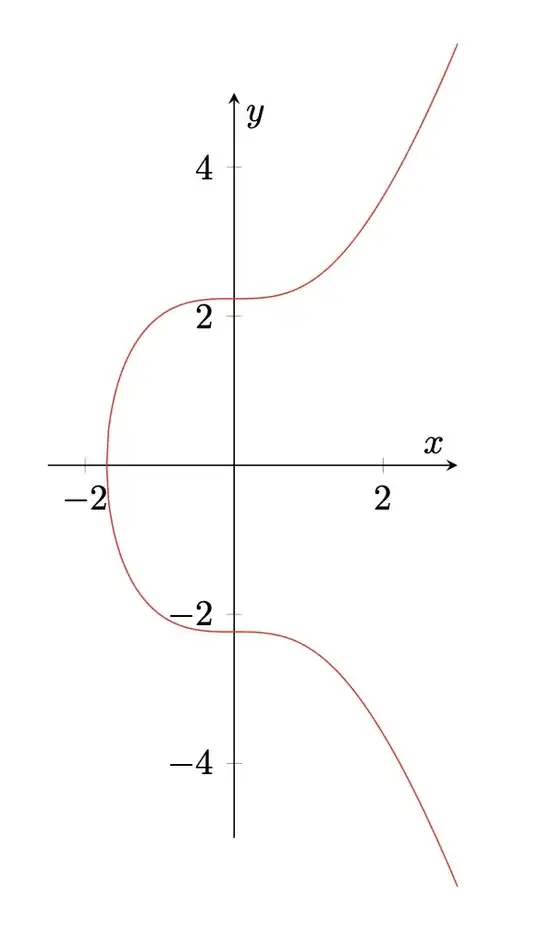
enter image description here

enter image description here

egreg
  • 1,121,712
  • +1: Is the xfp package "only" needed for the domain calculation? – Dr. Manuel Kuehner Apr 05 '22 at 17:33
  • @Dr.ManuelKuehner Yes. But in a short time it will no longer be needed. – egreg Apr 05 '22 at 17:34
  • Ok, I saw the message "From 2022-06-01 release of LATEX this will be included in the format so that the package doesn't need loading any longer." – Dr. Manuel Kuehner Apr 05 '22 at 17:35
  • Hm, compile time takes quite a hit from using xfp. On average 883.1 ms for xfp vs. 627.6 ms for pgfmath. – Henri Menke Apr 05 '22 at 17:44
  • 1
    @HenriMenke That's true. But what about getting the right output instead of a faulty one? :-) – egreg Apr 05 '22 at 17:45
  • @egreg Plots requiring high accuracy should just not be done in TeX in the first place. I used to plot everything in TeX as well, but at some point got tired of compile times of the order of 5 minutes and just switch to gnuplot. – Henri Menke Apr 05 '22 at 17:48
10

You can plot implicit functions curves with the pstricks package pst-func. Here is a code for that:

    \documentclass[svgnames, pstricks, border=10pt]{standalone}
    \usepackage{pst-plot,pst-func }
\begin{document}

\begin{pspicture*}(-3,-5)(3,5)
\psset{plotpoints=4000, showorigin=false, arrowinset=0.12, linejoin=1}
\psaxes[labelFontSize=\scriptstyle,ticksize=0 4pt, Dx=2, Dy=2]{->}(0,0)(-3,-5)(3,5)[$x$,-120][$y$,210]
\psplotImp[algebraic, linecolor=Tomato, linewidth=1.2pt](-4,-6)(4,6){x^3-y^2 + 5}
\end{pspicture*}

\end{document} 

enter image description here

Bernard
  • 271,350
6

Here is an Asymptote drawing for that implicit function. Also see this answer.

enter image description here

// Run on http://asymptote.ualberta.ca/
unitsize(1cm);
import contour;
import graph;
real f(real x, real y) { return y^2-x^3; }
pair A=(-2.5,-5), B=(3,5);
limits(A,B);
guide[][] g = contour(f,A,B, new real[] {5});
draw(g[0],blue+1pt);

real[] x={-2,2}; real[] y={-4,-2,2,4}; xaxis(Label("$x$",EndPoint,align=N),Ticks(x,1mm,red)); yaxis(Label("$y$",EndPoint,align=E),Ticks(y,1mm,red));

shipout(bbox(5mm,invisible));

Black Mild
  • 17,569
4

As pgfplots cannot (as far as I can see?) plot implicit curve, you have to manually parametrize it (or switch to another package like explained in the other answer), and if you want good curve you have to find good parametrization.

In this case, let the parameter be the variable y works better:

%! TEX program = lualatex
\documentclass{article}

\usepackage{pgfplots} \pgfplotsset{compat=1.12}

\begin{document} \begin{tikzpicture} \begin{axis}[ xmin=-2.5, xmax=3, ymin=-5, ymax=5, xlabel={$x$}, ylabel={$y$}, scale only axis, axis lines=middle, smooth, % to avoid that the "plot node" is clipped (partially) clip=false, % use same unit vectors on the axis axis equal image=true ] \addplot [variable=t, domain=-5:5, samples=50, red] ({abs(t^2-5)^0.333333333333*sign(t^2-5)}, {t}); \end{axis} \end{tikzpicture} \end{document}
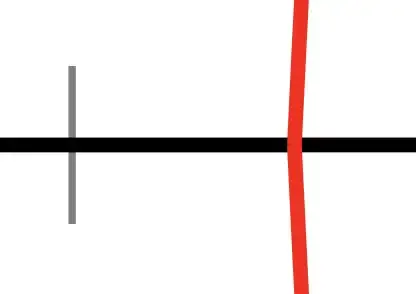
Reference: https://tex.stackexchange.com/a/582731/250119 (manual parametrization example) How can I draw an implicit equation with pgfplots? (how to cube root) Using pgfplots to create 2-D parameterized parametric plot (how to plot parametrized)

user202729
  • 7,143