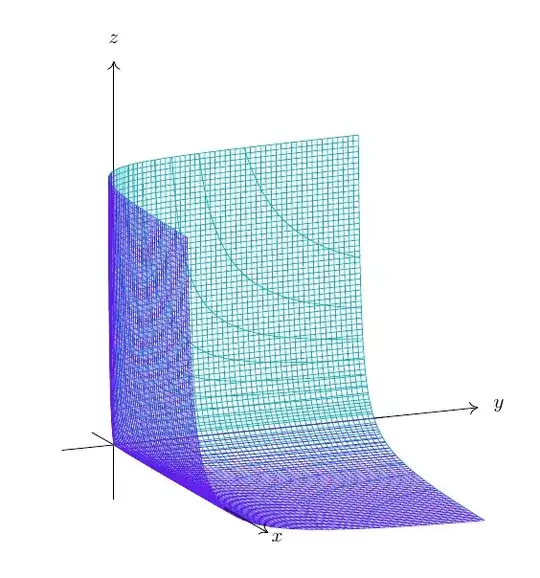
I think that implicit surfaces can be sketched in TikZ when the level curves (or other hyperplane sections) can be drawn. For the surface xyz - x - y - z + 2 = 0 (in fact for any value of theta in the question), the level curves are hyperbolas and it is not difficult to draw them.
Some comments
I changed the coordinates as to have the singular point at the origin, i.e. I considered the surface defined by xyz + xy + yz + zx = 0. It is only a translation of the previous one.
Looking at the example that it was given, I represented only a "sheet" of the surface; explicitly I considered the portion of the surface living in the cube [-1, 5]^3 and which is swept out by only one branch of each z=h hyperbola.
For z=0 the hyperbola degenerates into the union of two lines. For z=-1 it degenerates again into two lines, but one is at infinity. For these reasons, the drawing of the level curve depends on the sign of z. In the neighborhood of -1 things are more subtle since the limits of TikZ are easily reached. For example, if the first \foreach is performed for \i=1 or \i=2, the curves obtained are not "real" (or at least the intended ones).
The code might seem long, but what counts are the first two \foreach commands that draw the z=h level curves. Afterwards, they are just copied and modified in order to obtain the x=h and y=h level curves.
Each branch of a hyperbola is drawn as a parametrized curve; the bounds of the parameter are computed to obtain only the portion inside the cube.
The code
\documentclass[margin=.5cm]{standalone}
\usepackage{tikz}
\usetikzlibrary{math}
\usepackage{tikz-3dplot}
\usetikzlibrary{3d}
\usetikzlibrary{arrows.meta}
\begin{document}
\xdefinecolor{Cy}{RGB}{17, 170, 187}
\xdefinecolor{VB}{RGB}{102, 25, 240}
\tikzmath{
  integer \N-, \N+;
  \N- = 12;
  \N+ = 50;
  real \a;
  \a = 5;
}
\tikzset{
  pics/level curve+/.style args={height=#1, varbound=#2, color=#3}{%
    code={%
      \draw[#3, variable=\t, domain=-#2:#2, samples=40]
      plot ({#1/(#1 +1)(exp(\t) -1)}, {#1/(#1 +1)(exp(-\t) -1)});
    }
  },
  pics/level curve-/.style args={height=#1, varbound=#2, color=#3}{%
    code={%
      \draw[#3, variable=\t, domain=-#2:#2, samples=40]
      plot ({-#1/(#1 +1)(exp(\t) +1)}, {-#1/(#1 +1)(exp(-\t) +1)});
    }
  }
}
\begin{tikzpicture}
  \tdplotsetmaincoords{76}{67}
  \begin{scope}[tdplot_main_coords]
    % axes first part
    \draw (-1, 0, 0) -- (\a +.2, 0, 0);
    \draw (0, -1, 0) -- (0, \a +.2, 0);
    \draw (0, 0, -1) -- (0, 0, \a +.2);
%%% $z=h$ level curves
% close to $0^-$
\foreach \i
[evaluate=\i as \h using {-(\N- +1 -\i)/(\N- +1))*\a/(\a +1)},
evaluate=\i as \b using {ln(-(\h +1)*\a/\h -1)}]
in {1, 2, 3, 4, ..., \N-}{
  \path[canvas is xy plane at z=\h, transform shape] (0, 0)
  pic {level curve-={height=\h, varbound=\b, color=Cy}};
}

% $h=0$
\draw[Cy, canvas is xy plane at z=0] (0, \a) |- (\a, 0);

% $h>0$
\foreach \i
[evaluate=\i as \h using {(\i/\N+)*\a},
evaluate=\i as \b using {ln((\h +1)*\a/\h +1)}]
in {1, 2, ..., \N+}{
  \path[canvas is xy plane at z=\h, transform shape] (0, 0)
  pic {level curve+={height=\h, varbound=\b, color=Cy}};
}

%%% $y=h$ level curves
% close to $0^-$
\foreach \i
[evaluate=\i as \h using {-(\N- +1 -\i)/(\N- +1))*\a/(\a +1)},
evaluate=\i as \b using {ln(-(\h +1)*\a/\h -1)}]
in {3, 4, ..., \N-}{
  \path[canvas is xz plane at y=\h, transform shape] (0, 0)
  pic {level curve-={height=\h, varbound=\b, color=Cy}};
}

% $h=0$
\draw[Cy, thin, canvas is xz plane at y=0] (0, \a) |- (\a, 0);

% $h>0$
\foreach \i
[evaluate=\i as \h using {(\i/\N+)*\a},
evaluate=\i as \b using {ln((\h +1)*\a/\h +1)}]
in {1, 2, ..., \N+}{
  \path[canvas is xz plane at y=\h, transform shape] (0, 0)
  pic {level curve+={height=\h, varbound=\b, color=Cy}};
}

%%% $x=h$ level curves
% close to $0^-$
\foreach \i
[evaluate=\i as \h using {-(\N- +1 -\i)/(\N- +1))*\a/(\a +1)},
evaluate=\i as \b using {ln(-(\h +1)*\a/\h -1)}]
in {3, 4, ..., \N-}{
  \path[canvas is yz plane at x=\h, transform shape] (0, 0)
  pic {level curve-={height=\h, varbound=\b, color=Cy}};
}

% $h=0$
\draw[VB, canvas is yz plane at x=0] (0, \a) |- (\a, 0);

% $h>0$
\foreach \i
[evaluate=\i as \h using {(\i/\N+)*\a},
evaluate=\i as \b using {ln((\h +1)*\a/\h +1)}]
in {1, 2, ..., \N+}{
  \path[canvas is yz plane at x=\h, transform shape] (0, 0)
  pic {level curve+={height=\h, varbound=\b, color=VB}};
}

%%% axes second part
\begin{scope}[arrows={->[length=1ex, width=1.5ex]}]
  \draw (\a, 0, 0) -- (\a +2, 0, 0)  node[pos=1.2] {$x$};
  \draw (0, \a, 0) -- (0, \a +2, 0)  node[pos=1.2] {$y$};
  \draw (0, 0, \a) -- (0, 0, \a +2)  node[pos=1.2] {$z$};
\end{scope}

\end{scope}
\end{tikzpicture}
\end{document}


