For long texts, balancing the quotation marks visually with the text can be done with a tabular or similar; and short texts can switch to their natural width.
Here, in expl3 as a mini-demo:
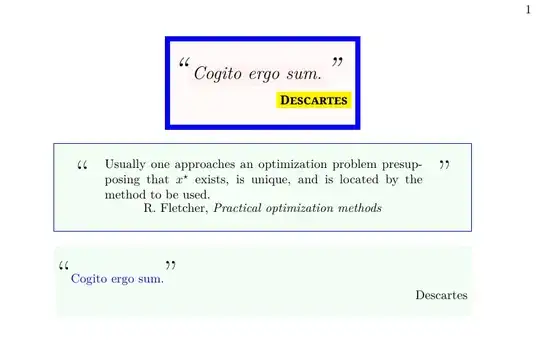
etc.
Expl3 can use keys, so allowing almost anything to become an option-setting parameter, but at some point the number of combinations and permutations in their interactions with each other becomes so exceedingly large that the ordinary mind cannot easily grasp them all in one go.
tcolorbox is more powerful, though, as it uses TikZ.
MWE
\documentclass{book}
\usepackage{geometry}
\usepackage{csquotes}
\usepackage{xcolor}
\usepackage{xparse}
\usepackage{fontspec}
\newfontfamily\fnserif{Noto Serif}
\ExplSyntaxOn
\keys_define:nn { pdqb }
{
framecolour .tl_set:c = { l_pd_framecolour_tl },
framecolour .default:n = { blue }, % name only is given
framecolour .initial:n = { blue },   % no key
%
frameboxcolour .tl_set:c = { l_pd_frameboxcolour_tl },
frameboxcolour .default:n = { blue!15!green!5 },
frameboxcolour .initial:n = { blue!15!green!5 },

%
outermpwidth .dim_set:c = { l_pd_outermpwidth_dim },
outermpwidth .default:n = { 0.95\linewidth },
outermpwidth .initial:n = { 0.95\linewidth },

%
innermpwidth .dim_set:c = { l_pd_innermpwidth_dim },
innermpwidth .default:n = { 0.95\linewidth },
innermpwidth .initial:n = { 0.95\linewidth },

%
usephrasewidth .bool_set:c = { l_pd_usephrasewidth_bool },
usephrasewidth .default:n = { false },
usephrasewidth .initial:n = { false },

%
usephraseouterwidth .bool_set:c = { l_pd_usephraseouterwidth_bool },
usephraseouterwidth .default:n = { false },
usephraseouterwidth .initial:n = { false },

%
topmargin .dim_set:c = { l_pd_topmargin_dim },
topmargin .default:n = { 10pt },
topmargin .initial:n = { 10pt },

%
bottommargin .dim_set:c = { l_pd_bottommargin_dim },
bottommargin .default:n = { 10pt },
bottommargin .initial:n = { 10pt },

%
middlemargin .dim_set:c = { l_pd_middlemargin_dim },
middlemargin .default:n = { 10pt },
middlemargin .initial:n = { 10pt },

%
middlebreak .tl_set:c = { l_pd_middlebreak_tl },
middlebreak .default:n = { \smallbreak },
middlebreak .initial:n = { \smallbreak },

%
lqformat .tl_set:c = { l_pd_lqformat_tl },
lqformat .default:n = { \Huge },
lqformat .initial:n = { \Huge },

%
rqformat .tl_set:c = { l_pd_rqformat_tl },
rqformat .default:n = { \Huge },
rqformat .initial:n = { \Huge },

%
lqmark .tl_set:c = { l_pd_lqmark_tl },
lqmark .default:n = { }, lqmark .initial:n = { },

%
rqmark .tl_set:c = { l_pd_rqmark_tl },
rqmark .default:n = { '' },
rqmark .initial:n = { '' },

%
leftouterformat .tl_set:c = { l_pd_leftouterformat_tl },
leftouterformat .default:n = { \begin{center} },
leftouterformat .initial:n = { \begin{center} },

%
rightouterformat .tl_set:c = { l_pd_rightouterformat_tl },
rightouterformat .default:n = { \end{center} },
rightouterformat .initial:n = { \end{center} },

%
leftinnerformat .tl_set:c = { l_pd_leftinnerformat_tl },
leftinnerformat .default:n = { \center },
leftinnerformat .initial:n = { \center },

%
rightinnerformat .tl_set:c = { l_pd_rightinnerformat_tl },
rightinnerformat .default:n = {  },
rightinnerformat .initial:n = {  },

%
leftsourceformat .tl_set:c = { l_pd_leftsourceformat_tl },
leftsourceformat .default:n = {  },
leftsourceformat .initial:n = {  },

%
rightsourceformat .tl_set:c = { l_pd_rightsourceformat_tl },
rightsourceformat .default:n = {  },
rightsourceformat .initial:n = {  },

%
boxrule .dim_set:c = { l_pd_boxrule_dim },
boxrule .default:n = { 0.2pt },
boxrule .initial:n = { 0.2pt },

%
boxsep .dim_set:c = { l_pd_boxsep_dim },
boxsep .default:n = { 3pt },
boxsep .initial:n = { 3pt },

%
leftquoteformat .tl_set:c = { l_pd_leftquoteformat_tl },
leftquoteformat .default:n = {  },
leftquoteformat .initial:n = {  },

%
rightquoteformat .tl_set:c = { l_pd_rightquoteformat_tl },
rightquoteformat .default:n = {  },
rightquoteformat .initial:n = {  },

}
\tl_new:N \l_pd_thequote_tl
%-----------------------------
    \cs_set:Npn \pd_funcqbox:nn #1#2 {
                \bool_if:cTF
                            { l_pd_usephrasewidth_bool }
                            {
                \tl_set:Nn
                        \l_pd_thequote_tl
                        {
%                            \begin{tabular}{ccc}
                                {
                                    \tl_use:c { l_pd_lqformat_tl }
                                    \tl_use:c { l_pd_lqmark_tl }
                                    }
%                           &

                                {
%                                \begin{minipage}{0.82\linewidth}
                                \tl_use:c { l_pd_leftquoteformat_tl }

                                { #1 }
                                \tl_use:c { l_pd_rightquoteformat_tl }

%                                    \end{minipage}
                                 }
%                           &

                                {
                                        \tl_use:c { l_pd_rqformat_tl }
                                        \tl_use:c { l_pd_rqmark_tl }
                                }
%                          \
%                          \end{tabular}

                        }
                        }%T bool
                        {
                \tl_set:Nn
                        \l_pd_thequote_tl
                        {
                             \begin{tabular}{ccc}
                                {
                                    \tl_use:c { l_pd_lqformat_tl }
                                    \tl_use:c { l_pd_lqmark_tl }
                                    }
                           &

                                {
                                \begin{minipage}{0.82\linewidth}
                                \tl_use:c { l_pd_leftquoteformat_tl }

                                { #1 }
                                \tl_use:c { l_pd_rightquoteformat_tl }

                                 \end{minipage}
                                 }
                           &

                                {
                                        \tl_use:c { l_pd_rqformat_tl }
                                        \tl_use:c { l_pd_rqmark_tl }
                                }
                          \
                          \end{tabular}

                        }
                        }%F bool
            %--- inner
            \bool_if:cT
                        { l_pd_usephrasewidth_bool }
                        {
                            \tl_set:Nn
                                    \l_tmpa_tl
                                    {
                                            \tl_use:N
                                                    \l_pd_thequote_tl
                                     }
                            \hbox_set:Nn
                                    \l_tmpa_box
                                    { \l_tmpa_tl }
                            \dim_set:cn
                                    { l_pd_innermpwidth_dim }
                                    {
                                        \box_wd:N \l_tmpa_box
                                    }
                        }
            %--- outer
            \bool_if:cT
                        { l_pd_usephraseouterwidth_bool }
                        {
                            \tl_set:Nn
                                    \l_tmpa_tl
                                    {
                                            \tl_use:N
                                                    \l_pd_thequote_tl
                                     }
                            \hbox_set:Nn
                                    \l_tmpa_box
                                    { \l_tmpa_tl }
                            \dim_set:cn
                                    { l_pd_outermpwidth_dim }
                                    {
                                        \box_wd:N \l_tmpa_box
                                        + 4em
                                    }
                        }
            %===
            \group_begin:

                    \setlength{\fboxrule}{ \dim_use:c { l_pd_boxrule_dim } }
                    \setlength{\fboxsep}{ \dim_use:c { l_pd_boxsep_dim } }

    \tl_use:c { l_pd_leftouterformat_tl }
                \fcolorbox
                            { \tl_use:c { l_pd_framecolour_tl } }
                            { \tl_use:c { l_pd_frameboxcolour_tl } }
                            {
            \begin{minipage}
                    { \dim_use:c { l_pd_outermpwidth_dim } }
                    \vspace{ \dim_use:c { l_pd_topmargin_dim } }
                    \tl_use:c { l_pd_leftinnerformat_tl }
                    \begin{minipage}
                                { \dim_use:c { l_pd_innermpwidth_dim } }
                                                                    \tl_use:N
                                                                                \l_pd_thequote_tl
                    \end{minipage}
                    \tl_use:c { l_pd_rightinnerformat_tl }

                                                \tl_use:c { l_pd_middlebreak_tl }

                                                        \tl_use:c { l_pd_leftsourceformat_tl }
                    {#2}
                   \tl_use:c { l_pd_rightsourceformat_tl }

                    \vspace{ \dim_use:c { l_pd_bottommargin_dim } }
            \end{minipage}}
    \tl_use:c { l_pd_rightouterformat_tl }
    \group_end:

}
\NewDocumentCommand{\pdquotebox}{ o +m +m  }{
        %---
    \group_begin:
  \IfNoValueF { #1 }
{
    \keys_set:nn { pdqb } { #1 }
    }

        \pd_funcqbox:nn { #2 } { #3 }
        \group_end:

}
\ExplSyntaxOff
\begin{document}
\pdquotebox[
usephrasewidth=true,
usephraseouterwidth=true,
%middlebreak={\ \vspace{0pt}},
%rqformat={\color{red}},
%rqmark={ \ xxx },
%leftouterformat={\itshape\Large},
%rightouterformat={\upshape\normalsize},
leftinnerformat={\Large\itshape},
rightinnerformat={\upshape\normalsize},
leftsourceformat={\hfill\fnserif\bfseries\scshape\colorbox{yellow}},
leftquoteformat={\colorbox{red!5}},
boxrule={4pt},
frameboxcolour={green!32!yellow!10!red!2},
%outermpwidth={0.45\linewidth},
]{Cogito ergo sum.}{Descartes}
\pdquotebox[innermpwidth={0.72\linewidth}]{Usually one approaches an optimization problem presupposing that $x^\star$ exists, is unique, and is located by the method to be used.}{R. Fletcher, \textit{Practical optimization methods}}
\pdquotebox[
usephrasewidth=true,
leftsourceformat={\hfill},
leftquoteformat={\color{blue}},
leftinnerformat={},
framecolour={white},
]{Cogito ergo sum.}{Descartes}
\end{document}


