The line
\node (C) at (0,\pgfmathparse{sqrt(7)}\pgfmathresult) {C};
will not work because TikZ expects fully expandable content in coordinate specifications (and \pgfmathparse is not).
As TikZ already throws everything in PGFmath you can just use sqrt(7) directly but you need to protect the ) from the parser because said parser is not smart and will grab everything until the next ) – even if the parentheses are unbalanced then.
So, you need
\node (C) at (0, {sqrt(7)}) {C};
Though, in this simple case, you can also write just
\node (C) at (0, sqrt 7) {C};
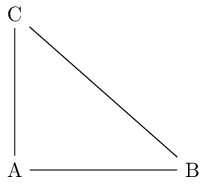
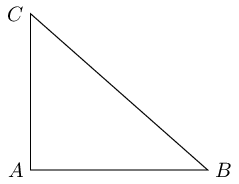
I've added a second TikZ picture which I believe looks more like something I believe you want.
Because PGFmath if forgiving, you could even do
at (0, sqrt(7)
but this isn't Code Golf.
Code
\documentclass[tikz]{standalone}
\begin{document}
\begin{tikzpicture}
\node (A) at (0,0) {A};
\node (B) at (3,0) {B};
\node (C) at (0, sqrt 7) {C};
\draw (A) -- (B) -- (C) -- (A);
\end{tikzpicture}
\begin{tikzpicture}
\coordinate[label=left: $A$] (A) at (0, 0);
\coordinate[label=right:$B$] (B) at (3, 0);
\coordinate[label=left: $C$] (C) at (0, sqrt 7);
\draw (A) -- (B) -- (C) -- cycle;
\end{tikzpicture}
\end{document}
Output


(0, sqrt 7)or(0, {sqrt(7)})protecting the)from the parser. – Qrrbrbirlbel Oct 10 '22 at 09:33