I'm not sure what your aim is. Here's a fairly general method for outputting values depending on the row index.
\documentclass{article}
\usepackage{siunitx}
\ExplSyntaxOn
\NewDocumentCommand{\formulatable}{mmm}
 {% #1 = number of rows
  % #2 = format of the column
  % #3 = formula to typeset
  \gnusupporter_formulatable:nnn { #1 } { #2 } { #3 }
 }
\cs_new:Nn __gnusupporter_formulatable_do:n {}
\cs_new:Nn __gnusupporter_formulatable_cycle:n
 {
  #1 & __gnusupporter_formulatable_do:n { #1 } \
 }
\cs_new_protected:Nn \gnusupporter_formulatable:nnn
 {
  \cs_set:Nn __gnusupporter_formulatable_do:n { \fp_eval:n { #3 } }
  \begin{tabular}{rS[table-format=#2]}
  \int_step_function:nN { #1 } __gnusupporter_formulatable_cycle:n
  \end{tabular}
 }
\ExplSyntaxOff
\begin{document}
\formulatable{10}{2.0}{#1+1}
\qquad
\formulatable{10}{1.6}{round(exp(#1/10),6)}
\qquad
\formulatable{10}{1.4}{round(sind(#1),4)}
\end{document}
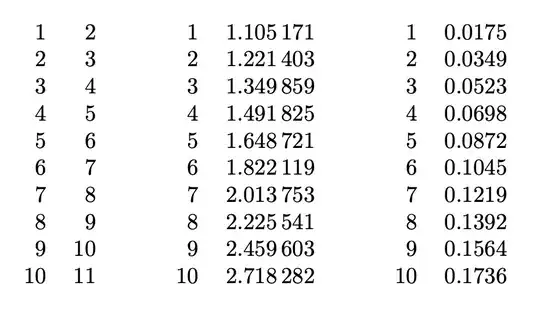
The second argument should be adjusted once you know the amount of digits in the second column.
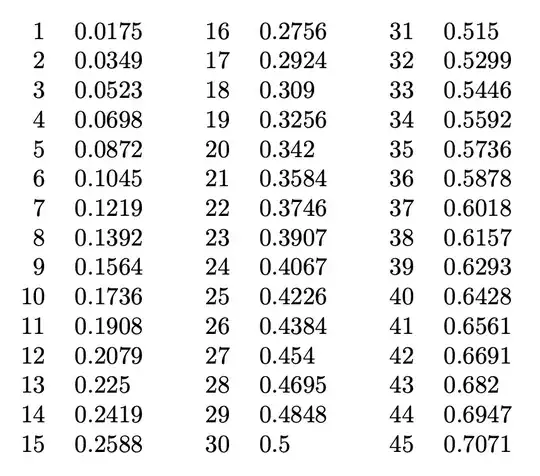
We can add also a starting point, so we can typeset the table of sines for angles in degrees from 1 to 45, which would have been very helpful to Ptolemy.
\documentclass{article}
\usepackage{siunitx}
\ExplSyntaxOn
\NewDocumentCommand{\formulatable}{mO{1}mm}
 {% #1 = number of rows
  % #2 = starting point
  % #3 = format of the column
  % #4 = formula to typeset
  \gnusupporter_formulatable:nnnn { #1 } { #2 } { #3 } { #4 }
 }
\cs_new:Nn __gnusupporter_formulatable_do:n {}
\cs_new:Nn __gnusupporter_formulatable_cycle:n
 {
  #1 & __gnusupporter_formulatable_do:n { #1 } \
 }
\cs_new_protected:Nn \gnusupporter_formulatable:nnnn
 {
  \cs_set:Nn __gnusupporter_formulatable_do:n { \fp_eval:n { #4 } }
  \begin{tabular}{rS[table-format=#3]}
  \int_step_function:nnN { #2 } { #1+#2-1 } __gnusupporter_formulatable_cycle:n
  \end{tabular}
 }
\ExplSyntaxOff
\begin{document}
\formulatable{15}{1.4}{round(sind(#1),4)}
\quad
\formulatable{15}[16]{1.4}{round(sind(#1),4)}
\quad
\formulatable{15}[31]{1.4}{round(sind(#1),4)}
\end{document}