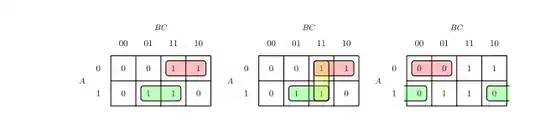
Like this:
\documentclass{article}
\usepackage{karnaugh-map}
\usepackage[margin=1cm]{geometry}
\begin{document}
    \begin{karnaugh-map}[4][2][1][$C$][$B$][$A$]
        \minterms{3,2,5,7}
        \autoterms[0]
        \implicant{3}{2}
        \implicant{5}{7}
    \end{karnaugh-map}\hfill \hspace{-.5cm}%

    \begin{karnaugh-map}[4][2][1][$C$][$B$][$A$]
        \minterms{3,2,5,7}
        \autoterms[0]
        \implicant{3}{2}
        \implicant{5}{7}
        \implicant{3}{7}
    \end{karnaugh-map}\hfill \hspace{-.5cm}%

    \begin{karnaugh-map}[4][2][1][$C$][$B$][$A$]
        \minterms{3,2,5,7}
        \autoterms[0]
        \implicant{0}{1}
        \implicantedge{4}{4}{6}{6}
    \end{karnaugh-map}
\end{document}
Output:

I make the text width greater with geometry package.
Before I tried to make smaller characters without success (perhaps You need to change the package karnaugh-map).
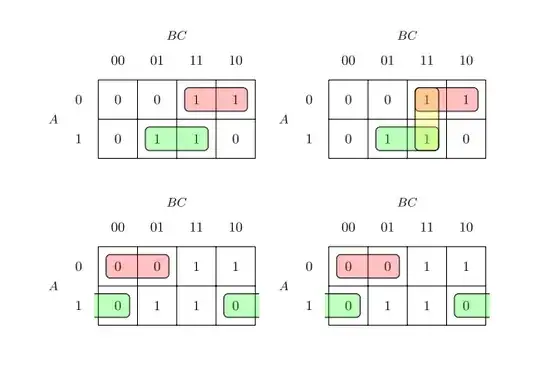
EDIT If You want 4 maps on two lines, You dont need minipage or geometry package:
\documentclass{article}
\usepackage{karnaugh-map}
%\usepackage[margin=1cm]{geometry}
\begin{document}
    \begin{karnaugh-map}[4][2][1][$C$][$B$][$A$]
        \minterms{3,2,5,7}
        \autoterms[0]
        \implicant{3}{2}
        \implicant{5}{7}
    \end{karnaugh-map}\hfill \hspace{-.5cm}%

    \begin{karnaugh-map}[4][2][1][$C$][$B$][$A$]
        \minterms{3,2,5,7}
        \autoterms[0]
        \implicant{3}{2}
        \implicant{5}{7}
        \implicant{3}{7}
    \end{karnaugh-map}\hfill \hspace{-.5cm}%

    \indent
    \begin{karnaugh-map}[4][2][1][$C$][$B$][$A$]
        \minterms{3,2,5,7}
        \autoterms[0]
        \implicant{0}{1}
        \implicantedge{4}{4}{6}{6}
    \end{karnaugh-map}\hfill \hspace{-.5cm}%

    \begin{karnaugh-map}[4][2][1][$C$][$B$][$A$]
        \minterms{3,2,5,7}
        \autoterms[0]
        \implicant{0}{1}
        \implicantedge{4}{4}{6}{6}
    \end{karnaugh-map}
\end{document}
Output:
LAST EDIT You van put also more than 3 k-maps on the same line, without geometry or minipage, with resizebox:
\documentclass{article}
\usepackage{karnaugh-map}
\begin{document}
    \resizebox{.95\columnwidth}{!}{%
    \begin{karnaugh-map}[4][2][1][$C$][$B$][$A$]
        \minterms{3,2,5,7}
        \autoterms[0]
        \implicant{3}{2}
        \implicant{5}{7}
    \end{karnaugh-map}\hfill \hspace{-.5cm}%

    \begin{karnaugh-map}[4][2][1][$C$][$B$][$A$]
        \minterms{3,2,5,7}
        \autoterms[0]
        \implicant{3}{2}
        \implicant{5}{7}
        \implicant{3}{7}
    \end{karnaugh-map}\hfill \hspace{-.5cm}%
\begin{karnaugh-map}[4][2][1][$C$][$B$][$A$]
    \minterms{3,2,5,7}
    \autoterms[0]
    \implicant{0}{1}
    \implicantedge{4}{4}{6}{6}
\end{karnaugh-map}
}

\end{document}
Output: