The question is asked in two ways: "In terms of future-proof-ness, is it still beneficial for a beginner to learn Metapost?", and "Is Metapost still relevant in the age of lua?".
tl;dr -- Yes, which ever way you ask the question.
Let's first consider the state of the Metapost project. Metapost was first released in 1995 after a surprisingly long six-year gestation period. John Hobby had worked on TeX and Metafont with Knuth, and built the elegant cubic spline curve system for Metafont; it occurred to him in 1989 that the system could be adapted to produce PostScript output, so that he could produce better figures for his research papers. Hobby passed the project on to others after some years, and in 2007 it was separated into a front-end and back-end library by Taco Hoekwater, and support for extended floating point arithmetic was added. The project is still actively maintained by a small team who are very responsive to questions on the mailing list. You can find more details on the project home page at Tug.
The split into separate libraries was an important step, because it has allowed the system to be linked into lualatex. This greatly simplifies the work flow. If I want to produce a stand-alone MP graphic today, I use this template file:
\documentclass[border=5mm]{standalone}
\usepackage{luamplib}
\begin{document}
\mplibtextextlabel{enable}
\begin{mplibcode}
beginfig(1);
endfig;
\end{mplibcode}
\end{document}
and compile it with lualatex to produce a self-contained PDF file. My work flow looks a bit like this:
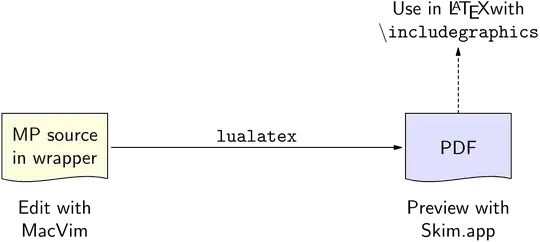
With the \mplibtextextlabel option enabled, you get a complete integration with regular LaTeX typesetting. You can include whatever LaTeX packages you want in the template, and use all the modern fonts supported by fontspec. You can even include an image file in a TeX label and draw on top of it (something that was very hard in regular old-fashioned Metapost). If you want to find out more about the work flow and integration with TeX, you might like to read Chapter 12 of my Drawing with Metapost project.
But you are not limited to producing single-picture PDFs. Provided you are happy to switch to the modern font world of fontspec, you will find that lualatex is very capable of producing large documents with all your Metapost illustrations included in a single source file. I have some examples of what you can do in one of my other pet projects, here. The details of how to integrate your graphics into your TeX source are set out in the (admittedly sparse) documentation for the luamplib package on CTAN.
All of this is to say that (in my opinion) MP is alive and well in 2023, and you can invest time and effort into learning it with confidence that the system will be around for as long as TeX is.
However, none of this touches on why you might like to learn it. So here are just two possible reason that echo the list of points in @mickep's answer.
It's a very well-designed language. I have nothing but admiration for the tikz-pgf team, but I have never really got to enjoy using TikZ, with its seemingly endless array of special-purpose notations and layers. Plain Metapost is a pretty small language and is well-adapted for semi-numerical drawings.
It's simple, but it is also subtle and interesting. I realise that this might sound odd to some people, but you might actually get a therapeutic joy from working out your own way to solve a geometrical puzzle in MP. It is a pleasure to use, like a well-designed hand tool.
Finally here's an example of the sort of drawing it's good at.
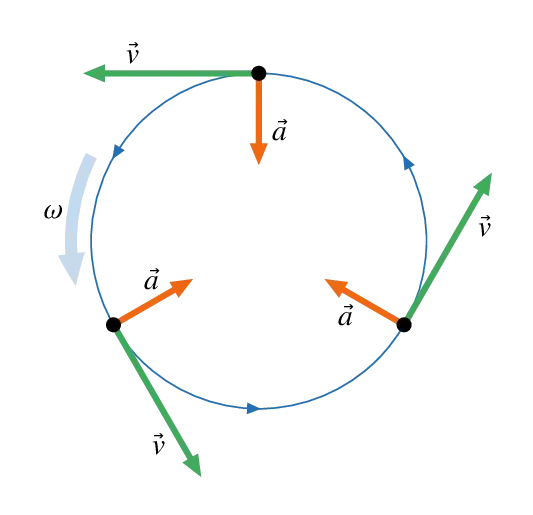
\documentclass[border=5mm]{standalone}
\usepackage{luamplib}
\usepackage{unicode-math}
\setmathfont{TeX Gyre Termes Math}
\begin{document}
\mplibtextextlabel{enable}
\begin{mplibcode}
input colorbrewer-rgb
beginfig(1);
    path C, vv, aa, oo;
    C = fullcircle scaled 4cm;
    linejoin := 0;
    linecap := 0;
    for t=0 upto 2:
      p := 8/3t+2;
      drawarrow subpath (p-4/3,p+4/3) of C withcolor Blues 8 7;
      vv := (origin -- unitvector(direction p of C) scaled 2cm)            shifted point p of C;
      aa := (origin -- unitvector(direction p of C) scaled 1cm rotated 90) shifted point p of C;
      drawarrow vv withpen pencircle scaled 2 withcolor Greens 8 6;
      drawarrow aa withpen pencircle scaled 2 withcolor Oranges 8 6;
      label("$\vec{v}$", unitvector(direction 3/4 of vv) rotated -90 scaled 7 shifted point 3/4 of vv);
      label("$\vec{a}$", unitvector(direction 2/3 of aa) rotated +90 scaled 7 shifted point 2/3 of aa);
      fill fullcircle scaled 5 shifted point p of C;
    endfor
    oo = subpath(3.4,4.2) of C scaled 1.12;
    drawarrow oo withpen pencircle scaled 4 withcolor Blues 8 3;
    label.lft("$\omega$", point 2/3 of oo);
endfig;
\end{mplibcode}
\end{document}


luamplibteam who have made careful well thought-out improvements to the integration with LaTeX and the support of large valued arithmetic without spoiling the beauty of the core language. – Thruston Feb 06 '23 at 09:08luamplibproject which integrates Metapost into LuaLaTeX, as @mickep notes in his first bullet point below. – Thruston Feb 07 '23 at 09:03