You just described the sagetex package, documentation here, which gives you access to the Python programming along with a free open source Computer Algebra System (CAS) called Sage, documentation here. Sage can handle algebra, calculus, matrices, vectors, polynomials, graph theory, and a lot more.
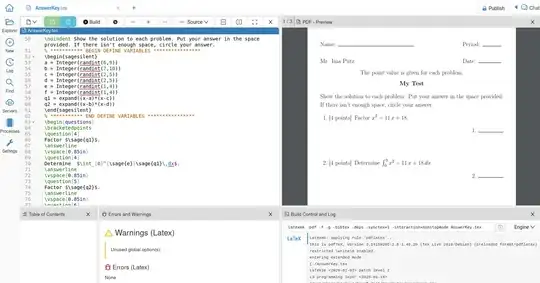
Here's a sample test I designed years ago in trying to learn sagetex. The problems are created randomly, according to my specifications, along with an answer key.
\documentclass[a4paper,addpoints,12point]{exam}%
% -----------------------------The preamble ------------------------------------
\usepackage{xcolor}
\usepackage{fix-cm}% allow for a bigger font
%  mathematical typesetting, fonts, and symbols
\usepackage{amsmath, amsfonts, amssymb}
\usepackage[T1]{fontenc}% change the fonts
\usepackage[margin=.5in]{geometry}%  sets the margins
\usepackage{sagetex}%  use Sage for it's math ability
\usepackage{graphicx}%  for including pictures
\usepackage{tikz} %tikz pictures, graph paper.
\pagestyle{empty} % remove the page numbers
\pagestyle{head}
\printanswers % If you want to print answers
%\noprintanswers % If you don't want to print answers
\addpoints % if you want to count the points
% \noaddpoints % if you don't want to count the points
% Specifies the way question are displayed:
%\qformat{\textbf{\thequestion.}   \quad(\thepoints)\hfill}
\shadedsolutions % defines the style of the solution environment
% \framedsolutions % defines the style of the solution environment
\definecolor{SolutionColor}{rgb}{0.8,0.9,1}    % light blue
% Defines the title of the solution environment:
\renewcommand{\solutiontitle}{\noindent\textbf{Solution:}\par\noindent}
% **************** BEGIN INPUT ASSIGNMENT INFO *******************
\newcommand{\course}{My Math Course}
\newcommand{\assignment}{My Test}
\newcommand{\teacher}{Mr. Ima Putz}
% **************** END INPUT ASSIGNMENT INFO *******************
\runningheadrule
\runningheader{\course}{\assignment}{\teacher}
\setlength{\parskip}{1.2ex} %space between paragraphs
\setlength{\parindent}{1em} %Paragraph indentation
\linespread{1.2} %spacing between lines
\widowpenalty = 10000   %penalty for a broken page
\newcommand\T{\rule{0pt}{2ex}} % \T will create extra space above (used to fix tables)
\newcommand\B{\rule[-1.5ex]{0pt}{0pt}}% \B will create extra space below (used to fix tables)
 % -----------------------------End of the preamble ------------------------------
 \begin{document}
 \fontsize{17pt}{20pt}\selectfont %sets font size and line spacing
 \noindent
 \begin{tabular}{@{}l p{1.6in}r @{}}
Name: \vrule height 0 pt depth 0.4 pt width 3.0 in & & Period: \vrule height 0 pt depth 0.4 pt width .75 in \\\\
 \teacher &  &Date: \hrulefill \\
 \end{tabular}
 \begin{center}
 The point value is given for each problem.\\ \vspace{.1in}
 {\bf \assignment}
 \end{center}
 \noindent Show the solution to each  problem. Put your answer in the space provided. If there isn't enough space, circle your answer.
 % *********** BEGIN DEFINE VARIABLES ****************
 \begin{sagesilent}
 a = Integer(randint(6,9))
 b = Integer(randint(7,10))
 c = Integer(randint(2,5))
 d = Integer(randint(2,5))
 e = Integer(randint(1,4))
 f = Integer(randint(1,4))
 q1 = expand((x-a)*(x-c))
 q2 = expand((x-b)*(x-d))
 \end{sagesilent}
 % *********** END DEFINE VARIABLES ****************
 \begin{questions}
 \bracketedpoints
 \question[4]
 Factor $\sage{q1}$.
 \answerline
 \vspace{0.85in}
 \question[4]
 Determine  $\int_{0}^{\sage{e}}\sage{q1}\,dx$.
 \answerline
 \vspace{0.85in}
 \question[5]
 Factor $\sage{q2}$.
 \answerline
 \vspace{0.85in}
 \question[6]
 Find $\frac{d}{dx}\left(\sage{q2}\right)$.
 \answerline
 \newpage
 \question[5]
 Factor $\sage{a*b*c}$.
 \answerline
 \vspace{0.85in}
 \question[4]
 The table shows the number of voters in  Mickey Mouse U. who were polled on their vote  for Alex and Bob in the school election. Find  the probability that a randomly selected person  voted for Alex.
 \\\\
 \begin{sagesilent}
 g=Integer(randint(23,37))
 h=Integer(randint(31,42))
 i=Integer(randint(19,45))
 j=Integer(randint(19,40))
 k=Integer(randint(15,36))
 l=Integer(randint(24,34))
 \end{sagesilent}
\begin{tabular}{c|c|c|c}
 & Sophomores & Juniors & Seniors\
 \hline
 Alex & $\sage{g}$ & $\sage{h}$ & $\sage{i}$\
 \hline
 Bob & $\sage{j}$ & $\sage{k}$ & $\sage{l}$\
 \hline
 \end{tabular}
 \answerline
 \vspace{0.85in}
 \question[6]
 Find the distance between the points $(\sage{a},\sage{b})$ and $(\sage{c},\sage{e})$.
\newpage
\begin{center}
{\large Answers}
\end{center}
\begin{solution}
$x=\sage{a}$, and $x=\sage{c}$
\end{solution}
\begin{solution}
$\sage{integrate(q1,(x,0,e))}$
\end{solution}
\begin{solution}
$x=\sage{b}$, and $x=\sage{d}$
\end{solution}
\begin{solution}
$\sage{diff(q2)}$
\end{solution}
\begin{solution}
$\sage{factor(abc)}$
\end{solution}
\begin{solution}
$\sage{(g+h+i)/(g+h+i+j+k+l)}$
\end{solution}
\begin{solution}
$\sage{sqrt((a-c)^2+(b-e)^2)}$
\end{solution}
\end{questions}
\end{document}
The result running in Cocalc is:
The answer key on the third page is:
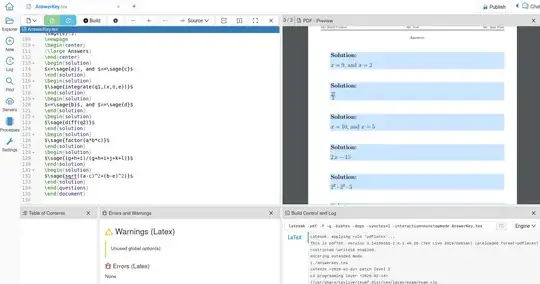
Note the answer to the integration problem:
$\sage{integrate(q1,(x,0,e))}$. Sage figures it out thereby preventing mistakes. It also gave the answer as a fraction, instead of a decimal.
Sage is not part of your LaTeX distribution. There are 2 main ways to access it. One is to download it to your computer and get it to work with LaTeX. The second way is the easiest: Get a free Cocalc account.
Search this site for sagetex examples. My answer to getting the matrix transpose here shows how easily you can get the correct answer and calculate with it. Sage can plot graphs and it's possible to force the output through tikz to make it look better: see my answer for the Riemann Zeta plot here.


