Here is a basic solution for the loops. \int_while_do must be used instead of \int_do_while. It remains to make efficient the use of the sequence of integers that does not work here, even if this gives a correct "visual" algorithm. SEe below for a solution.
\documentclass{article}
\ExplSyntaxOn
\int_new:N \l_row_int
\int_new:N \l_col_int
\NewDocumentCommand\eratosthenes{ O{#2}m }{
\seq_new:N \l_notprime_seq
\int_new:N \l_tested_int
\int_set:Nn \l_tested_int { 1 }
\int_new:N \l_striked_int
\int_new:N \l_max_int
\int_set:Nn \l_max_int { #2*#2 }
\int_while_do:nn {
% \l_tested_int <= #2
% The following inefficient test shows one of my problem.
\l_tested_int <= \l_max_int
} {
\int_compare:nNnTF \l_tested_int = 1 {
\ \quad STRIKE ~ THIS: ~ 1
\seq_put_left:Nn \l_notprime_seq 1
} {
\seq_if_in:NnTF \l_notprime_seq \l_tested_int {
\ PRIME: ~ \int_use:N \l_tested_int
} {
\int_set:Nn \l_striked_int { 2*\l_tested_int }
\int_while_do:nn {
\l_striked_int <= \l_max_int
} {
% \seq_if_in:NnF \l_notprime_seq \l_striked_int {
\ \quad STRIKE ~ ME: ~ \int_use:N \l_striked_int
\seq_put_left:Nn \l_notprime_seq {\l_striked_int}
% }
\int_set:Nn \l_striked_int { \l_striked_int + \l_tested_int }
}
}
}
\int_incr:N \l_tested_int
}
}
\ExplSyntaxOff
\begin{document}
\noindent \eratosthenes{3}
\end{document}
This code correctly prints.
STRIKE THIS: 1
STRIKE ME: 4
STRIKE ME: 6
STRIKE ME: 8
STRIKE ME: 6
STRIKE ME: 9
STRIKE ME: 8
Final version striking numbers only once
Here is the code I was looking for. This makes an interesting LaTeX3 exercise.
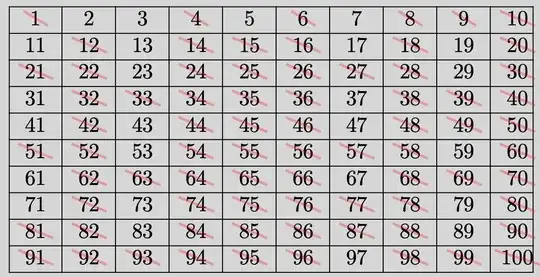
\documentclass{article}
\usepackage{nicematrix}
\usepackage{tikz}
\NewDocumentCommand\drawstrike{ mm } {

    \begin{tikzpicture}[
        remember picture,
        overlay
    ]
        \draw[
            very thick,
            red,
            opacity = 0.3
        ]
        ([xshift=-3pt]this-#1-#2.north west)
        --
        ([xshift=3pt]this-#1-#2.south east);
    \end{tikzpicture}
}
\ExplSyntaxOn
\int_new:N \l_row_int
\int_new:N \l_col_int
\NewDocumentCommand\strikeme{ mm } {
    \int_set:Nn \l_row_int { \int_div_truncate:nn {#2}{#1} }
    \int_set:Nn \l_col_int { \int_mod:nn {#2} {#1}}
\int_compare:nNnTF \l_col_int = 0 {
    \int_set:Nn \l_col_int { #1 }
} {
    \int_set:Nn \l_row_int { \l_row_int + 1}
}

\drawstrike{\int_use:N \l_row_int}{\int_use:N \l_col_int}

}
\NewDocumentCommand\eratosthenes{ O{#2}m }{

    $\AutoNiceMatrix[
        hvlines,
        columns - width = auto,
        name            = this
    ]{
        #2-#2
    }{
        \cellval{#2}{\arabic{iRow}}{\arabic{jCol}}
    }$
\seq_new:N \l_notprime_seq

\int_new:N  \l_tested_int
\int_set:Nn \l_tested_int { 1 }

\int_new:N  \l_striked_int

\int_new:N  \l_max_int
\int_set:Nn \l_max_int { #2*#2 }

\int_while_do:nn {
     \l_tested_int <= #2
} {
    \int_compare:nNnTF \l_tested_int = 1 {
        \strikeme{#2}{1}
        \seq_put_left:Nn \l_notprime_seq 1
    } {
        \seq_if_in:NxF \l_notprime_seq {\int_use:N \l_tested_int} {
            \int_set:Nn \l_striked_int { 2*\l_tested_int }

            \int_while_do:nn {
                \l_striked_int <= \l_max_int
            } {
                \seq_if_in:NxF \l_notprime_seq {\int_use:N \l_striked_int} {
                    \strikeme{#2}{\int_use:N \l_striked_int}
                    \seq_put_left:Nx \l_notprime_seq {\int_use:N \l_striked_int}
                }

                \int_set:Nn \l_striked_int { \l_striked_int + \l_tested_int }
            }
        }
    }

    \int_incr:N \l_tested_int
}

}
\NewDocumentCommand\cellval{ mmm }{

    \int_eval:n{#3 + #1*(#2 - 1)}
}
\ExplSyntaxOff
\begin{document}
\eratosthenes{10}
\end{document}


\int_show:Neverywhere to check the logic. And correct the naming of your variables, it should be\l_my_max_intand\l_my_striked_int. – Ulrike Fischer Jun 12 '23 at 13:44\bool_if:nTFyou need is one\int_compare_p:n, don't use\bool_if:nTF, but instead\int_compare:nNnTFor\int_compare:nTF(the former if you don't need<=but only<, it is much faster). – Skillmon Jun 12 '23 at 14:13\bool_do_while:nn { \int_compare_p:n {\l_striked_int <= \l_max_int } }. – projetmbc Jun 12 '23 at 14:19int_do_while. I will play with this now... – projetmbc Jun 12 '23 at 14:20INTprimitives, but the problem does not seem to be solved. – projetmbc Jun 12 '23 at 14:31do_whileandwhile_do. I'll be inoculated in future. I'll answer my question in a few minutes... – projetmbc Jun 12 '23 at 15:10do_whileanddo_until? There are synonyms in a sense.do_while PREDICATE <===> do_until NOT PREDICATE. No? – projetmbc Jun 12 '23 at 15:26\bool_if:nTFis just much slower if you only use it on a single predicate. – Skillmon Jun 12 '23 at 18:20a < bto obtain quicklydo_until a >= bviado_while a < b. This should be indicated clearly in theinterface3PDF. – projetmbc Jun 12 '23 at 23:05