I made some commands to store a matrix and to show the matrix, an element of the matrix, or a submatrix.
The elements of the matrix are saved <matrix name>-<y>-<x>, so you could define further commands with that.
Result
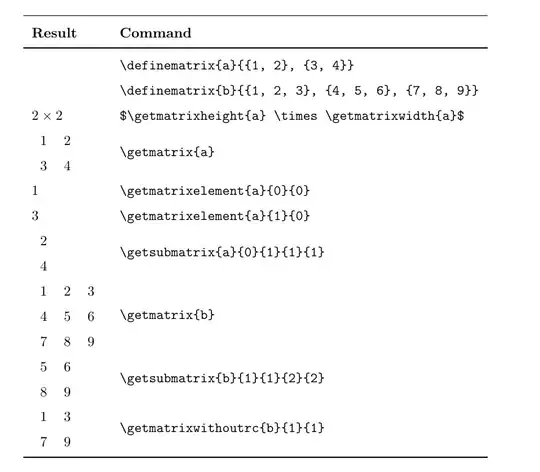
Code
\documentclass{article}
\usepackage{etoolbox}
\usepackage{pgffor}
\usepackage{booktabs}
\def\dmname{}
\newcounter{dmx}
\newcounter{dmy}
\newcommand{\dmlines}[1]{%
    \setcounter{dmx}{0}
    \forcsvlist{\dmelements}{#1}
    \stepcounter{dmy}
}
\newcommand{\dmelements}[1]{%
    \csdef{\dmname-\thedmy-\thedmx}{#1}%
    \stepcounter{dmx}%
}
\newcommand{\definematrix}[2]{%
    % #1 = name
    % #2 = matrix
    \gdef\dmname{#1}%
    \setcounter{dmy}{0}%
    \forcsvlist{\dmlines}{#2}%
    \csxdef{\dmname-w}{\thedmx}%
    \csxdef{\dmname-h}{\thedmy}%
}
\newcommand{\getmatrixelement}[3]{%
    % #1 = name
    % #2 = y
    % #3 = x
    \csuse{#1-#2-#3}%
}
\newcommand{\getsubmatrix}[5]{%
    % #1 = name
    % #2 = y
    % #3 = x
    % #4 = y2
    % #5 = x2
    \def\dmtablecontent{}%
    \foreach \y in {#2, ..., #4} {%
        \foreach \x in {#3, ..., #5} {%
            \xappto\dmtablecontent{\csuse{#1-\y-\x}}%
            \ifnumless{\x}{#5}{%
                \xappto\dmtablecontent{&}%
            }{}%
        }%
        \xappto\dmtablecontent{\}%
    }%
    %
    \begin{tabular}{*{\the\numexpr#5-#3+1\relax}{c}}%
        \dmtablecontent%
    \end{tabular}%
}
\newcommand{\getmatrixwidth}[1]{%
    % #1 = name
    \csuse{#1-w}%
}
\newcommand{\getmatrixheight}[1]{%
    % #1 = name
    \csuse{#1-h}%
}
\newcommand{\getmatrix}[1]{%
    % #1 = name
    \getsubmatrix{#1}{0}{0}
    {\the\numexpr\getmatrixheight{#1}-1\relax}
    {\the\numexpr\getmatrixwidth{#1}-1\relax}%
}
\newcommand{\getmatrixwithoutrc}[3]{%
    % shows the matrix without the given row and column
    % #1 = name
    % #2 = row
    % #3 = column
    \def\dmtablecontent{}%
    \def\dmymax{\the\numexpr\getmatrixheight{#1}-1\relax}%
    \def\dmxmax{\the\numexpr\getmatrixwidth{#1}-1\relax}%
    \foreach \y in {0, ..., \dmymax} {%
        \ifnumequal{\y}{#2}{}{%
            \foreach \x in {0, ..., \dmxmax} {%
                \ifnumequal{\x}{#3}{}{%
                    \xappto\dmtablecontent{\csuse{#1-\y-\x}}%
                    \ifnumless{\x}{\dmxmax}{%
                        \xappto\dmtablecontent{&}%
                    }{}%
                }%
            }%
            \xappto\dmtablecontent{\}%
        }%
    }%
    %
    \begin{tabular}{*{\getmatrixwidth{#1}}{c}}
        \dmtablecontent
    \end{tabular}
}
\begin{document}
\definematrix{a}{{1, 2}, {3, 4}}
\definematrix{b}{{1, 2, 3}, {4, 5, 6}, {7, 8, 9}}
\renewcommand{\arraystretch}{1.5}
\begin{tabular}{ll}
    \toprule
    \textbf{Result} & \textbf{Command}\
    \midrule
    & \verb|\definematrix{a}{{1, 2}, {3, 4}}|\
    & \verb|\definematrix{b}{{1, 2, 3}, {4, 5, 6}, {7, 8, 9}}| \
    $\getmatrixheight{a} \times \getmatrixwidth{a}$ &
    \verb|$\getmatrixheight{a} \times \getmatrixwidth{a}$|
    \
    \getmatrix{a} &
    \verb|\getmatrix{a}|
    \
    \getmatrixelement{a}{0}{0} &
    \verb|\getmatrixelement{a}{0}{0}|
    \
    \getmatrixelement{a}{1}{0} &
    \verb|\getmatrixelement{a}{1}{0}|
    \
    \getsubmatrix{a}{0}{1}{1}{1} &
    \verb|\getsubmatrix{a}{0}{1}{1}{1}|
    \
    \getmatrix{b} &
    \verb|\getmatrix{b}|
    \
    \getsubmatrix{b}{1}{1}{2}{2} &
    \verb|\getsubmatrix{b}{1}{1}{2}{2}|
    \
    \getmatrixwithoutrc{b}{1}{1} &
    \verb|\getmatrixwithoutrc{b}{1}{1}|
    \
    \bottomrule
\end{tabular}
\end{document}


\csname foo\i.\j\endcsnamewhich can be manipulated easily. Printing it would be a separate step. – John Kormylo Sep 06 '23 at 03:28etoolbox(combining storing a matrix and building another one), though at the end, they would be pretty similar. Are you okay with a comma-separated list of rows of comma-separated entries per row or do you need the LaTeX-like input with&and\\? – Qrrbrbirlbel Sep 06 '23 at 12:31