1

I am using the IEEEtran class (two columns) for a paper, and have several long expressions that I cannot figure out the best way to format them. I am currently using \split and aligning everything manually as I see best for clarity, but this takes up a lot of space. Perhaps with the use of \multlined and \shoveright I can get better results. Below is the MWE:

\usepackage{mathtools,amssymb}

\begin{document} \begin{align} \begin{split} \mathcal{UB}\left(\underset{\boldsymbol{Z}}{\mathrm{E}}\log C_{pq}\right) &=-\frac{\log p}{p}-\frac{\log q}{q}\ &\phantom{=}-\mathcal{E}B\log m{Z}-\log m_{X}\ &\phantom{=}+ \mathcal{E}B\log\left(m{X}M_{X}^{q-1}+m_{Z}M_{Z}^{p-1}\right)\ &\phantom{=}+\Pr{(B)}\log\Biggl( m_{X}M_{X}^{q-1}\ &\phantom{=+\Pr{(B)}\log\Biggl(} +\inf_{Z\in B}m_{Z}\left(\sup_{Z\in B}M_Z\right)^{p-1}\Biggr)\ &\phantom{=}-\Pr{(B)}\log\inf_{Z\in B}m_{Z}, \end{split} \end{align} \end{document}
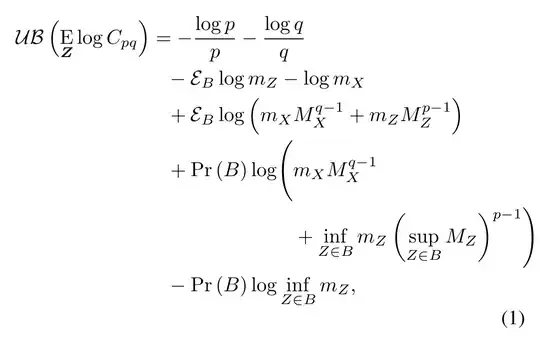
rendered

If using \multlined then the MWE would be:

\begin{align}
        \begin{multlined}
            \mathcal{UB}\left(\underset{\boldsymbol{Z}}{\mathrm{E}}\log C_{pq}\right)
            =-\frac{\log p}{p}-\frac{\log q}{q}\\
            -\mathcal{E}_B\log m_{Z}-\log m_{X}\\
            + \mathcal{E}_B\log\left(m_{X}M_{X}^{q-1}+m_{Z}M_{Z}^{p-1}\right)\\
            +\Pr{(B)}\log\Biggl( m_{X}M_{X}^{q-1}\\
            +\inf_{Z\in B}m_{Z}\left(\sup_{Z\in B}M_Z\right)^{p-1}\Biggr)\\
            -\Pr{(B)}\log\inf_{Z\in B}m_{Z},
        \end{multlined}
    \end{align}
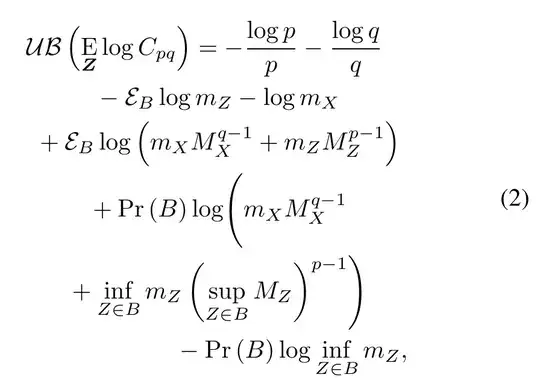
render

In my full document, as the IEEEtran is two column, the equations often overflow a bit into the other column. What would be the best way to handle these scenarios?

betaros
  • 11
  • You can surely use two columns for such a long equation. This question might be a duplicate (see https://tex.stackexchange.com/questions/16429/equation-spanning-two-columns-in-ieeetran). – Bibi Sep 13 '23 at 08:37

1 Answers1

1

First proposal

The math fonts clearly clash with the text font.

\documentclass{IEEEtran}
\usepackage{amsmath,amssymb}

\usepackage{lipsum}

\DeclareMathOperator*{\E}{E}

\begin{document}

\lipsum[1][1-4] \begin{equation} \begin{split} &\mathcal{UB}\bigl(,\E_{\boldsymbol{Z}}\log C_{pq}\bigr) \ &\quad=-\frac{\log p}{p}-\frac{\log q}{q}-\mathcal{E}B\log m{Z}-\log m_{X}\ &\qquad+ \mathcal{E}B\log(m{X}M_{X}^{q-1}+m_{Z}M_{Z}^{p-1})\[1ex] &\qquad\begin{aligned}[t] &+\Pr(B)\log\bigl( m_{X}M_{X}^{q-1}\ &\qquad+\inf_{Z\in B}m_{Z}\bigl(\sup_{Z\in B}M_Z\bigr)^{p-1}\bigr) \end{aligned} \[1ex] &\qquad-\Pr(B)\log\inf_{Z\in B}m_{Z}, \end{split} \end{equation} \lipsum[2][1-4]

\end{document}

enter image description here

Second proposal

Matching math and text fonts.

\documentclass{IEEEtran}
\usepackage{amsmath}
\usepackage{newtx}
\usepackage{bm}

\usepackage{lipsum}

\DeclareMathOperator*{\E}{E}

\begin{document}

\lipsum[1][1-4] \begin{equation} \begin{split} &\mathcal{UB}\bigl(,\E_{\bm{Z}}\log C_{pq}\bigr) \ &\quad=-\frac{\log p}{p}-\frac{\log q}{q}-\mathcal{E}B\log m{Z}-\log m_{X}\ &\qquad+ \mathcal{E}B\log(m{X}M_{X}^{q-1}+m_{Z}M_{Z}^{p-1})\[1ex] &\qquad+\Pr(B)\log\bigl( m_{X}M_{X}^{q-1} +\inf_{Z\in B}m_{Z}\bigl(\sup_{Z\in B}M_Z\bigr)^{p-1}\bigr) \[1ex] &\qquad-\Pr(B)\log\inf_{Z\in B}m_{Z}, \end{split} \end{equation} \lipsum[2][1-4]

\end{document}

enter image description here

Comments

I don't think there's a gain in clarity with big fences. Actually, I believe the contrary.

The command \Pr doesn't take an argument. Look closely at the difference between \Pr(B) and \Pr{(B)} and you'll see that the latter is wrong.

egreg
  • 1,121,712