An old-style implementation:
\documentclass{article}
\usepackage{amsmath}
\makeatletter
\newcommand{\lon}[1]{% list of numbers
  \ifmmode
    \if@display
      \ERROR
    \else
      \lon@{#1}%
    \fi
  \else
    $\lon@{#1}$%
  \fi
}
\newcommand{\lon@}[1]{%
  \begingroup
  \lon@activate\mathcode,="8000 #1 \endgroup } \newcommand{\lon@activate}{% \mathchardef\lon@comma=\mathcode,
  \begingroup\lccode~=,\lowercase{\endgroup
    \def~}{{\lon@comma}\penalty0 \hspace{0.3em plus 0.2em minus 0.1em}}
}
\makeatother
\begin{document}
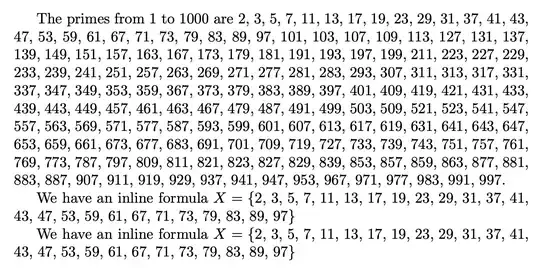
The primes from $1$ to $1000$ are \lon{2, 3, 5, 7, 11, 13, 17, 19, 23, 29, 31,
37, 41, 43, 47, 53, 59, 61, 67, 71, 73, 79, 83, 89, 97, 101, 103, 107, 109, 113,
127, 131, 137, 139, 149, 151, 157, 163, 167, 173, 179, 181, 191, 193, 197, 199,
211, 223, 227, 229, 233, 239, 241, 251, 257, 263, 269, 271, 277, 281, 283, 293,
307, 311, 313, 317, 331, 337, 347, 349, 353, 359, 367, 373, 379, 383, 389, 397,
401, 409, 419, 421, 431, 433, 439, 443, 449, 457, 461, 463, 467, 479, 487, 491,
499, 503, 509, 521, 523, 541, 547, 557, 563, 569, 571, 577, 587, 593, 599, 601,
607, 613, 617, 619, 631, 641, 643, 647, 653, 659, 661, 673, 677, 683, 691, 701,
709, 719, 727, 733, 739, 743, 751, 757, 761, 769, 773, 787, 797, 809, 811, 821,
823, 827, 829, 839, 853, 857, 859, 863, 877, 881, 883, 887, 907, 911, 919, 929,
937, 941, 947, 953, 967, 971, 977, 983, 991, 997}.
We have an inline formula $X={\lon{2, 3, 5, 7, 11, 13, 17, 19, 23, 29, 31,
37, 41, 43, 47, 53, 59, 61, 67, 71, 73, 79, 83, 89, 97}}$
We have an inline formula (X={\lon{2, 3, 5, 7, 11, 13, 17, 19, 23, 29, 31,
37, 41, 43, 47, 53, 59, 61, 67, 71, 73, 79, 83, 89, 97}})
[
\lon{1,2,3}
]
\end{document}
The \lon (list of numbers) command cannot be used in displays, where it doesn't make sense.
A new-style implementation.
\documentclass{article}
\usepackage{amsmath}
\ExplSyntaxOn
\NewDocumentCommand{\lon}{m}
 {% #1 = list of numbers
  \mode_if_math:TF
   {
    \legacy_if:nTF {@display} { \ERROR } { $ \scan_stop: \robin_lon:n { #1 } \scan_stop: $ }
   }
   {
    \robin_lon:n { #1 }
   }
 }
\cs_new_protected:Nn \robin_lon:n
 {
  $ \clist_use:nn { #1 } { {,}\penalty0 \hspace{0.3em plus 0.2em minus 0.1em} } $
 }
\ExplSyntaxOff
\begin{document}
The primes from $1$ to $1000$ are \lon{2, 3, 5, 7, 11, 13, 17, 19, 23, 29, 31,
37, 41, 43, 47, 53, 59, 61, 67, 71, 73, 79, 83, 89, 97, 101, 103, 107, 109, 113,
127, 131, 137, 139, 149, 151, 157, 163, 167, 173, 179, 181, 191, 193, 197, 199,
211, 223, 227, 229, 233, 239, 241, 251, 257, 263, 269, 271, 277, 281, 283, 293,
307, 311, 313, 317, 331, 337, 347, 349, 353, 359, 367, 373, 379, 383, 389, 397,
401, 409, 419, 421, 431, 433, 439, 443, 449, 457, 461, 463, 467, 479, 487, 491,
499, 503, 509, 521, 523, 541, 547, 557, 563, 569, 571, 577, 587, 593, 599, 601,
607, 613, 617, 619, 631, 641, 643, 647, 653, 659, 661, 673, 677, 683, 691, 701,
709, 719, 727, 733, 739, 743, 751, 757, 761, 769, 773, 787, 797, 809, 811, 821,
823, 827, 829, 839, 853, 857, 859, 863, 877, 881, 883, 887, 907, 911, 919, 929,
937, 941, 947, 953, 967, 971, 977, 983, 991, 997}.
We have an inline formula $X={\lon{2, 3, 5, 7, 11, 13, 17, 19, 23, 29, 31,
37, 41, 43, 47, 53, 59, 61, 67, 71, 73, 79, 83, 89, 97}}$
We have an inline formula (X={\lon{2, 3, 5, 7, 11, 13, 17, 19, 23, 29, 31,
37, 41, 43, 47, 53, 59, 61, 67, 71, 73, 79, 83, 89, 97}})
[
\lon{1,2,3}
]
\end{document}
 How can I get this to wrap around the page?


f(x,y)to break). You can manually allow it by adding\allowbreakafter the commas at which a break was allowed. – daleif Sep 13 '23 at 13:311, 2, 3(as numbers) in the statement of a theorem? – egreg Sep 13 '23 at 15:08