You can map the list and check every item against the given token list, incrementing the counter if they match. At the end, you print the counter's value.
The separator (default a comma) is specified in an optional argument.
\documentclass{article}
%\usepackage{xparse} % no longer needed
\ExplSyntaxOn
\NewDocumentCommand{\countmember}{O{,}mm}
 {
  \krantz_countmember:onn { #3 } { #2 } { #1 }
 }
\seq_new:N \l__krantz_countmember_items_seq
\int_new:N \l__krantz_countmember_count_int
\cs_new_protected:Nn \krantz_countmember:nnn
 {
  \int_zero:N \l__krantz_countmember_count_int
  \seq_set_split:Nnn \l__krantz_countmember_items_seq { #3 } { #1 }
  \seq_map_inline:Nn \l__krantz_countmember_items_seq
   {
    \tl_if_eq:nnT { ##1 } { #2 } { \int_incr:N \l__krantz_countmember_count_int }
   }
  \int_to_arabic:n { \l__krantz_countmember_count_int }
 }
\cs_generate_variant:Nn \krantz_countmember:nnn { o }
\ExplSyntaxOff
\begin{document}
\countmember{3}{3,4} (expected: 1)
\countmember{3}{ 3 ,4} (expected: 1)
\newcommand{\foo}{3,4}
\countmember{3}{\foo} (expected: 1)
\renewcommand{\foo}{3, 4, 4}
\countmember{4}{\foo} (expected: 2)
\countmember{foo}{\foo} (expected: 0)
\countmember[\]{1}{1 \ 2 \ 1 \ 0} (expected: 2)
\countmember[ ]{2}{1 2 1 0} (expected: 1)
\renewcommand{\foo}{1 2 1 0}
\countmember[ ]{2}{\foo} (expected: 1)
\end{document}
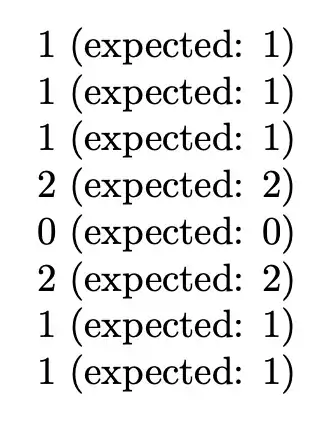
It is possible to add a trailing optional argument that should be a control sequence in which the result will be stored for later use.
\documentclass{article}
%\usepackage{xparse} % no longer needed
\ExplSyntaxOn
\NewDocumentCommand{\countmember}{O{,}mmo}
 {
  \krantz_countmember:onn { #3 } { #2 } { #1 }
  \IfNoValueTF { #4 }
   {% just print the count
    \int_to_arabic:n { \l__krantz_countmember_count_int }
   }
   {% store
    \tl_clear_new:N #4
    \tl_set:Nx #4 { \int_to_arabic:n { \l__krantz_countmember_count_int } }
   }
 }
\seq_new:N \l__krantz_countmember_items_seq
\int_new:N \l__krantz_countmember_count_int
\cs_new_protected:Nn \krantz_countmember:nnn
 {
  \int_zero:N \l__krantz_countmember_count_int
  \seq_set_split:Nnn \l__krantz_countmember_items_seq { #3 } { #1 }
  \seq_map_inline:Nn \l__krantz_countmember_items_seq
   {
    \tl_if_eq:nnT { ##1 } { #2 } { \int_incr:N \l__krantz_countmember_count_int }
   }
 }
\cs_generate_variant:Nn \krantz_countmember:nnn { o }
\ExplSyntaxOff
\begin{document}
\countmember{3}{3,4} (expected: 1)
\countmember{3}{ 3 ,4} (expected: 1)
\newcommand{\foo}{3,4}
\countmember{3}{\foo} (expected: 1)
\renewcommand{\foo}{3, 4, 4}
\countmember{4}{\foo} (expected: 2)
\countmember{foo}{\foo} (expected: 0)
\countmember[\]{1}{1 \ 2 \ 1 \ 0} (expected: 2)
\countmember[ ]{2}{1 2 1 0} (expected: 1)
\renewcommand{\foo}{1 2 1 0}
\countmember[ ]{2}{\foo} (expected: 1)
% store in \foo
\countmember{1}{1,2,2,1,1,2}[\foo]
\foo
\end{document}
The output is the same as before, but you will also see “3” at the end.


\usepackage{fp}then\fpeval{\countmember[ ]{2}{\foo}}, it does not work. I want to re-utilize the number. Any thoughts? – Krantz Oct 19 '23 at 00:38\countmemberexpandable. It's not difficult to add the possibility of storing the result so you can use it in calculations. – egreg Oct 19 '23 at 08:22storing the result so [I] can use it in calculationscould be great. That's what the question is about. That's why I asked the macro to output integers. Any thoughts? – Krantz Oct 19 '23 at 08:51~? It is not recognized now. – Krantz Oct 19 '23 at 10:19\countmember{~}{1,~,~,1,1,~}, I get 3. – egreg Oct 19 '23 at 10:39\countmember[]{}{1 ~ ~ 1 1 ~}to get 5? – Krantz Oct 22 '23 at 17:20