Updated solution
It's not much more complicated to automate this a bit. Here is a command \VennFour that takes one required argument, which is a comma separated list of regions/contents. For example,
\VennFour{a/2, bc/5, bcd/37, abc/33, abcd/3}
will place 2 in the subset that is just A, and 5 in the subset that is B and C but not A or D. Missing regions are left blank. The outer region uses the label o. The label U can be used for the universal set at the top right.
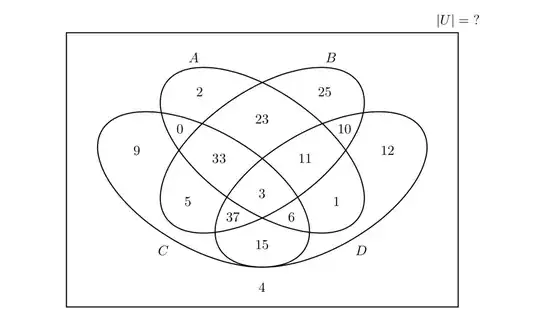
An optional argument can be used for TikZ options that apply to the whole picture. For example,
\VennFour[scale=.8, transform shape]{a/2, bc/5, bcd/37, abc/33, abcd/3}
would scale the entire picture.
\documentclass{article}
\usepackage{tikz}
\usetikzlibrary{shapes.geometric}
\tikzset{ellip/.style={ellipse, draw, thick,
    minimum height=3cm, minimum width=6cm, rotate=#1
}}
\newcommand{\VennFour}[2][]{\begin{tikzpicture}[#1]
    \draw[thick] (-5,-4) rectangle (5,3);
    \coordinate(U) at (5,3.3);
    \node[ellip=-35, label=160:$A$] (A) at (0,0){}; \node[ellip=35, label=20:$B$] (B) at (0,0){};
    \node[ellip=-30, label=270:$C$] (C) at (-1.5,-1){}; \node[ellip=30, label=270:$D$] (D) at (1.5,-1){};
    \coordinate(a)at(-1.6,1.5); \coordinate(b)at(1.6,1.5); \coordinate(c)at(-3.2,0); \coordinate(d)at(3.2,0);
    \coordinate(ab)at(0,.8); \coordinate(cd)at(0,-2.4); \coordinate(ac)at(-2.1,.55);
    \coordinate(bd)at(2.1,.55); \coordinate(ad)at(1.9,-1.3); \coordinate(bc)at(-1.9,-1.3);
    \coordinate(abc)at(-1.1,-.2); \coordinate(abd)at(1.1,-.2); \coordinate(acd)at(.75,-1.7); \coordinate(bcd)at(-.75,-1.7);
    \coordinate(abcd)at(0,-1.1); \coordinate(o)at(0,-3.5);
    \foreach \s/\n in {#2} {\node at (\s){\n};}
\end{tikzpicture}}
\begin{document}
\VennFour{U/$|U|=;?$, a/2, bc/5, bcd/37, abc/33, abcd/3, b/25, c/9, d/12, ac/0, bd/10, ab/23, abd/11, ad/1, acd/6, cd/15, o/4}
\end{document}
Original Solution
I am unfamiliar with the venndiagram package, but I don't see anything in the documentation that indicates its use for more than three sets. In particular, Venn diagrams with more than three sets can't be made from circles, and Venn diagrams with a composite number of sets can't be rotationally symmetric. [See for example, F. Ruskey, C. Savage, and S. Wagon, The search for simple symmetric Venn diagrams, Notices Amer. Math. Soc. 53 (2006) 1304–1312.]
So here is a version drawn from scratch with congruent ellipses.
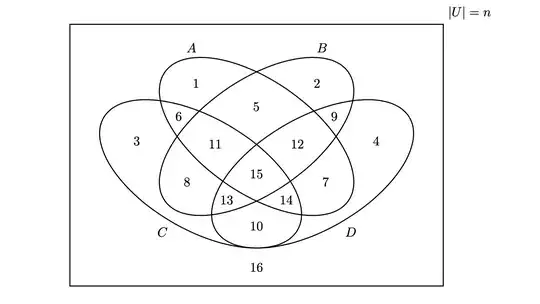
\documentclass{article}
\usepackage{tikz}
\usetikzlibrary{shapes.geometric}
\tikzset{venn/.style={ellipse, draw, thick,
    minimum height=3cm, minimum width=6cm, rotate=#1
}}
\begin{document}
\begin{tikzpicture}
\draw[thick] (-5,-4) rectangle (5,3)node[above right]{$|U|=n$};
\node[venn=-35, label=160:$A$] (A) at (0,0){};
\node[venn=35, label=20:$B$] (B) at (0,0){};
\node[venn=-30, label=270:$C$] (C) at (-1.5,-1){};
\node[venn=30, label=270:$D$] (D) at (1.5,-1){};
\node at ([shift=(-20:.9)]A.180){1};\node at ([shift=(200:.9)]B.0){2};
\node at ([shift=(-35:1.1)]C.180){3};\node at ([shift=(215:1.1)]D.0){4};
\node at ([shift=(90:.8)]A.center){5};
\node at ([shift=(40:.8)]B.180){8};\node at ([shift=(140:.8)]A.0){7};
\node at ([shift=(-72:1.25)]A.180){6};\node at ([shift=(252:1.25)]B.0){9};
\node at (0,-2.4){10};
\node at (-1.1,-.2){11};\node at (1.1,-.2){12};
\node at (-.8,-1.7){13};\node at (.8,-1.7){14};
\node at (0,-1){15};\node at (0,-3.5){16};
\end{tikzpicture}
\end{document}


venndiagram. – campa Oct 19 '23 at 09:20probsolnvenndiagramjmlr. – Sebastiano Oct 19 '23 at 09:40clips. Furthermore, we can define the circles as nodes which makes it easy to place labels in relation to it. (For example, the label for AB can be positioned by the halfway point between nodesAandB.) Using PGFKeys we can very easily adjust a few things if needed. — Don't you need ellipses for a 4set to cover all sets? – Qrrbrbirlbel Oct 19 '23 at 11:30venndiagramcode there is absolutely no time is wasted. The code is little and for those who are not experts in TeX they certainly understand it. I should send it to an excellent pensioned Mathematics professor who can only put the little numbers and labels on the outside. – Sebastiano Oct 19 '23 at 21:09TikZfor the reason that I have explained. Again infinitely thank you for your valuable help. +1 – Sebastiano Oct 19 '23 at 21:09venndiagrambecause a very dear professor of mine should use it. The package is very simple but very limited. – Sebastiano Oct 19 '23 at 21:12\VennFourmacro is as simple as they come. – Qrrbrbirlbel Oct 19 '23 at 23:21venndiagrampackage for the reason that I have written. :-( – Sebastiano Oct 20 '23 at 07:50