Ok, I'll add a full answer then.
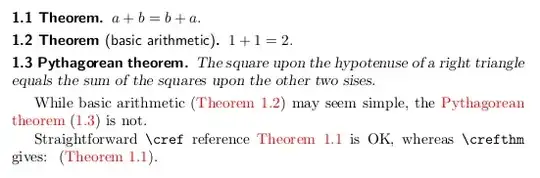
Method 1: Get the type/counter with cleveref's \cref@gettype (see https://tex.stackexchange.com/a/692754/105447) and the rest with refcount's \getrefbykeydefault:
\documentclass{memoir}
\usepackage{xstring}
\usepackage{suffix}
\usepackage{amsthm,thmtools}
\swapnumbers
\usepackage{hyperref}
\hypersetup{colorlinks,linkcolor=red}
\usepackage[nameinlink,noabbrev,capitalize]{cleveref}
% \usepackage{crossreftools} % <--- how eliminate?
\makeatletter
\declaretheoremstyle[
  headfont=\bfseries\sffamily,
  headpunct={\bfseries\sffamily.},
  postheadspace=0.5em,
  notefont=\sffamily\mdseries,
  headformat=\NAME\NUMBER\let\thmt@space@empty\NOTE,
  bodyfont=\mdseries\slshape,
]{thmstyle}
\declaretheoremstyle[
  headfont=\bfseries\sffamily,
  postheadspace=0.5em,
  notefont=\bfseries\sffamily,
  notebraces={}{},
  headformat=\NUMBER\let\thmt@space@empty\NOTE,
  bodyfont=\mdseries\slshape,
]{namedthmstyle}
\makeatother
\declaretheorem[name=Theorem, style=thmstyle, numberwithin=chapter]{theorem}
\declaretheorem[name=Theorem, style=namedthmstyle, title={}, numberlike=theorem]{namedtheorem}
\crefname{theorem}{Theorem}{Theorems}
\Crefname{theorem}{Theorem}{Theorems}
\crefname{namedtheorem}{Theorem}{Theorems}
\Crefname{namedtheorem}{Theorem}{Theorems}
% --> HERE is where crossreftools is exploited <--
% Allow names in cross-reference to named theorems, etc.,...
% and optional argument names of theorems, etc:
\newcommand{\mytemptype}{}
\makeatletter
\newcommand{\crefthm}[1]{%
  \cref@gettype{#1}{\mytemptype}%
  \IfStrEqCase{\mytemptype}{%
    {namedtheorem}{\crefthmname{#1}~(\ref{#1})}%
    }%
    [\crefthmname{#1}~(\cref{#1})]%
}
\WithSuffix\newcommand\crefthm[1]{%
  \cref@gettype{#1}{\mytemptype}%
  \IfStrEqCase{\mytemptype}{%
    {namedtheorem}{\crefthmname{#1}~(\ref{#1})}%
    }%
    [\crefthmname{#1}~(\cref{#1})]%
}
\makeatother
% For upper-casing, i.e., leave names as is:
\newcommand{\crefthmname}[1]{%
 \hyperlink{\getrefbykeydefault{#1}{anchor}{}}{\getrefbykeydefault{#1}{name}{}}}
\WithSuffix\newcommand\crefthmname[1]{\getrefbykeydefault{#1}{name}{}}
\newcommand{\Crefthmname}[1]{%
  \hyperlink{\getrefbykeydefault{#1}{anchor}{}}{\getrefbykeydefault{#1}{name}{}}}
\WithSuffix\newcommand\Crefthmname*[1]{\getrefbykeydefault{#1}{name}{}}
\begin{document}
\mainmatter
\chapter{Math}
\begin{theorem}\label{thm:plain}
    $a + b = b + a$.
\end{theorem}
\begin{theorem}[basic arithmetic]\label{thm:simple}
    $1+1=2$.
\end{theorem}
\begin{namedtheorem}[Pythagorean theorem]\label{thm:pythag}
    The square upon the hypotenuse of a right triangle equals
    the sum of the squares upon the other two sises.
\end{namedtheorem}
While \crefthm*{thm:simple} may seem simple,
the \crefthm{thm:pythag} is not.
Straightforward \verb!\cref! reference \cref{thm:plain} is OK, whereas \verb!\crefthm! gives: \crefthm{thm:plain}.
\end{document}
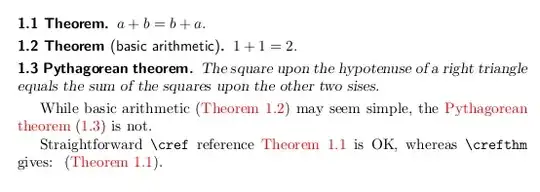
Method 2: Using the new ltproperties module:
(Proof of concept. I'd use method 1 myself, since there's no need to set any additional labels. The data is already there.)
\documentclass{memoir}
\usepackage{xstring}
\usepackage{suffix}
\usepackage{amsthm,thmtools}
\swapnumbers
\usepackage{hyperref}
\hypersetup{colorlinks,linkcolor=red}
\usepackage[nameinlink,noabbrev,capitalize]{cleveref}
% \usepackage{crossreftools} % <--- how eliminate?
\makeatletter
\declaretheoremstyle[
  headfont=\bfseries\sffamily,
  headpunct={\bfseries\sffamily.},
  postheadspace=0.5em,
  notefont=\sffamily\mdseries,
  headformat=\NAME\NUMBER\let\thmt@space@empty\NOTE,
  bodyfont=\mdseries\slshape,
]{thmstyle}
\declaretheoremstyle[
  headfont=\bfseries\sffamily,
  postheadspace=0.5em,
  notefont=\bfseries\sffamily,
  notebraces={}{},
  headformat=\NUMBER\let\thmt@space@empty\NOTE,
  bodyfont=\mdseries\slshape,
]{namedthmstyle}
\makeatother
\declaretheorem[name=Theorem, style=thmstyle, numberwithin=chapter]{theorem}
\declaretheorem[name=Theorem, style=namedthmstyle, title={}, numberlike=theorem]{namedtheorem}
\crefname{theorem}{Theorem}{Theorems}
\Crefname{theorem}{Theorem}{Theorems}
\crefname{namedtheorem}{Theorem}{Theorems}
\Crefname{namedtheorem}{Theorem}{Theorems}
% --> HERE is where crossreftools is exploited <--
% Allow names in cross-reference to named theorems, etc.,...
% and optional argument names of theorems, etc:
\ExplSyntaxOn
\bool_new:N \l__murray_inside_thm_bool % or any kind of boolean you prefer
\AddToHookWithArguments{label}{
  \bool_if:NT \l__murray_inside_thm_bool
    { \RecordProperties{#1.thm}{counter,title,target} }
}
\AddToHook{env/theorem/begin}{ \bool_set_true:N \l__murray_inside_thm_bool }
\AddToHook{env/namedtheorem/begin}{ \bool_set_true:N \l__murray_inside_thm_bool }
% Add any other theorem environments you use here...
\ExplSyntaxOff
\newcommand{\crefthm}[1]{%
  \IfStrEqCase{\RefProperty{#1.thm}{counter}}{%
    {namedtheorem}{\crefthmname{#1}~(\ref{#1})}%
    }%
    [\crefthmname{#1}~(\cref{#1})]%
}
\WithSuffix\newcommand\crefthm[1]{%
  \IfStrEqCase{\RefProperty{#1.thm}{counter}}{%
    {namedtheorem}{\crefthmname{#1}~(\ref{#1})}%
    }%
    [\crefthmname{#1}~(\cref{#1})]%
}
% For upper-casing, i.e., leave names as is:
\newcommand{\crefthmname}[1]{%
 \hyperlink{\RefProperty{#1.thm}{target}}{\RefProperty{#1.thm}{title}}}
\WithSuffix\newcommand\crefthmname[1]{\RefProperty{#1.thm}{title}}
\newcommand{\Crefthmname}[1]{%
  \hyperlink{\RefProperty{#1.thm}{target}}{\RefProperty{#1.thm}{title}}}
\WithSuffix\newcommand\Crefthmname*[1]{\RefProperty{#1.thm}{title}}
\begin{document}
\mainmatter
\chapter{Math}
\begin{theorem}\label{thm:plain}
    $a + b = b + a$.
\end{theorem}
\begin{theorem}[basic arithmetic]\label{thm:simple}
    $1+1=2$.
\end{theorem}
\begin{namedtheorem}[Pythagorean theorem]\label{thm:pythag}
    The square upon the hypotenuse of a right triangle equals
    the sum of the squares upon the other two sises.
\end{namedtheorem}
While \crefthm*{thm:simple} may seem simple,
the \crefthm{thm:pythag} is not.
Straightforward \verb!\cref! reference \cref{thm:plain} is OK, whereas \verb!\crefthm! gives: \crefthm{thm:plain}.
\end{document}
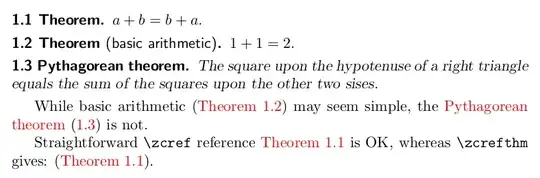
Alternative: Using zref-clever.
Since discussion in the comments suggested it might be of interest.
It turns out things are slightly simpler to set up, since zref makes it more straightforward to extract the references to different properties, and zref-clever allows for more flexibility with optional arguments, so we don't have to handle the hyperlink anchor manually. I also leveraged ltcmd (formerly xparse) and expl3 to also drop the dependencies on xstring and suffix.
\documentclass{memoir}
\usepackage{amsthm,thmtools}
\swapnumbers
\usepackage{hyperref}
\hypersetup{colorlinks,linkcolor=red}
\usepackage{zref-clever}
\zcsetup{
  cap,
  noabbrev,
  countertype={namedtheorem=theorem},
}
\usepackage{zref-titleref,zref-counter}
\makeatletter
\declaretheoremstyle[
  headfont=\bfseries\sffamily,
  headpunct={\bfseries\sffamily.},
  postheadspace=0.5em,
  notefont=\sffamily\mdseries,
  headformat=\NAME\NUMBER\let\thmt@space@empty\NOTE,
  bodyfont=\mdseries\slshape,
]{thmstyle}
\declaretheoremstyle[
  headfont=\bfseries\sffamily,
  postheadspace=0.5em,
  notefont=\bfseries\sffamily,
  notebraces={}{},
  headformat=\NUMBER\let\thmt@space@empty\NOTE,
  bodyfont=\mdseries\slshape,
]{namedthmstyle}
\makeatother
\declaretheorem[name=Theorem, style=thmstyle, numberwithin=chapter]{theorem}
\declaretheorem[name=Theorem, style=namedthmstyle, title={}, numberlike=theorem]{namedtheorem}
% Note that this implementation requires that a single label be received as
% the mandatory argument of \zcrefthm.  But it is the same as with yours.
\ExplSyntaxOn
\makeatletter
\NewDocumentCommand{\zcrefthm}{sO{}m}{
  \tl_if_empty:eF { \zref@extractdefault {#3} { title } { } }
    {
      \IfBooleanTF{#1}
        { \zcref*[noname,ref=title]{#3} }
        { \zcref[noname,ref=title]{#3}  }
      \nobreakspace
    }
  \tl_if_eq:enTF
    { \zref@extractdefault {#3} { counter } { } } { namedtheorem }
    { (\zcref[noname,#2]{#3}) }
    { (\zcref[#2]{#3}) }
}
\makeatother
\ExplSyntaxOff
\begin{document}
\mainmatter
\chapter{Math}
\begin{theorem}\label{thm:plain}
    $a + b = b + a$.
\end{theorem}
\begin{theorem}[basic arithmetic]\label{thm:simple}
    $1+1=2$.
\end{theorem}
\begin{namedtheorem}[Pythagorean theorem]\label{thm:pythag}
    The square upon the hypotenuse of a right triangle equals
    the sum of the squares upon the other two sises.
\end{namedtheorem}
While \zcrefthm*{thm:simple} may seem simple, the \zcrefthm{thm:pythag} is
not.
Straightforward \verb!\zcref! reference \zcref{thm:plain} is OK, whereas
\verb!\zcrefthm! gives: \zcrefthm{thm:plain}.
\end{document}
 Here is the source:


cleveref(which I think is the equivalent of\crtcrefcounter). For the anchor and name, you could probably rely onrefcount. Off-topic: alas, your reasons for not wanting to usecrossreftoolsseem a bit unfair. Just because a package has no recent update, it doesn't mean it is not working or not maintained. The latest version ofcleverefitself is from 2018... – gusbrs Dec 05 '23 at 22:10refcountcan provide the names; I am trying to get the contents of the theorem note field, after all. (But your comment about package status is well-taken!) – murray Dec 05 '23 at 22:32\getrefbykeydefault{thm:pythag}{name}{}. – gusbrs Dec 05 '23 at 22:52\getrefbykeydefaultcome from? I don't find it in the docs forhyperreforcleveref. – murray Dec 05 '23 at 23:24refcount! ;-) I thinkhyperref(ornameref) loads it for you. Btw, I think you have everything you need to answer, but if you are interested in azref-cleveranswer, I can provide one. – gusbrs Dec 05 '23 at 23:32\getrefbykeydefaultinrefcount. But I'd like to see, also, azref-cleveranswer. Then I'll have 3 ways to approach this and can see which is the most appropriate for my needs. – murray Dec 06 '23 at 01:45\cref@gettypeandrefcount(and accept it, because it is the answer to the actual question). – gusbrs Dec 06 '23 at 01:59ltpropertiesis also an alternative for this. – gusbrs Dec 06 '23 at 17:24\getrefbykeydefaultcan grab the "note" field (the optional argument from something like\begin{theorem}[some description]. I don't see in the\refcountany key for that. – murray Dec 07 '23 at 01:53namefield (forrefcount). The standard label has only 4 fields (actually five, but...): the ref, the page, the anchor, and the name/title. So it can only be in the name, and indeed that's where it is stored. – gusbrs Dec 07 '23 at 03:10