Here was my original naive attempt:
\node (A) [above=0.5cm of I] {$\delta$};
\draw[arrow] (R.north) |- (A.south) -| (S.north);
User Sandy G gives a better option which is to use a technique which was surprisingly difficult to research (turns out googling --++ is tough); I found this OLD (11yr) post which talks about it: TiKz dash dash plus plus
which led me to the TikZ manual section 13.4 Relative and Incremental Coordinates
We can specify a relative coordinate using ++ before a new path coordinate to make it relative to the coordinate which came before it in the path. From the manual:
You can prefix coordinates by ++ to make them “relative”. A coordinate such as ++(1cm,0pt) means “1cm to the right of the previous position, making this the new current position”. Relative coordinates are often useful in “local” contexts:
This makes it as easy as:
\draw[arrow] (R.north) -- ++(0,0.5) -| (S.north) node[above, pos=0.25] {$\delta$};
This will draw a node from the north of node R, up 0.5, then connect to the north of S but take a sharp turn to get there (specified by -|). A node is placed 0.25 above the path (which happens to be symmetrical) and filled with $\delta$.
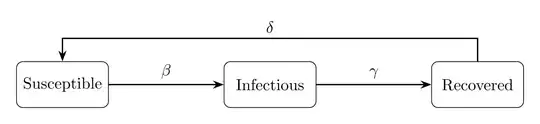
Both answers will give roughly the same image, but I thought you'd enjoy seeing multiple perspectives.
MWE:
\documentclass[tikz, border=10pt]{standalone}
\usetikzlibrary{positioning, arrows.meta}
\begin{document}
\begin{tikzpicture}[
    node distance=2.5cm,
    arrow/.style={->, >=Stealth, thick},
    box/.style={draw, rectangle, rounded corners, minimum width=2cm, minimum height=1cm, align=center}
    ]
% Nodes
\node[box] (S) {Susceptible};
\node[box, right=of S] (I) {Infectious};
\node[box, right=of I] (R) {Recovered};

% Arrows
\draw[arrow] (S) -- node[above]{$\beta$} (I);
\draw[arrow] (I) -- node[above]{$\gamma$} (R);

% My Naive Attempt
% \node (A) [above=0.5cm of I] {$\delta$};
% \draw[arrow] (R.north) |- (A.south) -| (S.north);

% Sandy G's code
\draw[arrow] (R.north) -- ++(0,.5) -| (S.north) node[above, pos=0.25] {$\delta$};


\end{tikzpicture}
\end{document}


\draw[arrow] (R.north) --++(0,.5) -| (S.north)node[above, pos=.25]{$\delta$};– Sandy G Jan 09 '24 at 19:37