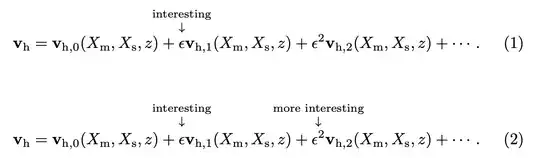
You can do it with \overset, where the upper part is a zero width tabular in the appropriate size, namely, \scriptsize.
In case you have various annotations, you may need to help TeX in order to get them at the same vertical position.
\documentclass{article}
\usepackage{amsmath}
\newcommand{\annot}[2]{% #1 symbol to annotate, #2 = text
  \overset{%
    \makebox[0pt]{%
      \normalfont\scriptsize
      \begin{tabular}{@{}c@{}} #2 \ $\downarrow$ \end{tabular}%
    }%
  }{\mathstrut #1}%
}
\begin{document}
\begin{equation}
\mathbf{v}{\mathrm{h}}=
\mathbf{v}{\mathrm{h},0}(X_{\mathrm{m}},X_{\mathrm{s}}, z)
  +\annot{\epsilon}{interesting}\mathbf{v}{\mathrm{h},1}(X{\mathrm{m}},X_{\mathrm{s}}, z)
  +\epsilon^2\mathbf{v}{\mathrm{h},2}(X{\mathrm{m}},X_{\mathrm{s}}, z)
  +\dotsb.
\end{equation}
\begin{equation}
\mathbf{v}{\mathrm{h}}=
\mathbf{v}{\mathrm{h},0}(X_{\mathrm{m}},X_{\mathrm{s}}, z)
  +\annot{\epsilon\vphantom{\epsilon^2}}{interesting}
   \mathbf{v}{\mathrm{h},1}(X{\mathrm{m}},X_{\mathrm{s}}, z)
  +\annot{\epsilon^2}{more interesting}
   \mathbf{v}{\mathrm{h},2}(X{\mathrm{m}},X_{\mathrm{s}}, z)
  +\dotsb.
\end{equation}
\end{document}
Note the omission of the useless \left and \right tokens, but also \dotsb instead of \cdots.
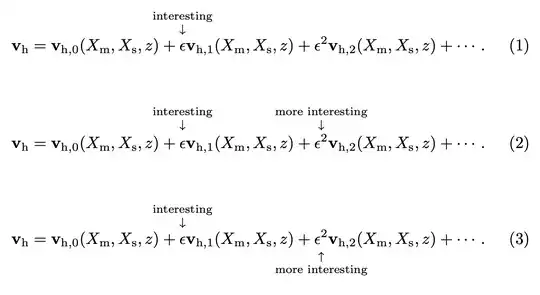
You can modify the code to allow for both above and below annotation: below positioning is obtained with \annot*.
\documentclass{article}
\usepackage{amsmath}
\NewDocumentCommand{\annot}{smm}{%
  % if *, below, otherwise above
  % #2 = symbol to annotate
  % #3 = text
  \IfBooleanTF{#1}{%
    \innerannot{\underset}{#2}{#3}{\textuparrow}%
  }{%
    \innerannot{\overset}{#2}{\textdownarrow}{#3}%
  }%
}
\NewDocumentCommand{\innerannot}{mmmm}{%
  #1{% \overset or underset
     \makebox[0pt]{%
       \normalfont\scriptsize
       \begin{tabular}{@{}c@{}} #4 \ #3 \end{tabular}%
    }%
  }{\mathstrut #2}%
}
\begin{document}
\begin{equation}
\mathbf{v}{\mathrm{h}}=
\mathbf{v}{\mathrm{h},0}(X_{\mathrm{m}},X_{\mathrm{s}}, z)
  +\annot{\epsilon}{interesting}\mathbf{v}{\mathrm{h},1}(X{\mathrm{m}},X_{\mathrm{s}}, z)
  +\epsilon^2\mathbf{v}{\mathrm{h},2}(X{\mathrm{m}},X_{\mathrm{s}}, z)
  +\dotsb.
\end{equation}
\begin{equation}
\mathbf{v}{\mathrm{h}}=
\mathbf{v}{\mathrm{h},0}(X_{\mathrm{m}},X_{\mathrm{s}}, z)
  +\annot{\epsilon\vphantom{\epsilon^2}}{interesting}
   \mathbf{v}{\mathrm{h},1}(X{\mathrm{m}},X_{\mathrm{s}}, z)
  +\annot{\epsilon^2}{more interesting}
   \mathbf{v}{\mathrm{h},2}(X{\mathrm{m}},X_{\mathrm{s}}, z)
  +\dotsb.
\end{equation}
\begin{equation}
\mathbf{v}{\mathrm{h}}=
\mathbf{v}{\mathrm{h},0}(X_{\mathrm{m}},X_{\mathrm{s}}, z)
  +\annot{\epsilon}{interesting}
   \mathbf{v}{\mathrm{h},1}(X{\mathrm{m}},X_{\mathrm{s}}, z)
  +\annot*{\epsilon^2}{more interesting}
   \mathbf{v}{\mathrm{h},2}(X{\mathrm{m}},X_{\mathrm{s}}, z)
  +\dotsb.
\end{equation}
\end{document}


\textnormalhere; instead, use\mathrm. – Mico Jan 19 '24 at 13:21