I wonder what to do to get a new macro after \GetCsVar with the meaning macro:->Hallo\thinspace you like the \txt-macro.
The problem is to expand \GetCsVar and \the \count 1 and \csname but not the initial \thinspace.
If you really want to do it via expansion, be aware that three single expansion steps need to be triggered which requires inserting sequences of 2k-1; k=3 tokens \expandafter = 7 tokens \expandafter.
The first expansion step delivers the replacement text of \GetCsVar with parameters replaced by the arguments grabbed from the token stream. That replacement text is a \csname..\endcsname-thingie.
The second expansion step turns the \csname..\endcsname-thingie into the corresponding control sequence token. In case that control sequence token is not already having a meaning/is undefined in the current scope, then it (only in the current scope, even if \globaldefs has a positive value) also is given the meaning of the primitive \relax.
The third expansion step - in case it is expandable - delivers "toplevel-expansion" of that control sequence token.
But I suggest avoiding expanding the macro whose definition/meaning is to be "copied":
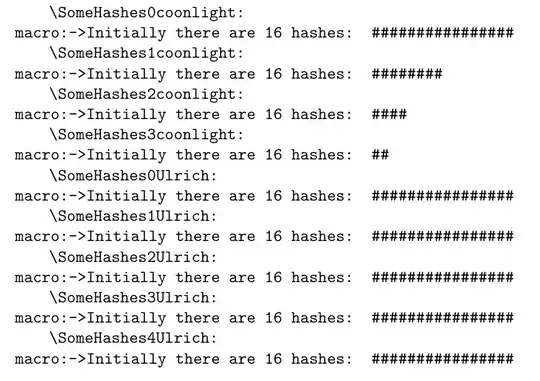
In the edge case of the ⟨replacement text⟩ of the definition of the macro to be copied containing several consecutive hashes, the ⟨replacement text⟩ of the definition of the macro which holds the copy might be different from the ⟨replacement text⟩ of the definition of the macro which holds the original. This is because two consecutive hashes ## in the ⟨replacement text⟩ of the definition of a macro are collapsed into a single hash # at the time of obtaining the replacement text due to expanding that macro.
You loose information about definition-prefixes like \long (or \protected when using a TeX-engine with builtin expansion-protection.)
You might not have heard about the \expandafter\endcsname\csname-trick yet...
In order to avoid the need of expanding macros and hereby loosing information about definition-prefixes and hereby facing the circumstance that with each expansion amounts of consecutive hashes occurring in the replacement text are halved I suggest using only \let, no intermediate scratch-macro-assignment.
\tt
%----------------------------------------------------------------------
\def\GetCsVarExp#1#2{%
  \expandafter\let\csname#2\expandafter\endcsname\csname#1\endcsname
}%
%----------------------------------------------------------------------
% Save content of a macro via \csname
\def\LetCsVar#1#2{\expandafter\let\csname#1\endcsname=#2}% #1=name, #2=definition
% Get the previous saved content of a macro via \csname
\def\GetCsVar#1{\csname#1\endcsname}% #1=name
\def\txt{Hello\thinspace you}%
txt: \meaning\txt % prints: txt: macro:->Hallo\thinspace you
\count1=1
\LetCsVar{test\the\count1}{\txt}%
% \txt can change here
\def\txt{Holla}%
\GetCsVarExp{test\the\count1}{d}%
d: \meaning\d      % prints: d: macro:->Hallo\thinspace you.
\bye
Let's exhibit the difference by defining a macro which expands to a bunch of hashes and seeing what happens to the definitions when "copying":
%----------------------------------------------------------------------
\tt
\def\GetCsVarExpcoonlight#1#2{%
  \expandafter\expandafter\expandafter\def
  \expandafter\expandafter\expandafter\ax
  \expandafter\expandafter\expandafter{%
    \csname#1\endcsname
  }%
  \expandafter\let\csname#2\endcsname=\ax
}%
%----------------------------------------------------------------------
\def\GetCsVarExpUlrich#1#2{%
  \expandafter\let\csname#2\expandafter\endcsname\csname#1\endcsname
}%
%----------------------------------------------------------------------
% Save content of a macro via \csname
\def\LetCsVar#1#2{\expandafter\let\csname#1\endcsname=#2}% #1=name, #2=definition
% Get the previous saved content of a macro via \csname
\def\GetCsVar#1{\csname#1\endcsname}% #1=name
\def\SomeHashes{Initially there are 16 hashes: ################}%
%----------------------------------------------------------------------
\LetCsVar{SomeHashes0coonlight}{\SomeHashes}%
\expandafter\string\csname SomeHashes0coonlight\endcsname:\hfil\break
\expandafter\meaning\csname SomeHashes0coonlight\endcsname
%----------------------------------------------------------------------
\GetCsVarExpcoonlight{SomeHashes0coonlight}{SomeHashes1coonlight}%
\expandafter\string\csname SomeHashes1coonlight\endcsname:\hfil\break
\expandafter\meaning\csname SomeHashes1coonlight\endcsname
\GetCsVarExpcoonlight{SomeHashes1coonlight}{SomeHashes2coonlight}%
\expandafter\string\csname SomeHashes2coonlight\endcsname:\hfil\break
\expandafter\meaning\csname SomeHashes2coonlight\endcsname
\GetCsVarExpcoonlight{SomeHashes2coonlight}{SomeHashes3coonlight}%
\expandafter\string\csname SomeHashes3coonlight\endcsname:\hfil\break
\expandafter\meaning\csname SomeHashes3coonlight\endcsname
% This would yield an error as the single hash is taken
% for s.th. that denotes a parameter in wrong ways (single
% hash not trailed by single digit in range 1..9; no
% parameters declared in the definition's parameter text, thus
% parameters #1 .. #9 may not occur in the replacement text) :
%\GetCsVarExpcoonlight{SomeHashes3coonlight}{SomeHashes4coonlight}%
%\expandafter\string\csname SomeHashes4coonlight\endcsname:\hfil\break
%\expandafter\meaning\csname SomeHashes4coonlight\endcsname
%----------------------------------------------------------------------
\LetCsVar{SomeHashes0Ulrich}{\SomeHashes}%
\expandafter\string\csname SomeHashes0Ulrich\endcsname:\hfil\break
\expandafter\meaning\csname SomeHashes0Ulrich\endcsname
%----------------------------------------------------------------------
\GetCsVarExpUlrich{SomeHashes0Ulrich}{SomeHashes1Ulrich}%
\expandafter\string\csname SomeHashes1Ulrich\endcsname:\hfil\break
\expandafter\meaning\csname SomeHashes1Ulrich\endcsname
\GetCsVarExpUlrich{SomeHashes1Ulrich}{SomeHashes2Ulrich}%
\expandafter\string\csname SomeHashes2Ulrich\endcsname:\hfil\break
\expandafter\meaning\csname SomeHashes2Ulrich\endcsname
\GetCsVarExpUlrich{SomeHashes2Ulrich}{SomeHashes3Ulrich}%
\expandafter\string\csname SomeHashes3Ulrich\endcsname:\hfil\break
\expandafter\meaning\csname SomeHashes3Ulrich\endcsname
% This does not yield an error:
\GetCsVarExpUlrich{SomeHashes3Ulrich}{SomeHashes4Ulrich}%
\expandafter\string\csname SomeHashes4Ulrich\endcsname:\hfil\break
\expandafter\meaning\csname SomeHashes4Ulrich\endcsname
%----------------------------------------------------------------------
\bye
In case you are interested:
As described in answers to other questions, using #{-notation you can implement a macro \CsNameToCsToken with the following syntax:
\CsNameToCsToken⟨stuff not in braces⟩{⟨NameOfCs⟩}
→
⟨stuff not in braces⟩\NameOfCs
(⟨stuff not in braces⟩ may be empty.)
Definition in plain-TeX:
\chardef\stopromannumeral=`\^^00 %
\long\def\CsNameToCsToken#1#{\romannumeral\InnerCsNameToCsToken{#1}}%
\long\def\InnerCsNameToCsToken#1#2{%
  \expandafter\exchange\expandafter{\csname#2\endcsname}{\stopromannumeral#1}%
}%
\long\def\exchange#1#2{#2#1}%
(Due to \romannumeral-expansion the result is obtained by triggering two expansion-steps, e.g., by having two "hits" with \expandafter which requires sequences of 2k-1; k=2 tokens \expandafter= sequences of 3 tokens \expandafter.)
With such a macro you are not bound to specific definition commands:
\CsNameToCsToken{foo} → \foo .
\CsNameToCsToken\newcommand{foo} → \newcommand\foo .
\CsNameToCsToken\DeclareRobustCommand{foo} → \DeclareRobustCommand\foo .
\CsNameToCsToken\NewDocumentCommand{foo} → \NewDocumentCommand\foo .
\CsNameToCsToken\global\long\outer\def{foo} → \global\long\outer\def\foo .
\CsNameToCsToken\expandafter{foo}\bar → \expandafter\foo\bar .
\CsNameToCsToken\expandafter\foo{bar} → \expandafter\foo\bar .
\CsNameToCsToken\CsNameToCsToken\expandafter{foo}{bar} → \CsNameToCsToken\expandafter\foo{bar} → \expandafter\foo\bar .
\CsNameToCsToken\string{foo} → \string\foo .
\CsNameToCsToken\meaning{foo} → \meaning\foo .
\CsNameToCsToken\let{foo}=\bar → \let\foo=\bar .
\CsNameToCsToken\let\foo={bar} → \let\foo=\bar .
\CsNameToCsToken\CsNameToCsToken\global\let{foo=}{bar} → \CsNameToCsToken\global\let\foo={bar} → \global\let\foo=\bar .
With \long\def\PassFirstToSecond#1#2{#2{#1}} and \def\bar{AAA}:
\CsNameToCsToken\PassFirstToSecond{bar}{\CsNameToCsToken\expandafter\def\expandafter{foo}\expandafter}
→ \PassFirstToSecond\bar{\CsNameToCsToken\expandafter\def\expandafter{foo}\expandafter}
→ \CsNameToCsToken\expandafter\def\expandafter{foo}\expandafter{\bar}
→ \expandafter\def\expandafter\foo\expandafter{\bar}
→ \def\foo{AAA} .
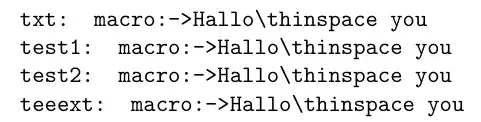
In your scenario you could do:
\tt
%------------------------------------------------------------------------------
\chardef\stopromannumeral=`\^^00 %
\long\def\CsNameToCsToken#1#{\romannumeral\InnerCsNameToCsToken{#1}}%
\long\def\InnerCsNameToCsToken#1#2{%
  \expandafter\exchange\expandafter{\csname#2\endcsname}{\stopromannumeral#1}%
}%
\long\def\exchange#1#2{#2#1}%
%------------------------------------------------------------------------------
\def\txt{Hallo\thinspace you}
txt: \meaning\txt  % prints: txt: macro:->Hallo\thinspace you
\CsNameToCsToken\let{test1}=\txt
test1: \CsNameToCsToken\meaning{test1}% prints: test1: macro:->Hallo\thinspace you
\CsNameToCsToken\CsNameToCsToken\let{test2}={test1}%
test2: \CsNameToCsToken\meaning{test2}% prints: test2: macro:->Hallo\thinspace you
\CsNameToCsToken\let\teeext={test2}%
teeext: \meaning\teeext % prints: teeext: macro:->Hallo\thinspace you
\bye
In a comment you say you couldn't find out how to set all the \expandafter.
You might be interested in the answers to How can I know the number of expandafters when appending to a csname macro?.


\def \axand then do\letrather than simply defining \csname#2\endcsname directly? – David Carlisle Mar 08 '24 at 13:55