6

I want to create a reference page which defines the notation which is used throughout a book I am writing. I would preferably like this page to go inside of the front cover, or inside of the back cover. For example, if the reader didn't recall the definition of some term, I would like the reader to be able to flip to the back of the book and see something like this:

$C[a,b]$: The space of continuous functions defined on $[a,b]$.

$C^{1}[a,b]$: The space of differentiable functions with continuous derivatives defined on $[a,b]$.

. . . and so on. Is there any easy and elegant way to do this?

user14717
  • 651
  • 4
  • 10
  • In the humanities, it is very common for there to be a list of abbreviations. Normally, it is put at the front of the book (but after the ToC and much of the front matter) unless the book uses endnotes, in which case the abbreviations are put right before the endnotes (where the abbreviations are most likely to be used). It is usually set in what amounts to a two-column table, organized alphabetically to the extent that is possible: <abbrev.> & <full description/explanation>. I have no idea whether math- or science-based fields follow similar conventions. – jon Mar 07 '13 at 21:03
  • 4
    It looks as if the nomencl package might be what you need. – Brent.Longborough Mar 07 '13 at 21:13
  • Or why not just type up a table and use the standard cross-references to point to where each symbol is introduced? – DGrady Mar 07 '13 at 22:42
  • 1
    In fact the memoir class already has its own implementation of the glossaries package, see Section 17.3 of the manual. – Carsten Thiel Jun 27 '13 at 14:24
  • Can you give an explicit example of exactly what program calls, with what options (besides the runs of [pdf]latex, of course), allow creating a glossary with the memoirclass -- given that one includes in the source .tex file the commands \makeglossary and \printglossary along with syntactically correct \glossary entries? – murray Jul 30 '16 at 01:08

1 Answers1

5

As Brent.Longborough mentioned in his comment, one option would be to use the nomencl package. Another option (allowing you to have not only the symbols and their descriptions, but also the page(s) in which they occur (typically one would use the page in which the concept is defined)) would be to use the glossaries package; a little example:

\documentclass[a4paper]{memoir}
\usepackage[style=super]{glossaries}
\makeglossaries

\renewcommand\glossaryname{List of Symbols}

\newglossaryentry{Cab}{name={$C[a,b]$},
sort=C,
description={The space of continuous functions defined on $[a,b]$}
}

\newglossaryentry{C1ab}{name={$C^{1}[a,b]$},
sort=C,
description={The space of differentiable functions with continuous derivatives defined on $[a,b]$},
}

\begin{document}

Next, we introduce The space \gls{Cab} of continuous functions defined on $[a,b]$ and its subspace \gls{C1ab} of differentiable functions with continuous derivatives defined on $[a,b]$.

\printglossaries

\end{document}

an image of the first page of the resulting document:

enter image description here

and an image of the resulting "List of Terms":
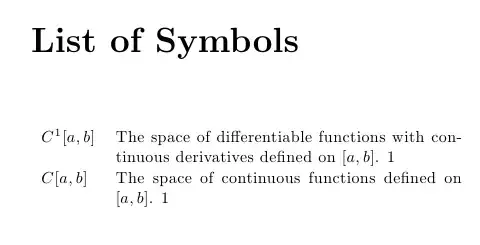
enter image description here

The glossaries package offers you many customization possibilities; please refer to the package documentation.

Gonzalo Medina
  • 505,128