I have the following Latex code, where I use biber and chicago style for citations:
\documentclass[12pt,a4paper]{article}
\usepackage[english,ngerman]{babel}
\usepackage[utf8]{inputenc}
\usepackage[authordate,bibencoding=auto,strict,backend=biber]{biblatex-chicago}
\selectlanguage{ngerman}

\bibliography{bibliography}

\begin{document}

    \cite{Herlocker2004}

    \newpage

    \printbibliography
\end{document}
And this bibliography.bib:
@article{Herlocker2004,
author = {Herlocker, Jonathan L. and Konstan, Joseph a. and Terveen, Loren G. and Riedl, John T.},
journal = {ACM Transactions on Information Systems},
month = jan,
number = {1},
pages = {5--53},
title = {{Evaluating collaborative filtering recommender systems}},
volume = {22},
year = {2004}
}
This produces
Herlocker u.a. 2004
But I want to put the year in brackets, and replace the german u.a. with et al., so that it looks like this
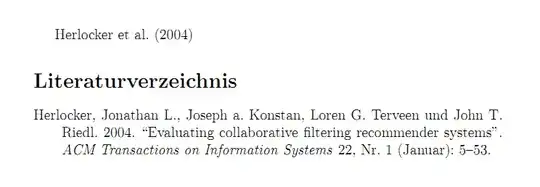
Herlocker et al. (2004)
Is there any way to format my citations like this?




\citetis just an alias for the standardbiblatex\textcite(with the addition of the starred option), one might add.\textcitedoes not need thenatbibcompatibility mode. – moewe Sep 07 '14 at 14:18\textciteworked fine for me withbiblatex. Seems logical to avoidnatbibcompatibility mode, if I've already chosenbiblatex? This is also the simplest answer. I now have brackets()around the date where I need them. Unless there's a reason not to do it this way? – Dave Everitt Sep 13 '15 at 20:21natbibcompatibility mode has a few side-effects besides allowing to use\citetand\citep(you can find the definitions inblx-natbib.def): the starred versions of\citecommands differ and the delimiter between year and date inauthoryear-like styles is set to\addcomma\space. So I generally don't use it if I don't neednatbib-like commands. I just commented because I felt that one could take the first few lines in the answer to mean that it is thenatbib-option that allows us to have parenthetical citations (but there is\parencite). – moewe Sep 14 '15 at 05:37