Yes, you can measure the width. With
\sbox0{$\scriptstyle N-$}
and one
\hspace*{.5\wd0}
before and after the actual content would solve this.
But it is easier to use the text width key (or minimum width subtracting the /pgf/inner xsep values). You can use either \widthof (more robust) or PGFmath’s width function.
Furthermore you can also simply specify any arbitrary value for minimum width or text width.
And if you do not want to give the content before hand you can use the .aux file as in Dependent node size in TikZ.
Code
\documentclass[tikz,convert=false]{standalone}
\begin{document}
\begin{tikzpicture}[nodes=draw]
\node           {$v_{N-1}$};
\node at (0,-.5) {$v_0$};
\end{tikzpicture}
\begin{tikzpicture}[nodes={draw,align=center,text width=\widthof{$v_{N-1}$}}]
\node           {$v_{N-1}$};
\node at (0,-.5) {$v_0$};
\end{tikzpicture}
\begin{tikzpicture}[nodes={draw,align=center,text width=width("$v_{N-1}$")}]
\node           {$v_{N-1}$};
\node at (0,-.5) {$v_0$};
\end{tikzpicture}
\begin{tikzpicture}[nodes={draw,minimum width=+3.5em}]
\node           {$v_{N-1}$};
\node at (0,-.5) {$v_0$};
\end{tikzpicture}
\begin{tikzpicture}[nodes=draw]
\node           {$v_{N-1}$};
\node at (0,-.5) {\sbox0{$\scriptstyle N-$}\hspace*{.5\wd0}$v_0$\hspace*{.5\wd0}};
\end{tikzpicture}
\end{document}
Output
Original

\widthof{…}

width("…")

Arbitrary value
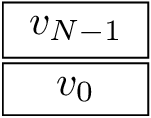
Measuring


\sbox0{$\scriptstyle N-$}and then you can use\hspace{.5\wd0}on both ends. But why don’t you use theminimum widthkey to esnure a certain width for all nodes (bubbles). Or even something like Dependent node size in TikZ? – Qrrbrbirlbel Aug 19 '13 at 22:24minimum widthkey. That fixed my problem. – Arrigo Aug 19 '13 at 22:59