The final line is printed as
\pld@R {4}{1}+\pld@R {1}{1}\pld@S {d}{1}
\pld@R has the meaning of \pld@Rational. Thus the following example redefines \pld@Rational. If the numerator and denominator are equal and a symbol (\pld@S) follows, then \pld@R{1}{1} will omit the factor before the symbol.
\documentclass{article}
\usepackage{polynom}

\makeatletter
\let\pldx@saved@PrintRational\pld@PrintRational
\renewcommand*{\pld@PrintRational}[2]{%
  \def\pldx@do{\pldx@PrintRational{#1}{#2}}%
  \futurelet\pldx@token\pldx@do
}
\newcommand*{\pldx@PrintRational}[2]{%
  \let\pldx@do\@firstofone
  \ifx\pldx@token\pld@S
    \def\pldx@a{#1}%
    \def\pldx@b{#2}%
    \ifx\pldx@a\pldx@b
      \let\pldx@do\@gobble
    \fi
  \fi
  \pldx@do{%
    \pldx@saved@PrintRational{#1}{#2}%
  }%
}
\makeatother

\begin{document}

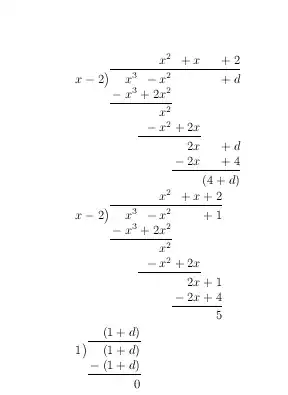
  \polylongdiv{x^3-x^2+d}{x-2}%

  \polylongdiv{x^3-x^2-3+d}{x-2}%

  % David Carlisle's test cases:

  \polylongdiv{x^3-x^2+1}{x-2}

  \polylongdiv{1+d}{1}

\end{document}




1+d, then the1will also vanish. – Heiko Oberdiek Sep 18 '13 at 20:14\pld@true/\letas next token was not specific enough for me. Thus I patched at a higher level. – Heiko Oberdiek Sep 18 '13 at 20:50