The following is a very elementary adaptation of the current grid feature (and has not been tested extensively). It extends it to add gridstep as a key-value (default is 1).
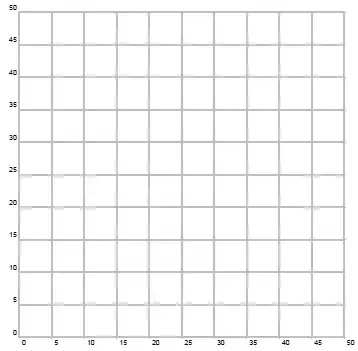
\documentclass[pstricks,border=12pt]{standalone}
\makeatletter
\define@key[psset]{pstricks}{gridstep}[1]{\def\psk@gridstep{/gridstep #1 def }}
\psset{gridstep=1}% Default grid step

\addto@pscode{
/StepGrid {
  newpath
  /a 4 string def
  /b ED %               psk@gridlabels in pt
  /c ED %               { \pst@usecolor\psgridlabelcolor }
  /n ED %               psk@griddots
  cvi dup 1 lt { pop 1 } if
  /s ED %               \psk@subgriddiv
  s div dup 0 eq { pop 1 } if
  /dy ED s div dup 0 eq { pop 1 } if %  \pst@number\psyunit abs
  /dx ED dy div round dy mul %      \pst@number\psxunit abs
  /y0 ED dx div round dx mul
  /x0 ED dy div round cvi
  /y2 ED dx div round cvi
  /x2 ED dy div round cvi
  /y1 ED dx div round cvi
  /x1 ED
  /h y2 y1 sub 0 gt { 1 } { -1 } ifelse def
  /w x2 x1 sub 0 gt { 1 } { -1 } ifelse def
  b 0 gt {
    /z1 b 4 div CLW 2 div add def
%    /Helvetica findfont b scalefont setfont
    /b b .95 mul CLW 2 div add def } if
  systemdict /setstrokeadjust known
    { true setstrokeadjust /t { } def }
    { /t { transform 0.25 sub round 0.25 add exch 0.25 sub round 0.25 add
       exch itransform } bind def } ifelse
  gsave n 0 gt { 1 setlinecap [ 0 dy n div ] dy n div 2 div setdash } { 2 setlinecap } ifelse
  /i x1 def
  /f y1 dy mul n 0 gt { dy n div 2 div h mul sub } if def
  /g y2 dy mul n 0 gt { dy n div 2 div h mul add } if def
  x2 x1 sub w mul 1 add dup 1000 gt { pop 1000 } if
  { i dx mul dup y0 moveto
    b 0 gt
      { gsave c i a cvs dup stringwidth pop
        /z2 ED w 0 gt {z1} {z1 z2 add neg} ifelse
    h 0 gt {b neg}{z1} ifelse
        rmoveto %
        i gridstep mod 0 eq { show } { pop } ifelse %show
        grestore } if
    dup t f moveto
    i gridstep mod 0 eq { g t L stroke } if %g t L stroke
    /i i w add def
  } repeat
  grestore
  gsave
  n 0 gt
  % DG/SR modification begin - Nov. 7, 1997 - Patch 1
  %{ 1 setlinecap [ 0 dx n div ] dy n div 2 div setdash }
    { 1 setlinecap [ 0 dx n div ] dx n div 2 div setdash }
  % DG/SR modification end
    { 2 setlinecap } ifelse
  /i y1 def
  /f x1 dx mul n 0 gt { dx n div 2 div w mul sub } if def
  /g x2 dx mul n 0 gt { dx n div 2 div w mul add } if def
  y2 y1 sub h mul 1 add dup 1000 gt { pop 1000 } if
  { newpath i dy mul dup x0 exch moveto
    b 0 gt { gsave c i a cvs dup stringwidth pop
      /z2 ED
      w 0 gt {z1 z2 add neg} {z1} ifelse
      h 0 gt {z1} {b neg} ifelse
      rmoveto %
      i gridstep mod 0 eq { show } { pop } ifelse %show
      grestore } if
    dup f exch t moveto
    i gridstep mod 0 eq {g exch t L stroke } if %g exch t L stroke
    /i i h add def
  } repeat
  grestore
} def
}
\def\tx@Grid{\psk@gridstep StepGrid }
\makeatother

\psset{unit=1mm}
\addtopsstyle{gridstyle}
{
    gridlabels=3pt,
    gridstep=5
}


\begin{document}
\begin{pspicture}[showgrid](50,50)

\end{pspicture}
\end{document}
Let's see what is going on here...
The original \psgrid macro (in pstricks.tex) sets a bunch of parameters and calls \tx@Grid, defined to be Grid . For completeness, here's a view on the \psgrid hierarchy:
\def\psgrid{\pst@object{psgrid}}
\def\psgrid@i{\@ifnextchar({\psgrid@ii}{\expandafter\psgrid@iv\pic@coor}}
\def\psgrid@ii(#1){\@ifnextchar({\psgrid@iii(#1)}{\psgrid@iv(0,0)(0,0)(#1)}}
\def\psgrid@iii(#1)(#2){\@ifnextchar({\psgrid@iv(#1)(#2)}{\psgrid@iv(#1)(#1)(#2)}}
\def\psgrid@iv(#1)(#2)(#3){%
  \begin@SpecialObj%
    \pst@getcoor{#1}\pst@tempA%  hv 1.11
    \pst@getcoor{#2}\pst@tempB%  hv 1.11
    \pst@@getcoor{#3}%
    \ifnum\psk@subgriddiv>1\relax
      \addto@pscode{
        gsave
        \tx@setStrokeTransparency
        \psk@subgridwidth SLW
        \pst@usecolor\pssubgridcolor
        \pst@tempB \pst@coor \pst@tempA                 % hv 1.11
%        \pst@number\psxunit \pst@number\psyunit        % hv 1.11
        \pst@number\psxunit abs \pst@number\psyunit abs % hv 1.11
        \psk@subgriddiv\space \psk@subgriddots\space
        {} 0
        \psk@gridfont findfont 0 scalefont setfont      % hv 1.16
    \tx@Grid
    grestore
      }%
    \fi%
    \addto@pscode{
      gsave
      \tx@setStrokeTransparency
      \psk@gridwidth SLW
      \pst@usecolor\psgridcolor
      \pst@tempB \pst@coor \pst@tempA                 % hv 1.11
      \pst@number\psxunit abs \pst@number\psyunit abs % hv 1.11
%      \pst@number\psxunit \pst@number\psyunit        % hv 1.11
      1 \psk@griddots\space { \pst@usecolor\psgridlabelcolor }
      \psk@gridlabels
      \psk@gridfont findfont \psk@gridlabels scalefont setfont  % hv 1.16
       \tx@Grid
      grestore
    }%
  \end@SpecialObj}
Note how it actually calls \tx@Grid twice. Once for the subgrid and once for the regular grid. From the definition of \tx@Grid, it should be clear that the actual grid is not typeset in TeX, but in Postscript. So, from pstricks.pro, here is the (Postscript) definition of Grid:
/Grid {
  newpath
  /a 4 string def
  /b ED %               psk@gridlabels in pt
  /c ED %               { \pst@usecolor\psgridlabelcolor }
  /n ED %               psk@griddots
  cvi dup 1 lt { pop 1 } if
  /s ED %               \psk@subgriddiv
  s div dup 0 eq { pop 1 } if
  /dy ED s div dup 0 eq { pop 1 } if %  \pst@number\psyunit abs
  /dx ED dy div round dy mul %      \pst@number\psxunit abs
  /y0 ED dx div round dx mul
  /x0 ED dy div round cvi
  /y2 ED dx div round cvi
  /x2 ED dy div round cvi
  /y1 ED dx div round cvi
  /x1 ED
  /h y2 y1 sub 0 gt { 1 } { -1 } ifelse def
  /w x2 x1 sub 0 gt { 1 } { -1 } ifelse def
  b 0 gt {
    /z1 b 4 div CLW 2 div add def
%    /Helvetica findfont b scalefont setfont
    /b b .95 mul CLW 2 div add def } if
  systemdict /setstrokeadjust known
    { true setstrokeadjust /t { } def }
    { /t { transform 0.25 sub round 0.25 add exch 0.25 sub round 0.25 add
       exch itransform } bind def } ifelse
  gsave n 0 gt { 1 setlinecap [ 0 dy n div ] dy n div 2 div setdash } { 2 setlinecap } ifelse
  /i x1 def
  /f y1 dy mul n 0 gt { dy n div 2 div h mul sub } if def
  /g y2 dy mul n 0 gt { dy n div 2 div h mul add } if def
  x2 x1 sub w mul 1 add dup 1000 gt { pop 1000 } if
  { i dx mul dup y0 moveto
    b 0 gt
      { gsave c i a cvs dup stringwidth pop
        /z2 ED w 0 gt {z1} {z1 z2 add neg} ifelse
    h 0 gt {b neg}{z1} ifelse
        rmoveto show grestore } if
    dup t f moveto
    g t L stroke
    /i i w add def
  } repeat
  grestore
  gsave
  n 0 gt
  % DG/SR modification begin - Nov. 7, 1997 - Patch 1
  %{ 1 setlinecap [ 0 dx n div ] dy n div 2 div setdash }
    { 1 setlinecap [ 0 dx n div ] dx n div 2 div setdash }
  % DG/SR modification end
    { 2 setlinecap } ifelse
  /i y1 def
  /f x1 dx mul n 0 gt { dx n div 2 div w mul sub } if def
  /g x2 dx mul n 0 gt { dx n div 2 div w mul add } if def
  y2 y1 sub h mul 1 add dup 1000 gt { pop 1000 } if
  { newpath i dy mul dup x0 exch moveto
    b 0 gt { gsave c i a cvs dup stringwidth pop
      /z2 ED
      w 0 gt {z1 z2 add neg} {z1} ifelse
      h 0 gt {z1} {b neg} ifelse
      rmoveto show grestore } if
    dup f exch t moveto
    g exch t L stroke
    /i i h add def
  } repeat
  grestore
} def
There are two loops within the definition of Grid (denoted by the {...} repeat blocks). The first sets the vertical grid components (both the rules and the labels), while the second sets the horizontal grid components. Lines are set using the L stroke directive, while strings are displayed using show. The definition of StepGrid in the original MWE mere conditions on whether or not to show/stroke the grid components if (using pseudocode representation) "the current item-to-display" MOD gridstep = 0. In more detail,
%...
rmoveto show grestore } if
%...
in Grid is updated to
%...
rmoveto %
i gridstep mod 0 eq { show } { pop } ifelse %show
grestore } if
%...
in StepGrid, where i is the current iteration and gridstep is the grid step size set using gridstep=<value>. The label is either shown or popped from the stack. Similarly for the rules,
%...
g t L stroke
%...
in Grid is updated to
%...
i gridstep mod 0 eq { g t L stroke } if %g t L stroke
%...
in StepGrid. Ultimately the formal definition of \psgrid (and subsidiaries) are kept the same. Only the definition of the Postscript grid-calling function on the LaTeX-side \tx@Grid is updated to now insert the grid step \psk@gridstep, and call the new StepGrid function.
For those interested in more detail when it comes to the Postscript language, consider reading the Postscript Language Reference (in particular, section 8.2 Operator Details, p 524 onward).


gridstep, is really needed. :-) – kiss my armpit Oct 06 '13 at 08:14