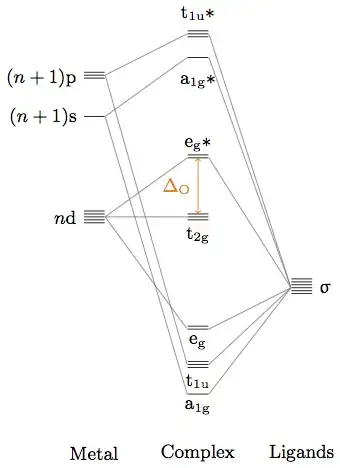
While the modiagram package does not cover a full range of orbitals, it is still worth using in concert with lower-level TikZ directives for constructing more involved cases. I have used the package in illustrating crystal field theory; for example, the case of a pure sigma donor might look like:
\documentclass{article}
\usepackage{modiagram}
\usepackage{upgreek}
\begin{document}

\begin{figure}
  \centering
    \begin{MOdiagram}[lines = gray]
      \small
      % Metal
      \AO[metal-3d-1]{s}{-0.10;}
      \AO[metal-3d-2]{s}{-0.05;}
      \AO[metal-3d-3]{s}{ 0.00;}
      \AO[metal-3d-4]{s}{ 0.05;}
      \AO[metal-3d-5]{s}{ 0.10;}
      % Complex
      \AO[complex-t2g-1](50 pt){s}{-1.05;}
      \AO[complex-t2g-2](50 pt){s}{-1.00;}
      \AO[complex-t2g-3](50 pt){s}{-0.95;}
      \AO[complex-eg-1] (50 pt){s}{1.50;}
      \AO[complex-eg-2] (50 pt){s}{1.55;}

      \node[inner sep = 0, outer sep = 0]
        (midway) at (55 pt, 0 pt) {};
      \draw[style = dotted] (45 pt, 0 pt) --  ++ (10 pt, 0 pt);

      \connect{
        metal-3d-3 & complex-t2g-2,
        metal-3d-3 & complex-eg-1
      }
      \node[right] at (complex-t2g-1.east){$\mathrm{t}_{2\mathrm{g}}$};
      \node[right] at (complex-eg-1.east) {$\mathrm{e}_{\mathrm{g}}$};

      \draw[orange, <->] (complex-t2g-3.west) -- (complex-eg-1.west)
        node[midway,left] {$\Delta_{\mathrm{O}}$} ;
      \draw[orange, <->] (complex-eg-1.east) -- (midway.east)
        node[midway,right] {$\frac{3}{5}\Delta_{\mathrm{O}}$} ;
      \draw[orange, <->] (complex-t2g-3.east) -- (midway.east)
        node[midway,right] {$\frac{2}{5}\Delta_{\mathrm{O}}$} ;
    \end{MOdiagram}
  \caption{Octahedral field splitting}
\end{figure}

\begin{figure}
  \centering
  \begin{MOdiagram}[lines= gray]
    \small
    % Metal
    \AO[metal-3d-1]{s}{3.20;}
    \AO[metal-3d-2]{s}{3.25;}
    \AO[metal-3d-3]{s}{3.30;}
    \AO[metal-3d-4]{s}{3.35;}
    \AO[metal-3d-5]{s}{3.40;}
    \AO[metal-4s]  {s}{5.00;}
    \AO[metal-4p-1]{s}{5.65;}
    \AO[metal-4p-2]{s}{5.70;}
    \AO[metal-4p-3]{s}{5.75;}

    % Ligand
    \AO[ligand-1](100 pt){s}{2.00;}
    \AO[ligand-2](100 pt){s}{2.05;}
    \AO[ligand-3](100 pt){s}{2.10;}
    \AO[ligand-4](100 pt){s}{2.15;}
    \AO[ligand-5](100 pt){s}{2.20;}
    \AO[ligand-6](100 pt){s}{2.25;}

    % Complex
    \AO[complex-a1g]   (50 pt){s}{0.30;}
    \AO[complex-t1u-1] (50 pt){s}{0.75;}
    \AO[complex-t1u-2] (50 pt){s}{0.80;}
    \AO[complex-t1u-3] (50 pt){s}{0.85;}
    \AO[complex-eg-1]  (50 pt){s}{1.40;}
    \AO[complex-eg-2]  (50 pt){s}{1.45;}
    \AO[complex-t2g-1] (50 pt){s}{3.25;}
    \AO[complex-t2g-2] (50 pt){s}{3.30;}
    \AO[complex-t2g-3] (50 pt){s}{3.35;}
    \AO[complex-eg*-1] (50 pt){s}{4.30;}
    \AO[complex-eg*-2] (50 pt){s}{4.35;}
    \AO[complex-a1g*]  (50 pt){s}{6.00;}
    \AO[complex-t1u*-1](50 pt){s}{6.35;}
    \AO[complex-t1u*-2](50 pt){s}{6.40;}
    \AO[complex-t1u*-3](50 pt){s}{6.45;}

    \connect
      {
        metal-3d-3     & complex-eg-1  ,
        metal-3d-3     & complex-t2g-2 ,
        metal-3d-3     & complex-eg*-1 ,
        metal-4s       & complex-a1g   ,
        metal-4s       & complex-a1g*  ,
        metal-4p-2     & complex-t1u-2 ,
        metal-4p-2     & complex-t1u*-2,
        complex-a1g    & ligand-3      ,
        complex-a1g*   & ligand-3      ,
        complex-t1u-2  & ligand-3      ,
        complex-t1u*-2 & ligand-3      ,
        complex-eg-1   & ligand-3      ,
        complex-eg*-1  & ligand-3
      }

    \node[left] at (metal-3d-3.west) {$n\mathrm{d}$};
    \node[left] at (metal-4s.west)   {$(n + 1)\mathrm{s}$};
    \node[left] at (metal-4p-1.west) {$(n + 1)\mathrm{p}$};

    \node[below] at (complex-a1g)   {$\mathrm{a}_{1\mathrm{g}}$};
    \node[below] at (complex-t1u-1) {$\mathrm{t}_{1\mathrm{u}}$};
    \node[below] at (complex-eg-1)  {$\mathrm{e}_{\mathrm{g}}$};
    \node[below] at (complex-t2g-1) {$\mathrm{t}_{2\mathrm{g}}$};
    \node[above] at (complex-eg*-1) {$\mathrm{e}_{\mathrm{g}}*$};
    \node[below] at (complex-a1g*.south)  {$\mathrm{a}_{1\mathrm{g}}*$};
    \node[above] at (complex-t1u*-1.north){$\mathrm{t}_{1\mathrm{u}}*$};

    \node[right] at (ligand-3.east) {$\upsigma$};

    \draw[orange, <->] (complex-t2g-3.center) -- (complex-eg*-1.center)
      node[midway,left] {$\Delta_{\mathrm{O}}$} ;

    \node at (  0 pt, -20 pt) {Metal};
    \node at ( 50 pt, -20 pt) {Complex};
    \node at (100 pt, -20 pt) {Ligands};
  \end{MOdiagram}
  \caption{Octahedral splitting with a pure $\upsigma$-donor}
\end{figure}

\end{document}


:-)You might want to have a look at our starter guide to familiarize yourself further with our format. Generally, it's best to mark package names with ``` backticks to make them stand out. We also generally avoid using names in posts since it automatically appears in the lower right corner of your post. Welcome! – Adam Liter Nov 25 '13 at 03:26modiagram– cgnieder Nov 25 '13 at 09:27