I finally developed from egreg's answer in my previous question ( Defining a macro with three optional arguments in the form \newmacro{a}{b}[c]{d}[e][f] and \newmacro{a}{b}[c]{d}*[f] ) While my original answer was about making a shorter code, I ended up with a ~190 lines package. For the curious you can check it here in github, and it is also documented here.
The macro works fine, except for a display mode I would like to achieve: I want
the macro to work inside tabular environments such as array or align:
that would allow to typeset several function definitions preserving some alignment.
However I found a problem.
Let's took a look of the following code:
\documentclass{article}
\def\tempi{0}
\def\tempii{1}
\newcommand\mymacro[1]{
  \let\tempiii\tempi
  \def\tempi{#1\tempiii}
  \def\tempii{#1}
  \mymacroi
}
\newcommand\mymacroi{\tempi & \tempii}
\begin{document}
\[
  \begin{array}{cccc}
    a & \mymacro{1} & b \\
    \mymacro{2} & \mymacro{3}
  \end{array}
\]
\end{document}
It gets this result: 
Changing the definition of \mymacroi
\newcommand\mymacroi{\tempi , \tempii}
The new result is: 
In the first code, the changes in \tempii are not preserved after the tab character &. The second one shows the modification of \tempii (but does not align).
Using \begingroup in \mymacro:
\newcommand\mymacro[1]{
  \begingroup
  \let\tempiii\tempi
  \def\tempi{#1\tempiii}
  \def\tempii{#1}
  \mymacroi
  \endgroup
}
And, with the original \mymacroi (the one with &) I get an error.
So the problem is indeed trying to use & from the macro, while preserving
changes local to my macro, while expanding these changes over several cells.
(In this MWE there is a circular reference which does not exist in my original macro.)
Update:
My original example was too simple to show some desired result, and given that my macro should work both inside tabular environment and non-tabular environments, I will mimic that in this MWE by redefining \mymacroi. I copy only the document environment.
\begin{document}
\[
  \begin{array}{cccccc}
    a & \mymacro{7} & b & \tempi & \tempii \\
    \mymacro{2} & \mymacro{3} & \tempi & \tempii
  \end{array}
\]
\renewcommand\mymacroi{%
  \edef\tmp{\tempi,\tempii}%
  \tmp
}
\par Test 1 \(\mymacro{5};\tempi,\tempii\)
\par Test 2 \(\mymacro{4};\tempi,\tempii\)
\end{document}
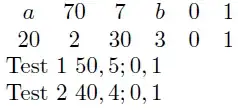
The expected result is:

and




\tempiipreserved inside\mymacroover the cells. But then\tempiiis also redefine outside\mymacrowhich is not desired. This example was probably too simple to show that part of the intended effect. – Carlos Eugenio Thompson Pinzón Dec 15 '13 at 03:58\tempiiis used nowhere else. However, you could use an alternative macro name, or restore it using another\gdefafter using it. But I would need more information to clearly help you. – Werner Dec 15 '13 at 05:13