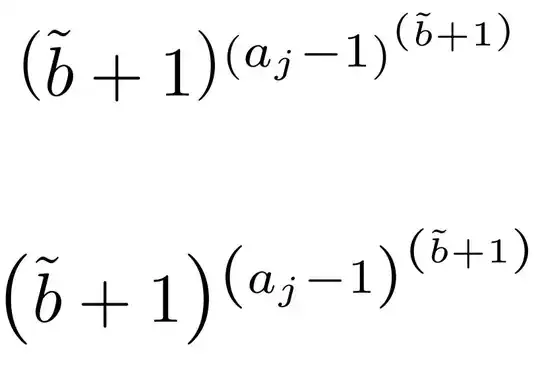
What I'm looking for is a way to use \big and its friends such that they adapt to the environment that they're in, e.g. \scriptstyle. To a degree, this was already covered in this question and the corresponding answer, but the results are not yet as I'd hope.
\documentclass{article}
\usepackage[english]{babel}
\usepackage{amsmath}

\newcommand{\tbo}{\tilde{b}+1}

\begin{document}

\[ \left(\tbo\right)^{\left(\tbo\right)^{\left(\tbo\right)}} \]
\vspace{-0.5cm}
\[ \bigl(\tbo\bigr)^{\bigl(\tbo\bigr)^{\bigl(\tbo\bigr)}} \]

% Bruno Le Floch's modification (see answer linked above)
\makeatletter
\let\bBigg@@\bBigg@
\renewcommand{\bBigg@}[2]{{%
  \mathchoice
    {\bBigg@@{#1}{#2}}%
    {\bBigg@@{#1}{#2}}%
    {\big@size=.7\big@size\bBigg@@{#1}{#2}}%
    {\big@size=.5\big@size\bBigg@@{#1}{#2}}}}%
\makeatother

\vspace{-0.5cm}
\[ \bigl(\tbo\bigr)^{\bigl(\tbo\bigr)^{\bigl(\tbo\bigr)}} \]

\end{document}

The modification improves the sizing a bit, but not substantially (especially in the \scriptscriptstyle). Also, the horizontal spacing in the small styles is a bit wide for my taste. I tried playing around with the factors 0.7 and 0.5 a bit, but this didn't change anything (to the bare eye).
I don't know if it's too much to ask, but I'd hope that it's possible to mimic the behaviour of \big for normal text as closely as possible also for the superscripts.
In a perfect world, a solution would also take into account what David Carlisle's comment to the answer linked above mentioned, namely preventing the scaling to be too small for smaller font sizes. However, I don't know how to read NFSS data, and neither whether this could be done dynamically...



\bigl(...\bigr)to make it a bit larger since it has a large exponent, but that depends a lot on the context, too. – yo' Dec 17 '13 at 12:17\bigin sub/superscripts is not good" in general? – Axel Dec 17 '13 at 12:45\lceil\tilde b\rceil). Again, my example was for demonstration purposes (similarly in this comment) - I would certainly try to avoid such expressions in supersuperscripts - but I am interested in commands that are as universal as possible. In particular, since I like the\DeclarePairedDelimiter-command frommathtools, having an adapted version of\bigis relevant to me to be able to use e.g.\ceil[\big]{\tilde b}also in superscripts. – Axel Dec 17 '13 at 13:34\lceil \tilde b \rceilbetter than adding\big, adding just the\bigand the tilde sort of disappear in the noise. – daleif Dec 17 '13 at 14:37\ceil-example with\tilde). Even so, I contend that everyone on StackExchange strives (possibly among other things) for beautifully set math, and as so often is the case with beauty, there are different opinions - why can't I decide for myself? – Axel Dec 17 '13 at 15:38