9

I have some problem to make the Underbrace partly for the equation like the picture shows. The unique part is the "b" is used twice.
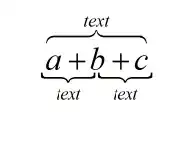
enter image description here

Thanks !

SLN
  • 715
  • What is the expected output? Try to explain it a little better. EDIT: I mean, if we achieve that “b is used twice”, both underbraces will obviously collide. Do you want one under, and other over? And then, on the top, the bigger one? – Manuel Feb 27 '14 at 10:32
  • As your reader, I'd be confused by this... – jub0bs Feb 27 '14 at 11:19
  • @Jubobs ,my bad,Eglish is not my first language. I didn't explain it in a proper way. I would like to say that the first under-brace is for "a+b" and the second under-brace is for "b+c" but there is only one "b" appeared in the equation. And usually I use \underbrace{a+b}\text{bla bla} for the first under-brace. However, the b is already used buy the first under-brace so \underbrace{b?+c}\text{bla bla} is really a problem for me – SLN Feb 27 '14 at 11:40
  • No no :) I understand what output you want to achieve. I'm just saying I have a problem with the output itself: whether b belongs to one, both or none of the the underbraces is not immediately obvious to me, and it may not be to your readers. – jub0bs Feb 27 '14 at 11:46

1 Answers1

12

You can underbrace “a+(nothing)”, print a zero width “b” and again underbrace “(nothing)+c”:

\documentclass{article}
\usepackage{mathtools}
\begin{document}
\[
\overbrace{
  \underbrace{a+{}}_\text{text}
  \mathclap{b}
  \underbrace{{}+c}_\text{text}
}^{\text{text}}
\]
\end{document}

enter image description here

egreg
  • 1,121,712
  • 2
    @user3004698 It would require some more work in case the symbol in the middle is wider. Just add to your question in case you need some adjustments. – egreg Feb 27 '14 at 11:43